




Sunnyvale, California | July 19, 2026
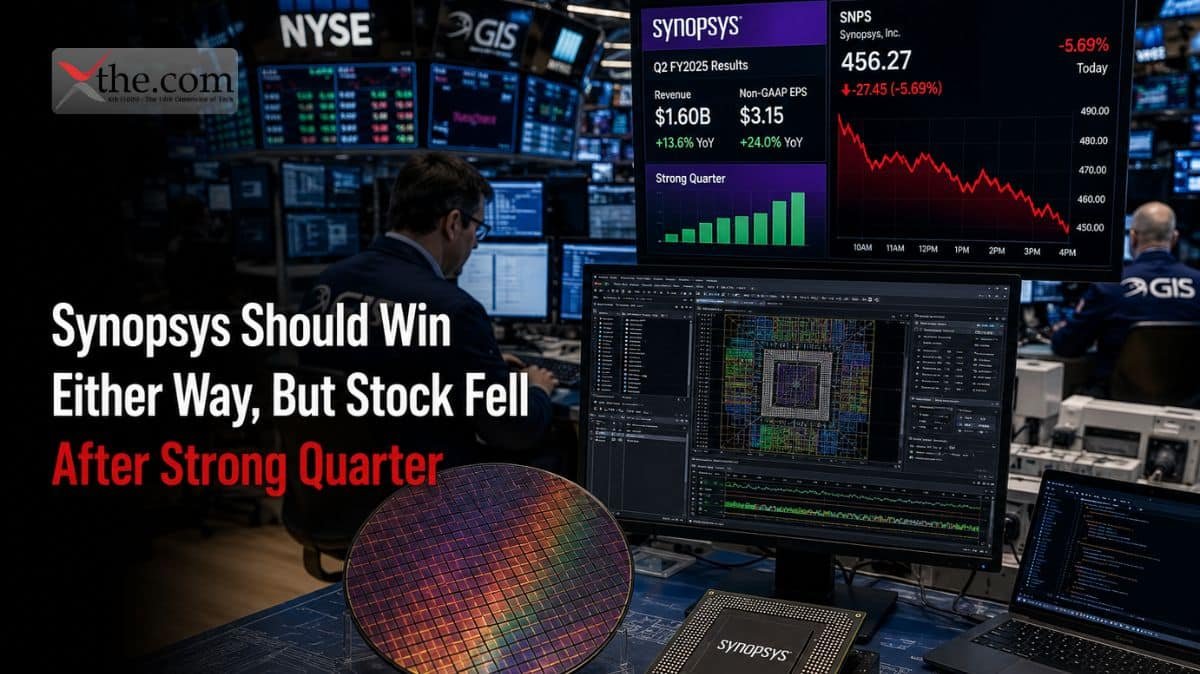
Synopsys delivered a classic beat-and-raise quarter, but the market still reacted negatively. The company reported second-quarter fiscal 2026 revenue of $2.276 billion, topping analyst estimates of $2.25 billion, and non-GAAP earnings of $3.35 per share versus a $3.15 forecast. Management also raised full-year guidance across the board. Yet Synopsys stock fell strong quarter results notwithstanding, sliding roughly 7% to 9% in the days after the May 27 report, leaving the stock down over 20% for the year. For a company whose software powers nearly every advanced chip, this sell-off seems, at first, like investors are ignoring the fundamentals.
The Case That Synopsys Wins Regardless
The bullish argument for Synopsys has always rested on a simple observation: it does not matter which company designs the fastest AI accelerator, because that company almost certainly used Synopsys tools to do it. This is the logic behind Synopsys’s benefits-AI-race-winner framing that dominates analyst notes. Nvidia, AMD, Broadcom, and a growing list of hyperscalers designing custom silicon all license from the same handful of electronic design automation vendors, and Synopsys is the largest of them. Whether the next breakthrough chip comes from Santa Clara or Beijing, the royalty check still gets written to Synopsys.
This is why investors keep saying that Synopsys benefits no matter who wins in AI. Instead of betting on one company, you are betting on the infrastructure that supports them all—like a toll bridge that collects from every car, no matter who is driving.
Synopsys Software Chipmakers Need, Not Optional
Chip design is now far too complex for engineers to do by hand, which is why the phrase ‘Synopsys software chipmakers need‘ is so common in the industry. Modern chips have tens of billions of transistors, and checking these designs before manufacturing requires advanced simulation software that only a few companies can provide. Synopsys, Cadence, and Siemens EDA share most of this market. Changing vendors during a project is costly and risky, giving Synopsys a pricing advantage that most software companies do not have. CEO Sassine Ghazi highlighted this in the earnings release, saying the company had a strong second quarter with solid execution and broad business strength.
So Why Did the Stock Fall?
Here the story gets more interesting. If chip design software Synopsys sells is genuinely indispensable, a beat-and-raise quarter should have pushed shares higher, not lower. Three specific factors explain the disconnection.
First, the company’s highest-margin segment, Design IP, dropped 6% year-over-year to $454 million. Investors see shrinking high-margin revenue as a red flag, even though the larger Design Automation business grew over 60%. Second, Synopsys still has about $10 billion in debt from buying Ansys. This deal boosted revenue growth to 42% year-over-year, but most of that came from the acquisition, not from the company’s own growth. Adjusted earnings per share fell nearly 9% year-over-year, even though adjusted net income rose 11%, because Synopsys issued about 23% more shares to fund the deal and to get a $2 billion investment from Nvidia. Third, the stock was already expensive before earnings, with a price-to-earnings ratio above 80, so there was little room for anything less than perfect results.
Put together, this is why Synopsys’s poor performance unclear remains the fairest description of the stock’s behavior. The headline numbers were strong. The reasons investors sold were narrower and more technical than the headline suggested, tied to segment mix, debt, and valuation rather than any erosion of Synopsys’s core competitive position.
A Business That Profits Either Way
None of these concerns change the underlying architecture of the business. Synopsys profits regardless AI breakthroughs arrive from Silicon Valley or Beijing, since all chip designs still need EDA software before manufacturing. Still, last week showed that Synopsys’s advantage is not completely safe. Shares fell further after Moonshot AI announced a chip-design project called Kimi K3, which erased about $6.3 billion in market value in one day. Investors are now wondering if AI could eventually automate parts of the design process that Synopsys currently handles. This is a long-term risk to watch, even though it has not affected the financial results yet.
What the Numbers Say About the Road Ahead
Management’s guidance shows confidence, not caution. Synopsys increased its full-year 2026 revenue outlook to between $9.625 billion and $9.705 billion, up from $9.56 billion to $9.66 billion before. It also increased its non-GAAP earnings per share projection to $14.72 to $14.80. For the third quarter, revenue is expected to be $2.41 billion to $2.46 billion, with non-GAAP EPS between $3.63 and $3.69. Wall Street still believes in the company: the stock has a consensus Strong Buy rating from the 20 analysts who cover it, and Piper Sandler raised its price target from $450 to $550 in late June, which is well above the current share price.
Why the Question of Why Synopsys Stock Fell Strong Quarter Results Still Matters to Investors
It is unusual to see a Strong Buy consensus while the stock is down more than 20% this year, and answering why Synopsys stock fell despite strong quarter results still matters. Management has said that Synopsys’s Investor Day in September will be the next chance to address key topics like Design IP growth, Ansys integration, and debt reduction. Until then, the market seems to be factoring in short-term uncertainty, even though most agree that Synopsys remains central to chip development, no matter who leads the AI race.
Investors now have to decide if short-term issues like integration costs and segment mix are more important than Synopsys’s long-standing position in the industry. Historically, businesses like toll roads last longer than any one customer, and Synopsys’s guidance suggests management expects their value to keep rising. The next two quarters, especially September’s Investor Day, should show whether Wall Street’s caution is a chance to buy or a warning sign that something is being missed in the headline numbers.