As AI technology becomes essential to contemporary computing systems, the definition of a “capable” PC system is evolving. In 2026, AI is no longer an optional feature it is integrated into operating systems, productivity tools, and everyday workflows. Companies like Microsoft, Intel, and Qualcomm are driving this shift by establishing new hardware benchmarks for what qualifies as an AI-ready PC.
The system requirements need to be understood by professionals, students, and enterprises, as these specifications are essential. Today, businesses face the risk of selecting the wrong hardware, leading to compatibility issues, performance drops, and shortened operational lifespans due to AI workloads.
The Rise of AI-Native Operating Systems
AI has become a fundamental part of modern operating system development. Windows from Microsoft now includes AI capabilities that users can access through built-in virtual assistants, automated processes, and Google search services.
The system requires hardware components, especially NPUs, to achieve fast, effective performance. Traditional PCs without dedicated AI acceleration struggle to support these advanced features.
The transition involves shifting AI development from cloud-based systems to hybrid models that use on-device hardware as the primary functional element.
Why 40+ TOPS NPU Performance Matters
The measurement of TOPS (trillions of operations per second) has emerged as the primary standard for assessing AI capabilities on personal computers. The industry now considers devices with 40 TOPS of NPU performance the essential standard for systems capable of supporting artificial intelligence applications.
The established requirement ensures that laptops have sufficient power to execute real-time transcription, image processing, and AI-assisted workflows without requiring extensive cloud computing support.
Qualcomm has focused on developing chips with strong NPU capabilities, while Intel has begun adding AI processing features to its upcoming processors to meet growing market demand.
Users who spend money on hardware that does not meet this standard will find their future abilities to use devices restricted.
CPU, GPU, and NPU: A Balanced Architecture
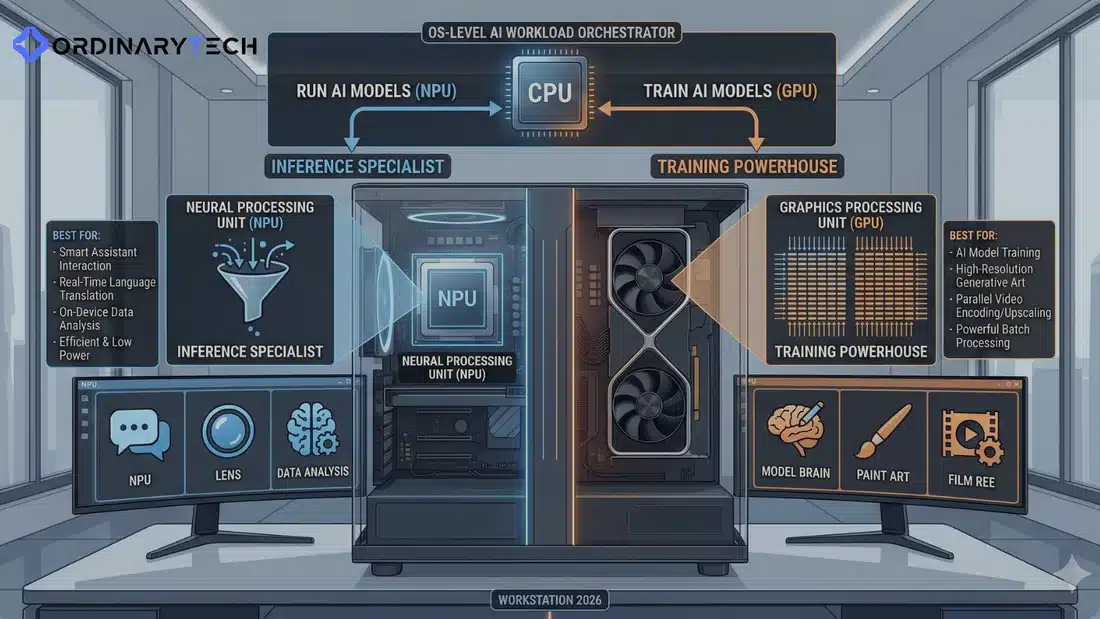
AI PCs need balanced system designs that integrate CPU, GPU, and NPU processing capabilities. Each component plays a distinct role in handling different types of workloads.
The CPU manages general computing tasks, while the GPU processes graphics and executes multiple operations, and the NPU performs AI-related functions. The system achieves responsive performance through its combined component configuration, which delivers efficient operation.
Intel and Qualcomm are developing unified systems that combine these elements to enhance system performance and reduce energy consumption.
The balanced method allows devices to perform multiple tasks by preventing any single component from becoming overloaded.
Memory and Storage Requirements
AI workloads require substantial memory and storage capacity for their operations. The minimum memory requirement for current AI systems is 16GB of RAM, but users who need advanced performance should use 32GB or more.
Local model execution and large dataset processing both require storage capacity as an essential component. Solid-state drives (SSDs) enable faster data retrieval, improving system performance.
Microsoft develops its AI functions to make efficient use of system resources, enabling greater value from advanced hardware configurations.
The system will maintain its operational capabilities through future AI applications by investing in appropriate memory and storage solutions.
Battery Efficiency and Thermal Design
Organizations must prioritize efficiency when managing the resource-intensive demands of AI. The NPUs (Neural Processing Units) provide a way to execute AI-based workloads on devices while reducing power consumption and extending battery life.
Qualcomm centers its competitive edge on energy efficiency and illustrates the benefits of its AI-based chip manufacturing, which provides longer battery life and lower thermal output.
Cooling system performance is based on thermal design and enables extended periods of efficient operation, enhancing the user experience and supporting mobile professionals.
Software Optimization and Ecosystem Support
Hardware components by themselves cannot provide users with a complete artificial intelligence experience. Software optimization is essential for applications to achieve their maximum operational potential with artificial intelligence technology.
Microsoft is developing artificial intelligence capabilities throughout its ecosystem while chip manufacturers supply developers with the necessary resources and development frameworks.
The complete potential of AI PCs can only be achieved through effective collaboration between hardware and software components.
Users should evaluate hardware specifications alongside the availability of specialized applications optimized for their systems.
Connectivity and Edge AI Capabilities
Modern AI PCs are designed to handle both local and cloud processing. The system enables users to connect with cloud services through high-speed links. The system enables users to compute data on their devices through its edge AI features.
The hybrid system allows users to control their system performance through performance control, cost management, and privacy protection.
Intel and Qualcomm are investing in technologies that enhance connectivity and edge processing.
AI applications will require this combination as their complexity increases over time.
Use Cases Driving Hardware Requirements
The need for artificial intelligence PCs exists because people require them for various applications. Professionals use artificial intelligence to create content, analyze data, and automate processes, while businesses use it to make decisions and improve operational efficiency.
Students and developers are now using AI tools to support their educational and research activities.
Different applications require hardware systems that can handle varying levels of complexity, so flexibility is essential.
Microsoft built its ecosystem to enable users to fulfill their needs, which requires diverse functionality and the ability to grow.
Risks of Underpowered Hardware
Selecting hardware that fails to meet artificial intelligence requirements leads to multiple operational problems. The devices face three main issues: they cannot support new features and rely on cloud processing, resulting in decreased performance.
The system will incur additional expenses throughout its life because users will have to replace their equipment earlier than planned.
Intel and Qualcomm have established partnerships to create standardized benchmarks that enable customers to choose suitable products.
Organizations need to invest in cutting-edge hardware solutions to protect themselves from emerging threats.
Conclusion: Building a Future-Ready AI PC
The shift to AI-native computing introduces new user experience standards for their devices. To meet 2026 requirements, organizations need to focus on NPU performance, balanced system design, adequate memory capacity, and system efficiency.
Users can maintain their system performance over the coming years by following the compatibility standards established by Microsoft, Intel, and Qualcomm.
Organizations need to invest in proper hardware today because it supports performance and enables them to use upcoming computing technologies.
Sources: Recent Articles
Introducing the ultimate college bundle: built for student life
Qualcomm Recommends Stockholders Reject Mini-Tender Offer by Tutanota LLC