




New York, New York | July 27, 2026
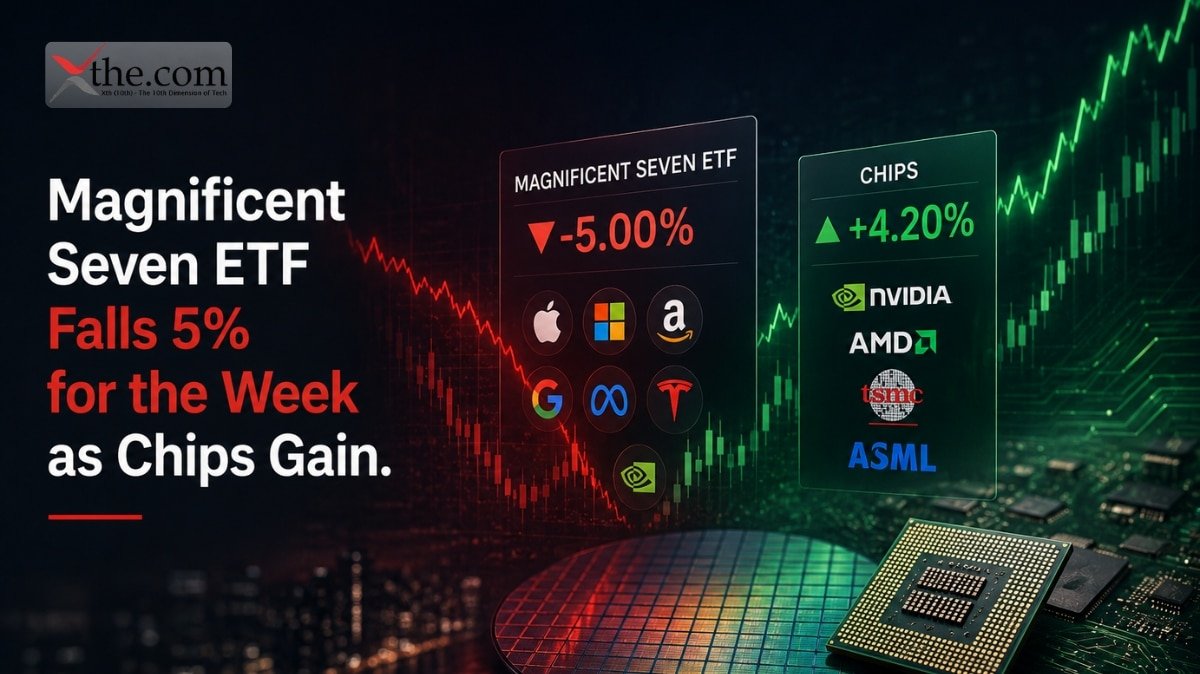
A sharp divide has emerged in the technology sector. While some of Wall Street’s biggest AI winners continue to report strong revenue growth, investors are paying less attention to earnings headlines and more attention to cash flow. That shift has fueled a significant rotation across the market, with the Magnificent Seven ETF falls 5 percent, standing in sharp contrast to semiconductor funds that finished the week in positive territory. The growing gap reflects mounting concerns that the race to dominate artificial intelligence may be becoming increasingly expensive.
The MAGS weekly decline has become one of the clearest indicators of changing investor outlook. At the same time, semiconductor ETFs’ higher week performance implies that investors are becoming more selective, favoring companies that directly benefit from AI infrastructure demand while questioning the spending strategies of large technology platforms.
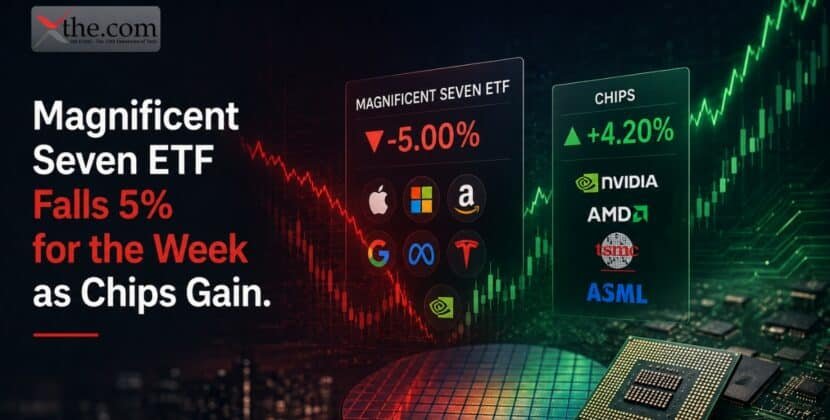
Magnificent Seven ETF falls 5 percent, highlighting market rotation.
The Magnificent Seven ETF falls 5 percent over the week, showing how quickly investor priorities might change. The Roundhill Magnificent Seven ETF (MAGS), which tracks Apple, Microsoft, Alphabet, Amazon, Meta, Nvidia, and Tesla, lost over five percent even though many of these companies reported solid results.
The Roundhill MAGS ETF performance reflected a wider review of valuation rather than deteriorating business fundamentals. Investors progressively questioned whether the enormous capital expenditures required to build AI infrastructure will generate acceptable returns within a reasonable timeframe.
This week’s market moves show that strong revenue growth is no longer enough for investors. They now want proof that AI investments will lead to lasting profits and steady cash flow.
Why the MAGS Weekly Decline Accelerated
The MAGS weekly decline gathered momentum after several earnings reports showed companies planning to spend heavily on expanding artificial intelligence.
Investors focused on Alphabet this week. Even though its earnings beat expectations, the company confirmed it would spend billions more on AI infrastructure and data centers. This spending plan took attention away from its otherwise healthy financial results.
One market strategist summarized the prevailing mood by stating, “Investors are really scared that these companies are spending all their cash flow on all this AI and data centers and so forth.”
This comment gets to the main issue. The question isn’t if AI will change industries, but whether companies can make enough returns before their heavy spending starts to hurt earnings and cash flow.
The growing concern surrounding investors scared AI spending cash flow has become one of the dominant themes influencing technology valuations this earnings season.
Semiconductor ETFs Higher Week Shows Investors Prefer AI Suppliers
While large technology stocks struggled, semiconductor ETFs’ higher-week performance highlighted a very different story.
Chip manufacturers occupy a distinct position within the AI ecosystem. Regardless of which software platform ultimately dominates artificial intelligence, the requirement for advanced processors, memory chips, networking equipment, and specialized AI accelerators continues to expand.
This trend helped semiconductor-focused ETFs outperform the wider technology market.
The phrase “Semiconductor ETFs end higher AI fear” sums up this split well. Instead of leaving AI investments, big investors seem to be shifting toward companies that supply the hardware for AI, rather than those taking on the biggest spending.
This difference matters more now for portfolio managers who want exposure to AI but also want to limit financial risk.
Data Centers Cash Flow Fear Reshapes Technology Valuations
Much of the current selling pressure centers on data center cash-flow fears.
Major technology companies have announced unprecedented investments in AI infrastructure. Building hyperscale data centers requires billions of dollars in spending on land acquisition, construction, cooling systems, networking equipment, and advanced semiconductors.
These investments lower free cash flow in the short term, even though they may create valuable assets over time.
For investors used to steady profit growth and strong cash flow, this is a big change in how companies manage their finances.
As a result, investors scared AI spending and cash flow now play a bigger role in how investors value companies, more than just revenue growth forecasts.
Companies that used to get high valuations for their earnings growth are now being watched more closely for how they spend their money.
Roundhill MAGS ETF Performance Shows Higher Expectations
The recent Roundhill MAGS ETF performance should not necessarily be interpreted as evidence that the largest technology companies are losing their competitive advantages.
Instead, expectations for these companies had become extremely high.
When stock prices already expect years powered by AI growth, even good quarterly results may not please investors if spending is rising quickly.
That’s why some companies reported solid results but still saw their stock prices drop right after earnings announcements.
Markets often care less about what companies have done and more about what they plan to spend in the future.
This focus on the future helps explain why the Magnificent Seven ETF falls 5 percent week became one of the defining market stories despite otherwise healthy corporate earnings.
AI Spending Is a Long-Term Opportunity
Even though there’s more short-term volatility, most analysts still see artificial intelligence as strategically important.
Cloud providers, software developers, cybersecurity firms, and chip makers are all still investing heavily, since demand for AI isn’t slowing down.
The main debate now is about timing.
Investors want to know when today’s infrastructure spending will start to bring higher profits, better cash flow, and steady returns.
Until there’s more clarity, tech stocks with the biggest spending plans may keep seeing big price swings.
At the same time, semiconductor companies may keep benefiting as demand for hardware grows throughout different AI platforms.
What Investors Should Watch Going Forward
The gap between large tech stocks and semiconductor funds may continue in the next few earnings seasons.
In the future, market performance will probably depend more on key financial indicators than just revenue growth headlines.
Investors will watch trends in free cash flow, capital spending plans, progress in making money from AI, how much cloud infrastructure is used, and how stable profit margins are.
If companies can show that their big AI investments are starting to pay off, the market mood could quickly get better.
Conversely, if spending continues accelerating without corresponding cash generation, the concerns surrounding data center cash flow fear may continue weighing on the sector.
The current shift in the market shows that investors are more careful. AI is still a major trend this decade, but investors now want clear proof that big spending will lead to big returns. For now, the difference between the Magnificent Seven ETF’s 5 percent drops and the gains in semiconductor ETFs is a strong indication that even the best growth stories need to deliver steady cash flow.
Source: Magnificent 7 Trade Is Broken — Here’s Where Smart Investors Should Look Next