






Seattle, Washington — Monday, July 27, 2026
Alphabet’s stock dropped by over $130 billion in one trading session last Thursday. The reason wasn’t a revenue miss; Google’s parent actually beat estimates on both revenue plus profit. Instead, the issue represented a figure hidden in the capital expenditure guidance: up to $205 billion set aside for artificial intelligence infrastructure in 2026, higher than the previous forecast of $180 billion to $190 billion. Free cash flow turned negative for the first time since Alphabet’s 2004 IPO. Investors made up their minds before the earnings call even ended.
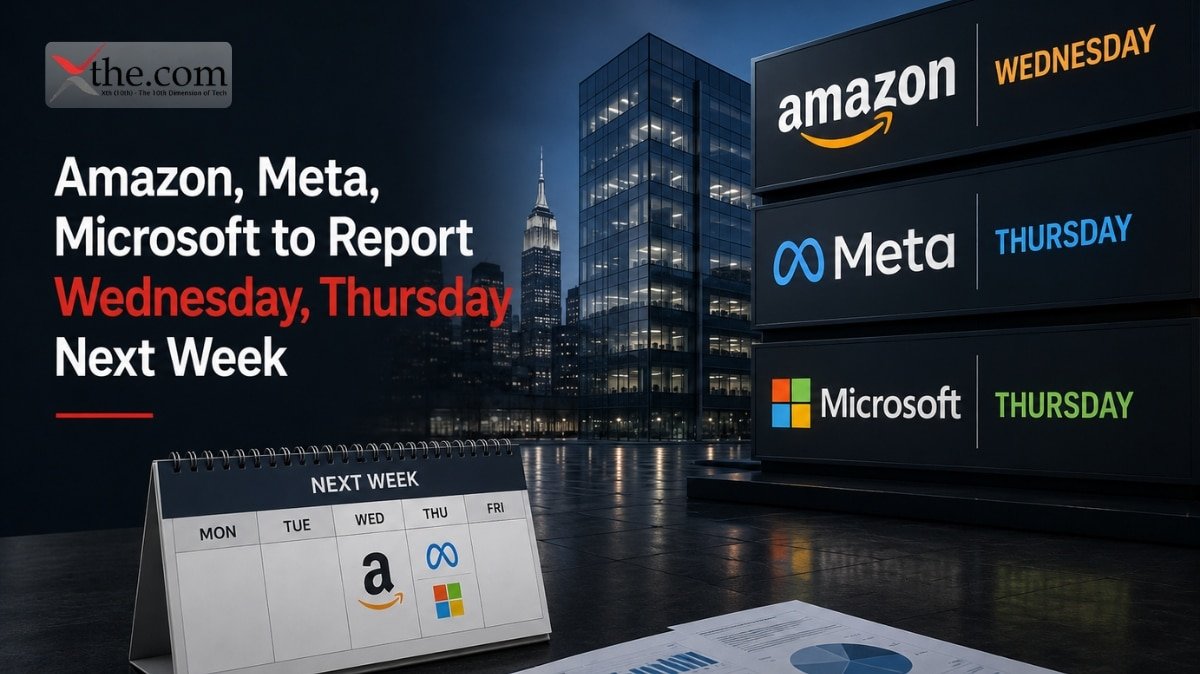
This sets the stage for Amazon, Meta, and Microsoft’s earnings week, which comes at a tense moment. Three of the four biggest hyperscale tech companies report results this week, and Wall Street has made it clear: investors want more than promises about AI spending.
Hyperscaler Earnings Wednesday Thursday: What’s on the Calendar
The hyperscaler earnings Wednesday-Thursday window has become the market’s central event for the back half of July. Microsoft and Facebook will report on Wednesday afternoon, followed by Amazon on Thursday. Apple and Qualcomm are also releasing their quarterly results this week, covering almost every part of the tech sector: cloud infrastructure, social media ads, e-commerce logistics, consumer hardware, and mobile chips.
In short, Big Tech earnings kick high gear this week, and the timing is tough for companies hoping for a warm reception. Alphabet’s sell-off on Thursday pulled the Nasdaq Composite down over 2 percent in one session and cut more than 500 points from the Dow. Meta, Microsoft, and Amazon shares also fell that day, even though they hadn’t reported yet. The market reacted quickly, then looked for answers.
Why Alphabet’s Report Became a Warning Shot
Wolfe Research analysts predicted before Alphabet’s report that capital expenditure, not revenue or profit, would be the key number this earnings season. They were right. Alphabet’s cloud division grew 82 percent year over year, which would usually be big news. But instead, the emphasis shifted to a capex figure that could mean over $300 billion in spending for 2027, according to some estimates. That’s much higher than Wall Street expected.
This reaction creates a real test for the three hyperscalers reporting this week. Big Tech earnings kick into high gear at a moment when investors have decided that spending discipline, not spending ambition, is the metric worth rewarding.
Megacap AI Spending Scrutiny Reaches a Tipping Point
The megacap AI spending scrutiny that greeted Alphabet’s results isn’t an isolated event. It shows a broader change in how investors view the AI buildout. Together, the four largest hyperscalers spent $129.8 billion on capital expenses in the first quarter, up 81 percent from last year.UBS expects total spending for the group to rise 76 percent this year, reaching about $673 billion.
In the past, numbers that big were seen as a sign of confidence. Now, more investors see them as a risk to short-term cash flow and profit margins. Amazon, Microsoft, and Meta all face the same question that Alphabet struggled with: can they show that AI infrastructure spending is turning into revenue quickly enough, or will higher spending forecasts cause a sell-off like Alphabet’s?
Microsoft may be the clearest test case, since its Azure cloud business is closely linked to AI demand and its partnership with OpenAI. Meta is under the microscope for its expanding data center buildout. Amazon’s AWS, still the top cloud provider by revenue, must show that its capital spending isn’t outpacing demand.
Apple, Qualcomm Add a Different Kind of Pressure
Apple and Qualcomm are also announcing earnings this week, alongside the hyperscalers, but face a different kind of scrutiny. Neither spends as much on AI infrastructure as Amazon, Meta, or Microsoft. Apple’s results will focus on iPhone demand and services growth, while Qualcomm’s will show trends in mobile chip demand and licensing revenue. Still, both will be partly judged through the same AI perspective that influenced Alphabet’s call, since AI features are now central to the industry.
The Semiconductor Makers Rewarded Pattern
One of the most notable trends this week is the semiconductor makers rewarded pattern that has taken hold even as hyperscaler stocks struggle. Chip and equipment suppliers like Taiwan Semiconductor Manufacturing, Micron, Applied Materials, and others have mostly seen their shares rise amid capital spending increases that hurt Alphabet. In July, TSMC raised its 2026 capex guidance to between $60 billion and $64 billion, and the market saw this as a positive sign, not a warning.
This isn’t a contradiction, but a structural difference. Chipmakers and equipment vendors get immediate revenue from hyperscaler spending, no matter if that spending leads to AI revenue for Amazon, Meta, or Microsoft. The hyperscalers, on the other hand, take on the financial risk if the AI investment cycle takes longer to pay off. That’s why Micron’s high-bandwidth memory is already sold out for 2026, even though the buyers face investor doubts about their spending.
Whether this trend continues after this week’s reports is a key question for markets. If Microsoft, Meta, and Amazon can raise their capital spending forecasts without causing a sell-off like Alphabet’s—perhaps by showing clearer proof of AI-fueled revenue growth—it would mean investors are willing to judge companies individually. But if the reaction is another sell-off, it would show that Wall Street has become more skeptical about AI investments, and that higher spending forecasts now carry real risks, no matter the business fundamentals.
Amazon, Meta, and Microsoft report Wednesday Thursday, and their results will influence tech market outlook far beyond this earnings cycle. Every capital spending figure, cloud growth number, and executive comment about AI monetization will be compared to the standard set by Alphabet’s recent stock move. Companies that show both discipline and ambition may find investors more forgiving than expected. Those that don’t could see a strong quarter eclipsed by just one spending number.
Source: 4 Big Tech earnings reports, a Fed meeting, and $100 oil: It’s the busiest week of the quarter








