






Dearborn, Michigan, July 30, 2026
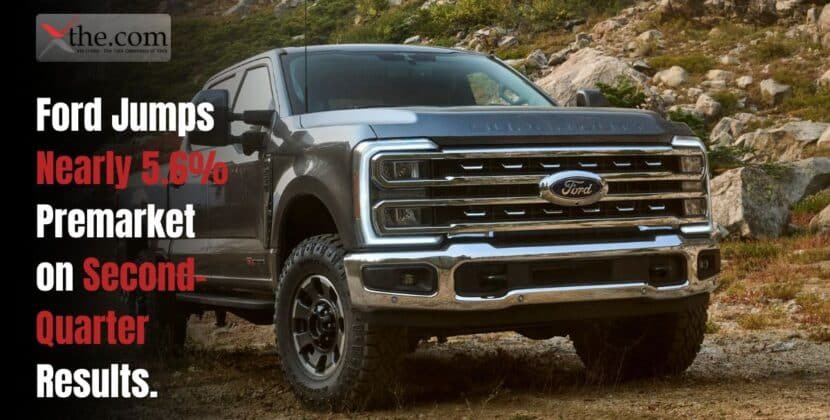
A company that wrote off billions on electric vehicles just handed investors one of its best trading days of the year. On Wednesday morning, Ford stock jumps premarket to roughly $15.90 a share, a gain of nearly 7% that stretched the stock’s year-to-date advance to 17%. The rally follows Tuesday’s after-the-bell release and stands out precisely because it occurred against a backdrop of wider market unease over Federal Reserve policy and rising technology capital expenditures. While semiconductor and software names wobbled, Dearborn’s century-old carmaker delivered a Ford strong quarterly results headline that Wall Street wasn’t positioned for.
The numbers explain the enthusiasm. Ford posted adjusted earnings per share of 42 cents, comfortably ahead of the roughly 34-to-36-cent consensus analysts had penciled in heading into the print. That represents a genuine Ford Q2 2026 earnings beat, not a low-bar comparison against a weak prior year. Automotive revenue came in at $44.89 billion, a touch below the $45.3 billion to $45.7 billion range analysts expected, which makes the earnings outperformance more impressive: Ford grew profit despite selling into softer-than-forecast top-line demand.
A Beat Built on Pricing and Mix, Not Volume
Dig into the Ford Q2 2026 earnings results, and a clear pattern emerges. This wasn’t a story of Ford simply moving more metal. That was a story about Ford making more money on every vehicle it sold. Resilient net vehicle pricing held steady even as unit sales declined, and a higher share of profitable products—especially high-margin trucks and commercial vehicles—helped boost results. Ford Pro, the company’s commercial vehicle and services arm, was a key driver this quarter. Paid software subscriptions in Ford Pro reached over 900,000 in the first half of 2026, up about 20% from last year, and total hands-free BlueCruise driving hours exceeded 12 million. These numbers are important because they show recurring, high-margin revenue beyond hardware sales, which is the kind of business mix investors value.
Ford also increased its full-year outlook. The company currently expects 2026 EBIT of $10 billion to $11 billion, up from its earlier estimate of $8.5 billion to $10.5 billion. Adjusted free cash flow is now forecast at $6 billion to $7 billion, up from $5 billion to $6 billion. It’s unusual for a company to raise its guidance in the same quarter it reports a GAAP net loss, but Ford did just that. A $3.6 billion charge related to its BlueOval SK battery joint venture, part of a scaling back of its electric vehicle plans, pushed GAAP results into the red even as the core automotive business improved.
The EV Drag Hasn’t Disappeared
Still, Ford’s electric vehicle challenges endure. The Model e segment lost $4.8 billion in 2025, and the unit is still struggling to regulate supply with weak demand while investing in new products. Wall Street’s ongoing “Hold” rating on the stock, even after Ford’s strong first quarter in April, shows this concern isn’t resolved. Investors are confident in Ford’s traditional and commercial vehicle business, but they remain wary of the company’s EV strategy from three years ago. The BlueOval SK charge is less a one-time setback and more a sign that management is recognizing this hesitation and moving to limit further losses.
How Ford Stacks Up This Earnings Season
Context matters, and the automaker earnings season underway across Detroit and beyond makes Ford’s results look even stronger. General Motors shares were flat near $90.30 that morning, with no similar boost. Tesla, on the other hand, is down about 32% for the year after a weak second-quarter report last week, which is a sharp contrast to Ford’s momentum. This difference stands out because Ford is often compared to Tesla within investor discussions. This quarter, the two companies had very different stories.
Analysts’ actions in response to these results indicate a shift in sentiment. Jefferies upgraded Ford to Buy before earnings, raising its price target from $14.50 to $17.50. Citi also upgraded Ford to Buy after the results. Ford has beaten revenue estimates for five straight quarters and exceeded earnings estimates in seven of the last ten, a record that had been largely ignored by a market fixated on the company’s EV losses. The Ford stock reaction suggests that view may be starting to change.
What Analysts Are Watching Next
Bernstein analyst Philippe Houchois described this quarter as a low point, not a peak. He believes the second quarter was likely the bottom for production volume, and that output from Ford’s Novelis-supplied aluminum operations should increase from here. If he’s right, future quarters should look better by comparison, giving Ford a boost for the rest of the year, even as EV losses continue to affect profits.
The Road Ahead
Ford’s July 2026 earnings could mark a turning point in how the market values the stock, separating its improving core automotive business from the older EV strategy that management is now moving away from. The premarket jump in Ford’s stock this week shows that shift is happening. Whether the gains last will depend on how well Ford delivers in the second half of the year: turning higher guidance into real cash flow, keeping Ford Pro’s subscription growth strong, and handling the EV wind-down without further unanticipated charges. Investors have shown they’ll reward the first two. The third is still something Ford needs to prove it can manage.
Source: Ford stock rises as automaker hikes full-year guidance, beats on Q2 earnings