New York, New York — July 30, 2026
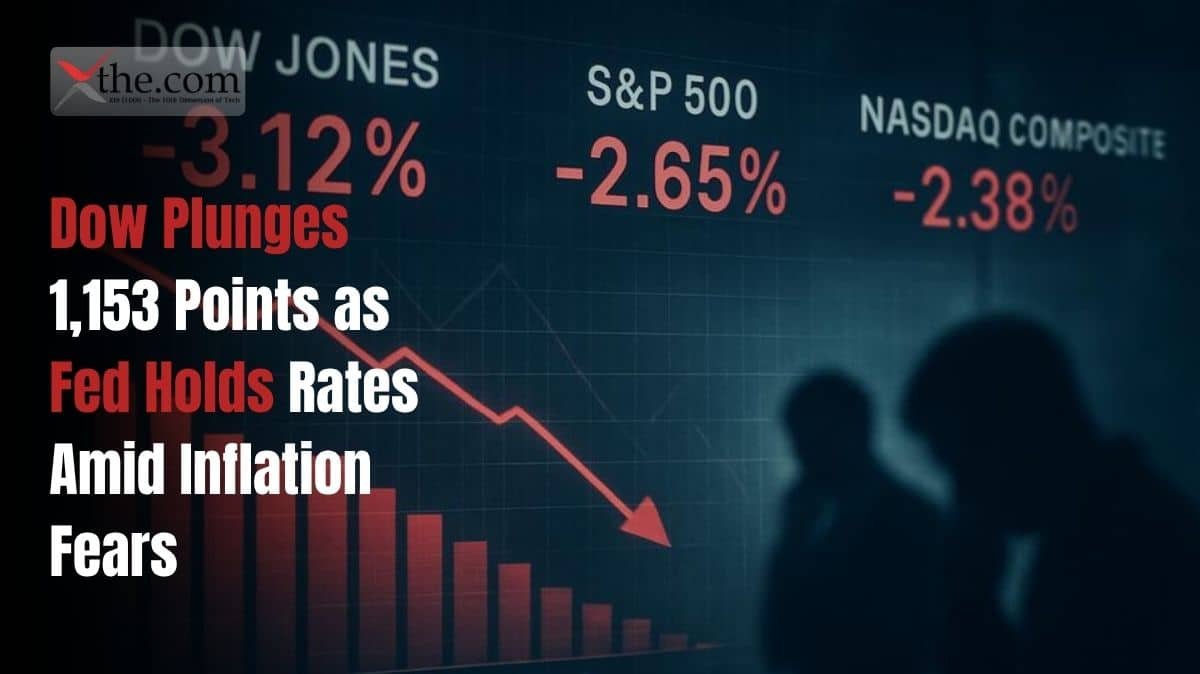
Just three dissenting votes. That is all it took to erase a month of investor optimism in a single afternoon. Wednesday’s Dow plunges Fed rate decision sequence played out exactly as bond traders had quietly feared: the Federal Reserve kept its benchmark rate steady, but Wall Street sold off anyway. The Dow Jones Industrial Average dropped 1,153.18 points, or 2.19%, closing at 51,594.14. This was the index’s worst decline since April 2025, even though the central bank did exactly what most economists expected.
This is what should concern investors most. Even though the rate decision matched expectations, it still led to the market’s worst day in over a year. The real issue was not the Fed’s action, but how divided the committee was when making it.
A Hawkish Hold Rattles Markets
The Federal Open Market Committee voted to keep rates unchanged, with the Fed holding rates at 3.50-3.75 percent, a decision that arrived largely as expected heading into Wednesday’s meeting. What markets did not expect was the internal math behind the vote. Three of the twelve voting members—Cleveland Fed President Beth Hammack, Minneapolis Fed President Neel Kashkari, and Dallas Fed President Lorie Logan—wanted a 25-basis-point increase instead. When a rate hold comes with three members pushing for a hike, it signals a shift in the committee’s stance. Traders reacted quickly, adjusting their positions within minutes of the announcement.
New Fed Chair Kevin Warsh did little to calm nerves when he stepped to the podium. During the Kevin Warsh press conference, he reiterated the Fed’s pledge to bring inflation to heel while insisting the labor market and wider economy remain solid. He spent a considerable portion of his remarks arguing that markets should trade on incoming economic data rather than anticipate the Fed’s next move — stance investors read as a warning that further easing is not imminent. Stocks briefly turned positive while Warsh spoke, then resumed their slide into the closing bell, a pattern that has become familiar during his tenure.
The Numbers Behind the Selloff
The S&P 500 dropped 1.52% to close at 7,316.15. The Nasdaq Composite fell 1.74% to 24,442.94, and its decline was more significant than the percentage alone suggests. The index is now down about 9.8% from its record high in early June, putting it on the doorstep of Nasdaq correction territory — a technical threshold reached at a 10% pullback from a recent peak. Semiconductor stocks were hit hardest. SK Hynix and Samsung both fell sharply in Asian trading before the U.S. market opened, and that weakness continued throughout the day, with AI-related hardware stocks taking most of the losses.
Tuesday’s session was very different, as the Dow rose 537 points to 52,747.32 on hopes that the Fed would be patient. But Wednesday wiped out that gain and more, showing how quickly trader sentiment can change when a rate decision arrives with unexpected difficulties.
What the Bond Market Is Telling the Fed
While stocks made the headlines, the real story was in the bond market. Long-term Treasury yields jumped even as near-term yields slipped, a divergence that amounts to a bond market inflation signal that the Fed may be moving too slowly. The 10-year yield rose 8 basis points to 4.68%, and the 30-year yield increased 12 basis points to 5.21%, its highest in 19 years. Meanwhile, the two-year yield, which reflects near-term Fed policy expectations, actually dropped four basis points to 4.24%.
This difference is important. When near-term yields go down, while long-term yields go up, it means bond investors expect rates to stay steady for now but are concerned about inflation worsening in the future. It’s the market’s way of warning the central bank that it might be falling behind, even if the bank says otherwise.
Barclays Flags an Underappreciated Risk
Not everyone on Wall Street was only watching the Fed. Barclays strategist Emmanuel Cau warned this week that equity positions are near record highs, with many portfolios heavily invested in artificial intelligence and momentum trades, even as second-quarter earnings continue to beat expectations. He said investors may be too confident that strong profits will offset tighter financial conditions. Rising real yields, more aggressive signals from central banks, and lower summer trading volumes are, in his view, risks the market has not fully considered. Wednesday’s selloff made his warning feel much more real.
This pattern is something strategists have pointed out before: strong earnings can hide underlying problems for only so long. When the “Dow worst day since April 2025″ headline appears alongside otherwise healthy corporate results, it usually means the market is repricing risk rather than fundamentals.
Why This Fed Meeting Was Different
Every Fed rate decision in July 2026 was watched more closely than usual, mainly because Warsh has tried to make a sharper distinction between market expectations and what the Fed actually says. Wednesday’s result shows that this effort is still ongoing. With the committee split three ways toward tighter policy and a chair who offered no comfort regarding future rate cuts, markets were left with little certainty, except that rates are staying the same for now.
Global markets felt the impact overnight. South Korea’s Kospi dropped sharply as chipmakers continued to lose ground, and European indexes opened mixed as investors faced the same struggle between strong earnings and tighter financial conditions that played out in New York.
The Road Ahead
Wednesday’s session will probably not be seen as a turning point on its own, but it does make the outlook for the coming months clearer. Investors can no longer assume that a Fed decision to hold rates will lead to a calm market now, how the votes are split matters just as much as the decision. With three officials openly supporting tighter policy and long-term yields indicating concern about inflation, the lead-up to the next Fed meeting will likely be judged more by how many members disagree than by what the committee officially says.