




Trump Rules Out Iran Strikes Before Nov. 3 Midterms as Indirect Talks Emerge
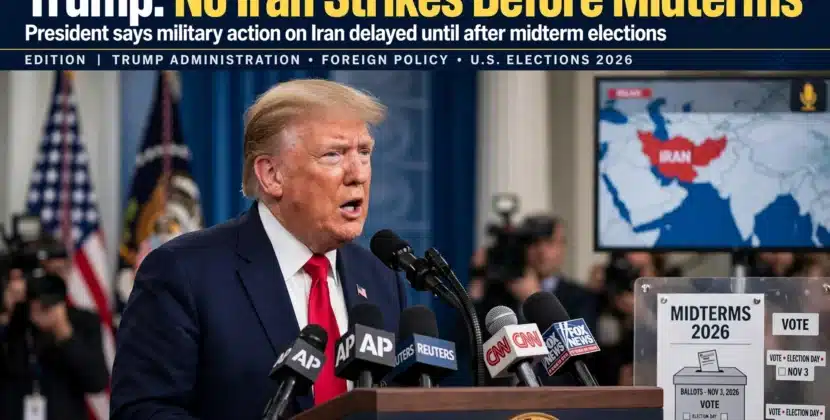
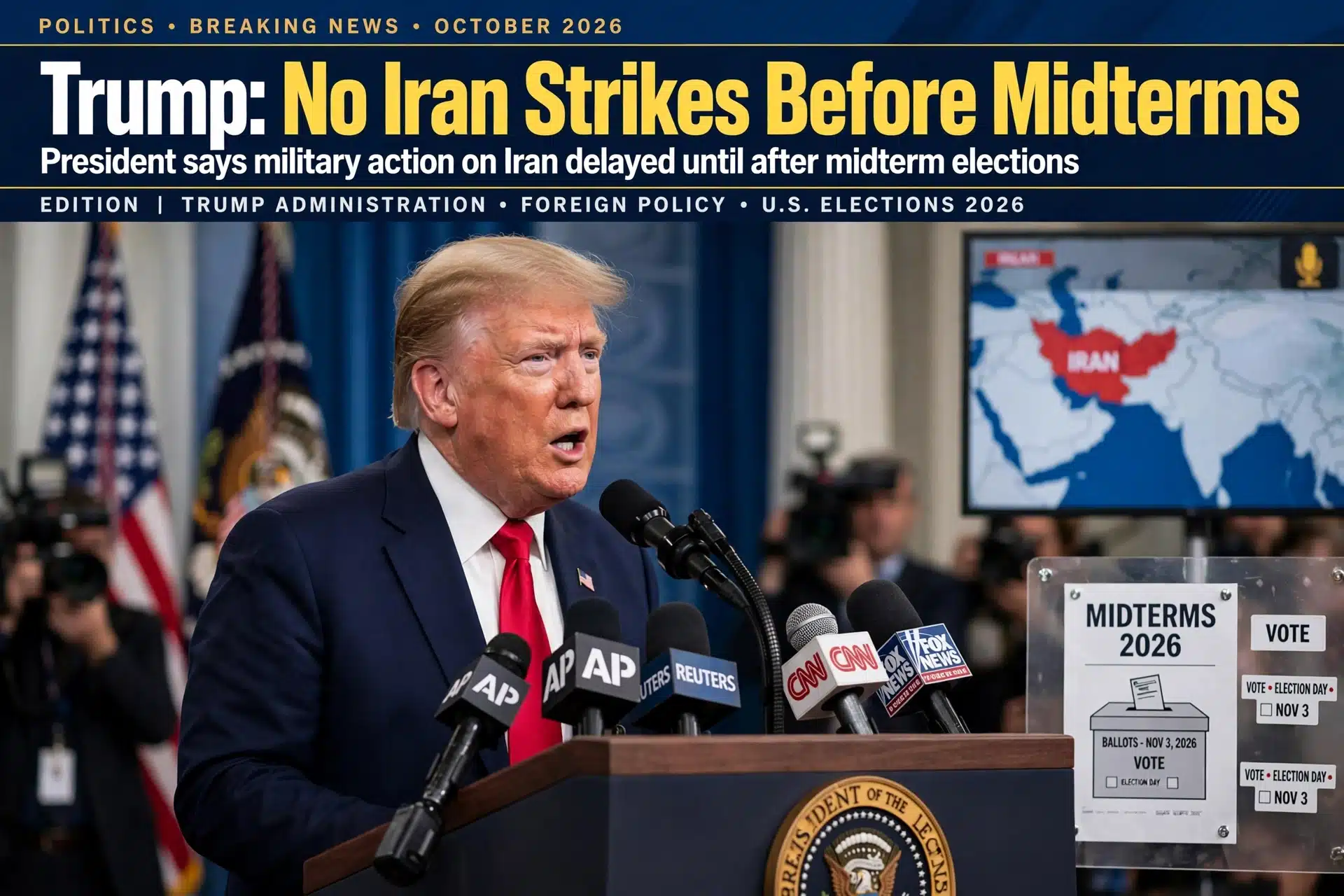
President Donald Trump announced Thursday that the United States will not attack Iran again before the November 3 midterm elections, a striking pause in a conflict that has escalated for weeks, and he confirmed at the same time that the two countries are holding indirect discussions. The message came in a post on Truth Social, where Trump wrote that we are having productive discussions with the Islamic Republic of Iran.
We will not be attacking Iran at any time prior to the Midterm Elections to be held in the United States on November 3rd, the president wrote, adding in the same post a bottom line demand about the central sticking point of the entire dispute: Iran will not have a nuclear weapon. The statement converted what had been weeks of back channel reporting into an explicit public commitment, with a date attached.
What Trump Actually Said
The post did three things at once. It set a timetable, ruling out military action for roughly four weeks. It revealed that indirect talks, in which the parties communicate through intermediaries rather than sitting across a table, are under way and, in Trump’s telling, productive. And it reasserted the red line on enrichment that has defined the administration’s position: no nuclear weapon for Iran.
Administration officials have framed the standoff similarly for days, demanding that Iran give up any path to a weapons capability while insisting that all options remain on the table after the deadline passes. What changed Thursday was the creation of a quiet period with the clock visible to everyone, including the voters heading to the polls on November 3 and the negotiators on the other side.
Where the War Stands
The pledge comes after a month in which strikes, proxy attacks and maritime threats have compounded. Iranian backed Houthi forces in Yemen attacked Riyadh’s airport on Thursday, killing three Saudi citizens according to state media, a reminder that allies across the region remain in the crossfire even as Washington signals restraint.
The maritime picture is if anything hotter. CNN reported this week that tanker attacks in the Strait of Hormuz have reached record levels, and Iran’s Revolutionary Guard acknowledged striking a liquefied petroleum gas carrier that it said was attempting to pass through what it called an illegal route south of the strait. Roughly a fifth of the world’s seaborne oil normally transits Hormuz, so every incident reprices the market within minutes.
The Pentagon Is Still Planning
A public pause has not stopped the machinery behind it. The New York Times reported Thursday that the Pentagon is drawing up new options to restart major combat operations, which suggests the White House views the pre election quiet as a tactical interval rather than an endgame. Trump also said the naval blockade remains in full force and effect, while claiming that oil is flowing in record numbers of barrels through the Strait of Hormuz.
That combination, no attacks authorized, blockade intact, strike options being refined, is the profile of a managed lull. It gives the administration a peace argument for the campaign trail without requiring concessions that Iran has so far refused to make, and it leaves the military plan ready if indirect talks stall after the election.
Oil Jumps Anyway
Financial markets barely paused to celebrate. Oil prices rose about 5 percent on Wednesday and Thursday, according to the Guardian, lifted by the record tanker attacks and by a hurricane threatening production in the Gulf of Mexico. CNN noted that the wave of attacks on tankers has kept futures nervous even on days when no shots are fired, and diesel prices have tracked crude upward throughout the war.
For American drivers, the connection is direct. The national average for gasoline has stood above $4 a gallon for weeks, and diesel has set records through the conflict, touching farming and trucking costs that feed into the price of everything delivered by road. Energy traders will watch the indirect talks as closely as the headlines, because any durable de escalation would show up first at the pump.
How Indirect Talks Actually Work
Indirect talks are not a summit. The two sides stay in separate rooms and pass proposals through an intermediary, a format the United States and Iran have used before, with Oman often facilitating communications when direct contact was politically impossible for Tehran. The advantage is that neither government has to be seen sitting with the other, which lowers the domestic cost of negotiating. The disadvantage is that nothing is truly agreed until it is agreed twice, through the mediator. Trump’s use of the word productive is therefore best read as a sign that the channel is active rather than proof that the gap on enrichment has narrowed.
The Politics of the Timing
The election dimension is impossible to miss. A war that began with broad backing has grown more complicated as prices rose, and both parties expect voters to factor the conflict into their choices on November 3. Republicans face competitive races in districts where fuel costs and deployment anxieties are live issues, while Democrats have pressed the administration on the legal basis for strikes conducted without new authorization from Congress.
Critics will argue that halting strikes for the length of a campaign is an election driven decision rather than a strategic one, and the Pentagon’s reported planning undercuts any claim that the war effort has ended. Supporters counter that a productive negotiating channel with a clear deadline attached is exactly how leverage is supposed to be used, and that a four week pause costs nothing if Iran is talking.
What to Watch Next
Four things will show whether Thursday’s statement is a turning point or a timeout. The first is the indirect channel itself: whether talks continue through the quiet period and whether a follow up session is scheduled. The second is the nuclear question, where the gap between Iran’s enrichment program and the administration’s zero tolerance demand remains wide.
The third is the maritime campaign, because record tanker attacks and a tense blockade are hard to keep compatible with a diplomatic track. The fourth is the calendar: whether strikes resume, pause further or convert into a negotiated arrangement in the days after November 3. Until then, the United States is in an announced lull, with the missiles grounded, the blockade running and the oil market counting the days.
Frequently Asked Questions
Did Trump say the US will not strike Iran before the midterms?
Yes. In a Truth Social post on Thursday, Trump wrote that the United States will not be attacking Iran at any time prior to the midterm elections on November 3, while also stating that Iran will not have a nuclear weapon.
Are the US and Iran holding talks?
Trump revealed that indirect discussions with Iran are under way and described them as productive. Indirect talks involve intermediaries rather than face to face negotiation between the two countries.
Why did oil prices jump if strikes are paused?
Oil rose about 5 percent amid record tanker attacks in the Strait of Hormuz and a hurricane threat to Gulf of Mexico production. Markets are pricing continued risk from the maritime campaign rather than from imminent US strikes.
What happens after the November 3 election?
The pause is tied to the election date, and the Pentagon is reportedly preparing options to restart major combat operations. Whether strikes resume depends on the state of the indirect talks and on Iran’s nuclear program at that point.