




Microsoft, Adobe and Six Outsourcing Firms Suspended From Green Cards in Vance Crackdown
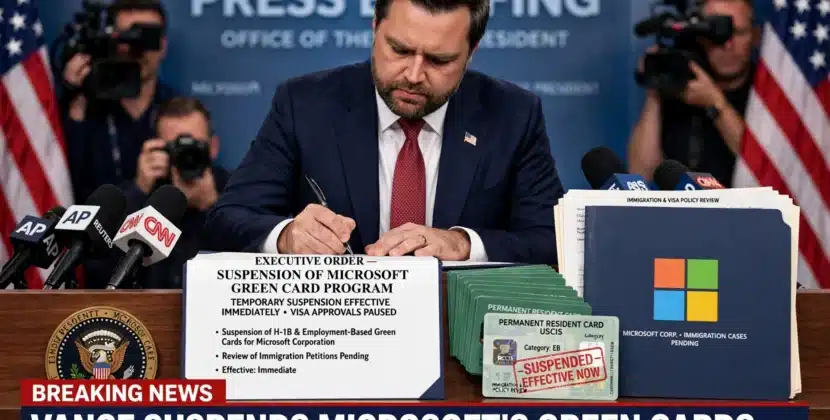
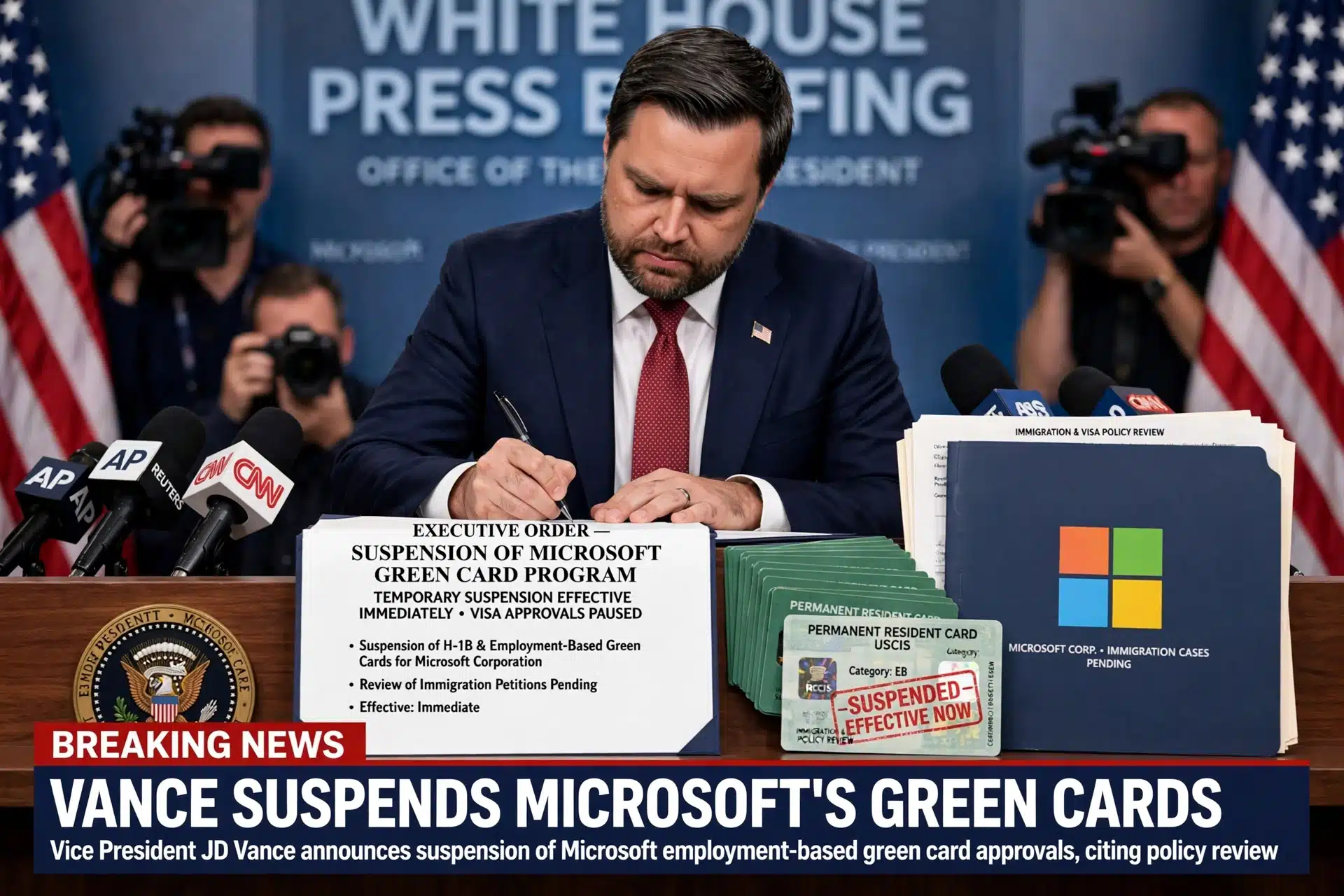
The Trump administration moved Thursday against some of the biggest names in American technology and outsourcing, suspending eight companies from the process employers use to sponsor foreign workers for green cards while opening fraud investigations into nine elite universities over their use of exchange visitor visas. Vice President JD Vance announced both actions at a White House press conference, casting them as a defense of American jobs and a warning to institutions he said have abused the immigration system for years.
Microsoft and Adobe lead the list of suspended firms, joined by six major information technology outsourcing companies: Cognizant, Infosys, Tata Consultancy Services, Wipro, HCL Technologies and Capgemini. On the same day, officials served subpoenas on Harvard, Yale, Stanford, Brown, the University of Pittsburgh, the University of California Davis, the California Institute of Technology, Arizona State University and the Massachusetts Institute of Technology over allegations that they misused the J-1 visa program that brings foreign students, teachers and researchers to the United States.
What the Suspension Actually Does
Labor Secretary Keith Sonderling defined the scope in blunt terms. We will not accept any new or process any pending permanent labor certification applications involving these companies, he said, referring to PERM, the permanent labor certification program that sits at the first step of the employment-based green card route. The certification requires employers to show that hiring a foreign worker will not depress the wages or opportunities of American workers, and it is the document almost every skilled-worker green card case must begin with.
Sonderling said the decision followed ongoing federal investigations and noted that the eight firms had been among the largest beneficiaries of the H-1B visa program. Together, he said, they had sought to hire almost 3 million foreign workers, received more than 230,000 H-1B visa approvals and obtained over 100,000 permanent labor certifications since 2009. Department of Labor data through June 2026 show that Microsoft was the single largest filer of PERM applications in the country. In fiscal year 2026, Amazon topped the list of employers with approved H-1B beneficiaries, followed by Tata Consultancy Services, Infosys, Apple and Microsoft.
Vance’s Case Against Microsoft
Vance saved his sharpest language for Microsoft. There has been no company in the United States, unfortunately, that has abused the system more than Microsoft, the vice president said. He built the argument around numbers: Microsoft laid off 6,000 American workers last year while obtaining 6,300 H-1B visas and nearly 3,000 green cards, and the company announced in July that it would cut another 4,800 jobs globally.
If you do the math, for every worker that Microsoft laid off, they replaced that worker with one and a half foreign indentured servants, Vance said. Our message to Microsoft is, you are a great American company, but you have got to hire great American workers. He also accused companies across the program of gaming the rules by posting job advertisements nobody would respond to, writing ads in a small-town newspaper and then citing the lack of replies as proof that no American was available for the role.
How Microsoft and the Other Firms Responded
Microsoft pushed back quickly. The company said that 80 percent of its H-1B applications in the last fiscal year were filed to extend or change the status of current employees rather than to hire new workers, and that the filings for new employees covered people already legally in the United States who decided to come work for Microsoft. Those hires, the company said, equal only 1 percent of its United States workforce and do not represent new arrivals to the country. Microsoft added that it pays H-1B employees the same as other workers in comparable roles and files petitions only for people who meet the rigorous standards of the visa category.
Tata Consultancy Services told Reuters that it did not expect the suspension to affect its workforce strategy or client engagements, noting that it had filed single-digit PERM applications over the past two years. Vance said the suspension would last as long as it needs to, leaving the timeline open ended while officials pressure the companies to change their hiring practices.
Nine Universities Subpoenaed Over J-1 Visas
The university investigations reach the same scale. Officials said the nine schools had been served subpoenas and would face a historic investigation into J-1 visa fraud, run by the Labor Department Office of Inspector General. The probe will focus on whether foreign influence, improper financial relationships or visa abuse were compromising federally funded research.
Labor Inspector General Anthony D’Esposito made clear the inquiry is not limited to paperwork. I do not care how prestigious a university thinks it is, he said. Break the law and screw the American people, and I will personally cuff you in the university square. I do not care how large your endowment is, how powerful your alumni are or how many politicians you have on speed dial. Federal data show the scale of the programs involved: Harvard sponsored 2,218 new J-1 exchange visitors in 2024, Stanford 1,436, Yale 1,169 and MIT 1,087. Harvard, Brown, Pittsburgh and MIT confirmed receiving subpoenas, Stanford and UC Davis said they would cooperate, Arizona State said it complies with United States law, and Yale said it would review the documents once they arrive.
What It Means for Workers and Scholars
Immigration lawyers say the practical hit falls on employees at the eight companies who are waiting in the green card line. The PERM pause delays one of the most common routes to permanent residency, and workers nearing the typical six year limit on their H-1B status face the greatest risk, according to immigration lawyer Lidice Samper. Supporters of the move argue it simply enforces rules written to protect American wages.
Critics say the logic runs backward. Doug Rand, who served as a senior adviser at United States Citizenship and Immigration Services under the Biden administration, called the policy incoherent, noting that a green card is precisely what frees an H-1B worker to change jobs and demand higher pay. If the administration were truly concerned that H-1B workers are indentured servants, Rand said, the last thing it would do is block companies from helping their own workers get green cards. Representative Pramila Jayapal of Washington argued that heavy handed attacks hurt the country’s ability to build a stable base of legal immigrant workers. India’s IT industry group, Nasscom, said the pause would have a limited effect because relatively few employees seek permanent residency through PERM.
Part of a Year Long Escalation
Thursday’s announcement is the latest chapter in a year of tightening rules for skilled immigration. On Wednesday, the Department of Homeland Security proposed a $70,000 fee on universities for every student they recommend for the Optional Practical Training work program. In August, officials proposed a $103,265 filing fee for every cap subject H-1B petition. A one-time $100,000 H-1B fee imposed in September 2025 was struck down by a federal judge in June who ruled it functioned as an unauthorized tax, though the government’s appeal is still pending. The Labor Department’s Project Firewall initiative has opened nearly 200 investigations into suspected H-1B abuse, and the administration also wants to replace the H-1B lottery with a wage based selection system and eliminate the 60 day grace period that lets fired workers find a new sponsor.
The enforcement wave is already visible in the numbers. New J-1 research scholars fell 27 percent last year to 17,622, and NAFSA estimated that new international student enrollment dropped 17 percent in fall 2025, contributing to more than $1.1 billion in lost revenue. Spring 2026 enrollment fell another 20 percent from a year earlier, and Columbia University paused admissions to its journalism master’s program as applications declined.
What Happens Next
For the eight companies, the immediate question is duration, because officials left it deliberately vague. PERM filings already in the queue will sit unprocessed, and each month of delay pushes affected workers closer to the six year H-1B ceiling. Legal challenges are possible, as they were with the $100,000 fee, and the nine universities must respond to subpoenas before the investigations move forward. Workers at the affected firms should document their status carefully, watch for guidance from their immigration counsel and track whether Congress takes an interest as the case list grows.
Frequently Asked Questions
Which companies are suspended from the green card program?
Microsoft, Adobe, Cognizant, Infosys, Tata Consultancy Services, Wipro, HCL Technologies and Capgemini cannot file new permanent labor certification applications, and pending filings involving them will not be processed while the suspension lasts.
What is the PERM program?
PERM is the permanent labor certification process, the first step of the employment based green card route, in which an employer must prove that hiring a foreign worker will not lower wages or displace American workers.
Why is the government investigating nine universities over J-1 visas?
Officials allege the schools misused the J-1 exchange visitor program, which brings foreign students and researchers to the United States, in ways that undercut American wages or compromise federally funded research. Harvard, Yale, Stanford, Brown, Pittsburgh, UC Davis, Caltech, Arizona State and MIT have been subpoenaed.
How long will the suspension last?
Vance said it will last as long as it needs to. No end date has been announced, and officials said the pause will continue while investigations into the companies remain open.