




Pentagon Drone Loan Sends $450M to Neros for US Parts
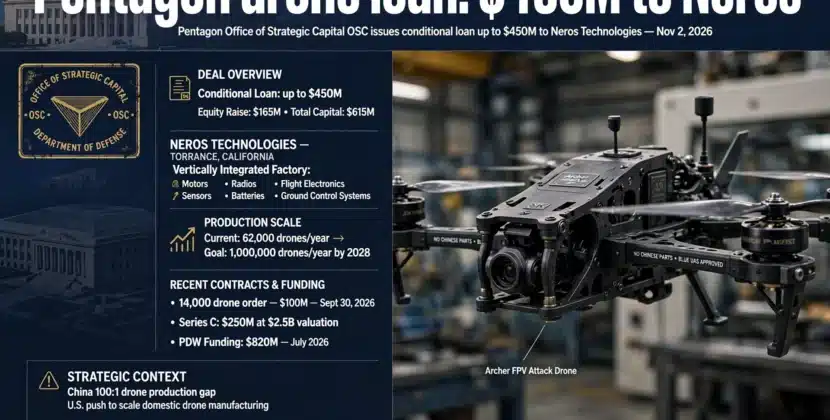
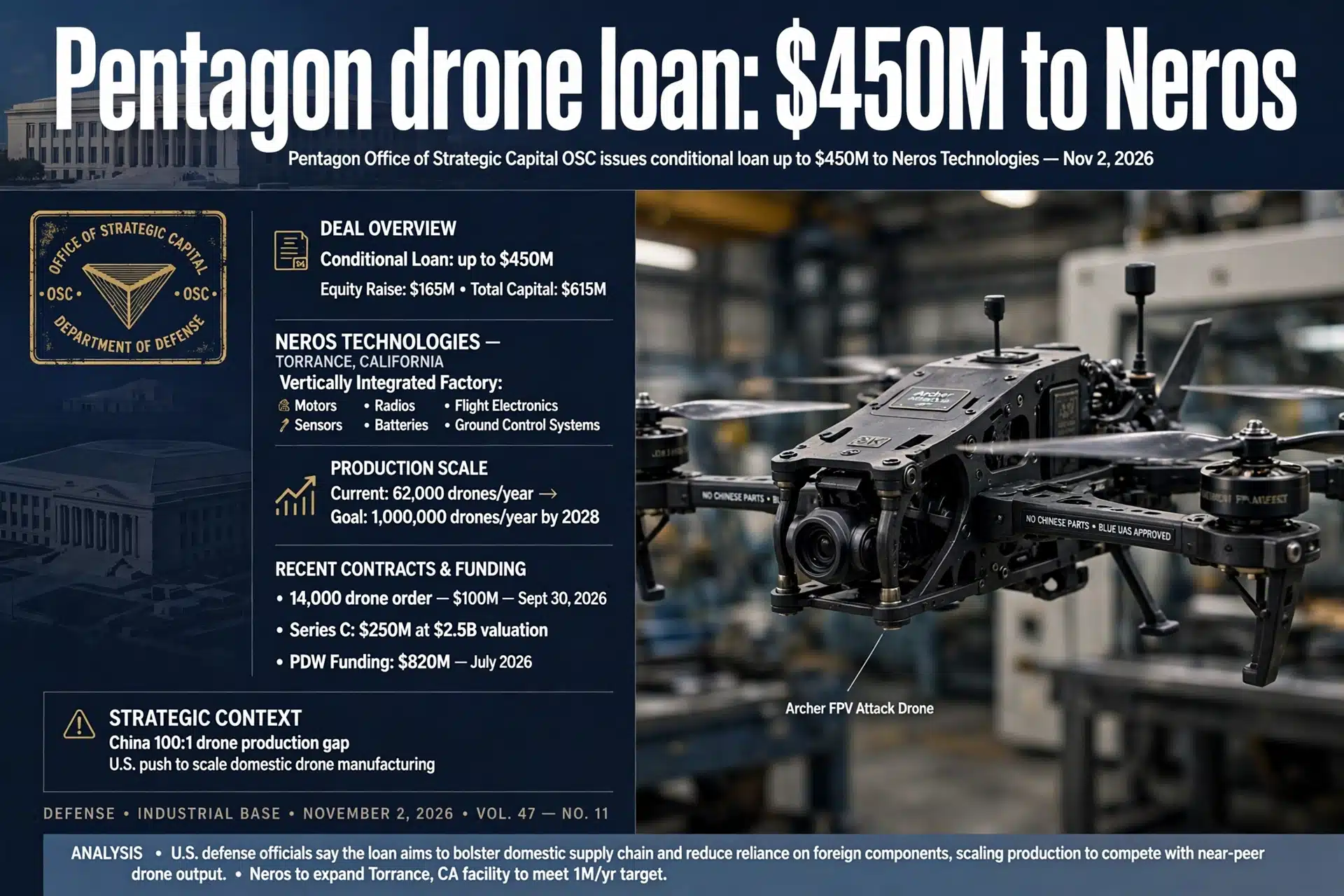
The Pentagon drone loan announced November 2, 2026 commits up to $450 million to Neros, Inc., a California maker of small attack drones, to build the motors, radios, sensors and batteries inside those drones on American soil. The Department of War’s Office of Strategic Capital framed the money as a way to reduce reliance on foreign-made components, not as a purchase of finished aircraft, which is the detail that makes the deal unusual.
Key Takeaways:
- – The Office of Strategic Capital signed a conditional loan commitment of up to $450 million with Neros on November 2, 2026.
- – Neros is adding $165 million of its own equity, bringing the total project to $615 million.
- – The money targets components such as motors, flight electronics, radios, thermal sensors and batteries, not just airframes.
- – The commitment is conditional; no funds move until Neros satisfies financial, legal and technical requirements.
What the Pentagon announced
The Department of War published the release on November 2, describing the commitment as support for Neros’ domestic manufacturing expansion and for reducing reliance on foreign-made parts. The office is a credit program rather than a procurement shop, so the instrument is a loan, and the announcement language describes financing made alongside private capital.
David A. Lorch, director of the Office of Strategic Capital, said in the release that Neros has already demonstrated an ability to design, manufacture and deliver small unmanned aircraft systems, and that “OSC’s investment will turbocharge Neros’ ability to manufacture drones and components critical for the production of drone systems.” The same release names the Torrance, California facility as the site where propulsion motors, flight stacks, radios and thermal sensors will be onshored.
Why the parts matter more than the aircraft
Neros already builds its Archer drone without Chinese components, according to defence-blog, so the loan is not about making a single aircraft compliant. It is about moving the supply of subcomponents inside the country so that the entire small-drone industry has a domestic source.
That distinction matters because airframes are the easy part. Motors, radios, flight controllers and batteries are where Chinese suppliers dominate global volume, and those are precisely the parts that become scarce in a prolonged conflict. By funding component lines, the Pentagon is buying industrial capacity that Neros can sell to other drone makers, including firms it competes with for contracts. A single qualification standard for a domestically made motor or battery is worth more to the military than one company’s finished product.
The China supply chain problem
The policy backdrop is a multi-year push to remove Chinese components from military small drones. Neros says the capital puts it on a path to one million drones per year by 2028 across long-range strike, close-quarters combat and interceptor categories, which is a production target rather than a current output.
Achieving that volume requires batteries at a scale the United States does not currently produce for small drones, along with motors that meet defense specifications and radios that pass security review. DroneXL reports that Neros said its first domestically built motors came off the line the week before the announcement, with flight electronics, sensors and batteries to follow. That sequence, motors first and the rest later, is a realistic read on how far the onshoring effort has actually progressed.
A conditional loan, not a check
The word conditional carries the weight in this deal. The Office of Strategic Capital’s release describes requirements the company must satisfy before financial close, covering financial, legal, technical, investment and due-diligence conditions. Until those are met, no money changes hands, and the announcement is a commitment rather than a completed financing.
There is also the question of what the government receives. Neros’ head of growth, Ross Pedersen, told Tectonic Defense that the Pentagon is getting a small stake in the company with no voting or decision-making rights, and that neither side has disclosed the size, form, interest rate or term of the loan. The company’s own website initially characterized the deal as giving taxpayers an ownership stake, while the government release said nothing about one, a gap that reporters noticed within a day.
What $615 million buys
The project total of $615 million combines the loan ceiling with Neros’ $165 million equity contribution. Neros says the money goes toward vertically integrated manufacturing at Torrance, covering complete drone platforms, ground control systems and the components underneath them.
The company has had a busy year. It raised a $250 million Series C in August at a reported $2.5 billion valuation, announced a 14,000-drone order worth more than $100 million through the Pentagon’s Drone Dominance program on September 30, and holds a position on an Army contract vehicle for attritable systems with a $500 million ceiling. The federal loan adds a manufacturing balance sheet to a company that until now was scaling on venture money and orders.
What happens next
The first checkpoint is financial close, which requires Neros to clear the conditions the office set. The second is whether domestic component lines reach qualification, because a motor that works in a prototype is not the same as a motor that passes military environmental testing at volume.
The larger test arrives with the next round of high-volume drone purchasing. If Neros can supply components to other American drone makers at competitive prices, the loan will have done something a procurement contract cannot, which is build a supplier base. If the parts stay expensive or scarce, the military will keep buying abroad through allied channels and the onshoring goal slips. Watch the Pentagon’s December directed-energy testing for signals about how quickly it intends to scale adjacent programs.
For US readers outside the defense industry, the loan is a small line item with a visible purpose. The Office of Strategic Capital exists to lend where private capital will not, and a component factory in Torrance is the kind of asset that either reaches volume or becomes an expensive pilot. The one-million-drone target for 2028 is a company projection, not a government commitment, and the gap between the two is where this deal will be judged. Taxpayers are exposed only if the conditions are met and the loan closes, which limits the downside while leaving the production risk with the company and its investors.
Frequently Asked Questions
How much is the Pentagon drone loan to Neros?
It is a conditional loan commitment of up to $450 million from the Office of Strategic Capital, announced November 2, 2026. Neros is contributing $165 million of equity, for a total project value of $615 million.
Is the money already paid out?
No. The commitment is conditional, and Neros must satisfy financial, legal, technical and due-diligence requirements before the loan closes. The announcement describes a pathway to financing, not a completed transaction.
What will Neros build with the money?
Domestic production of small drone components including propulsion motors, flight electronics, radios, thermal sensors and batteries, plus complete drones and ground control systems at its Torrance, California facility.
Bottom line
The Pentagon drone loan is a bet on parts rather than platforms. By financing domestic motors, radios and batteries, the Office of Strategic Capital is trying to fix the bottleneck that would matter most in a high-volume fight, and it is doing so through a conditional loan that has not yet closed. The drone count Neros promises by 2028 depends on whether those component lines qualify, not on the announcement itself.
Sources:
- https://www.war.gov/News/Releases/Release/Article/4638926/department-of-wars-office-of-strategic-capital-signs-conditional-loan-commitmen/
- https://www.prnewswire.com/news-releases/neros-signs-450m-conditional-loan-commitment-with-the-office-of-strategic-capital-to-establish-americas-drone-industrial-base-302926692.html
- https://www.tectonicdefense.com/pentagon-takes-stake-in-neros-with-450m-osc-loan
- https://defence-blog.com/neros-gets-450m-pentagon-loan-to-cut-reliance-on-chinese-drone-parts/
- https://dronexl.co/2026/11/04/neros-pentagon-small-stake-no-vote-who-buys-drones/