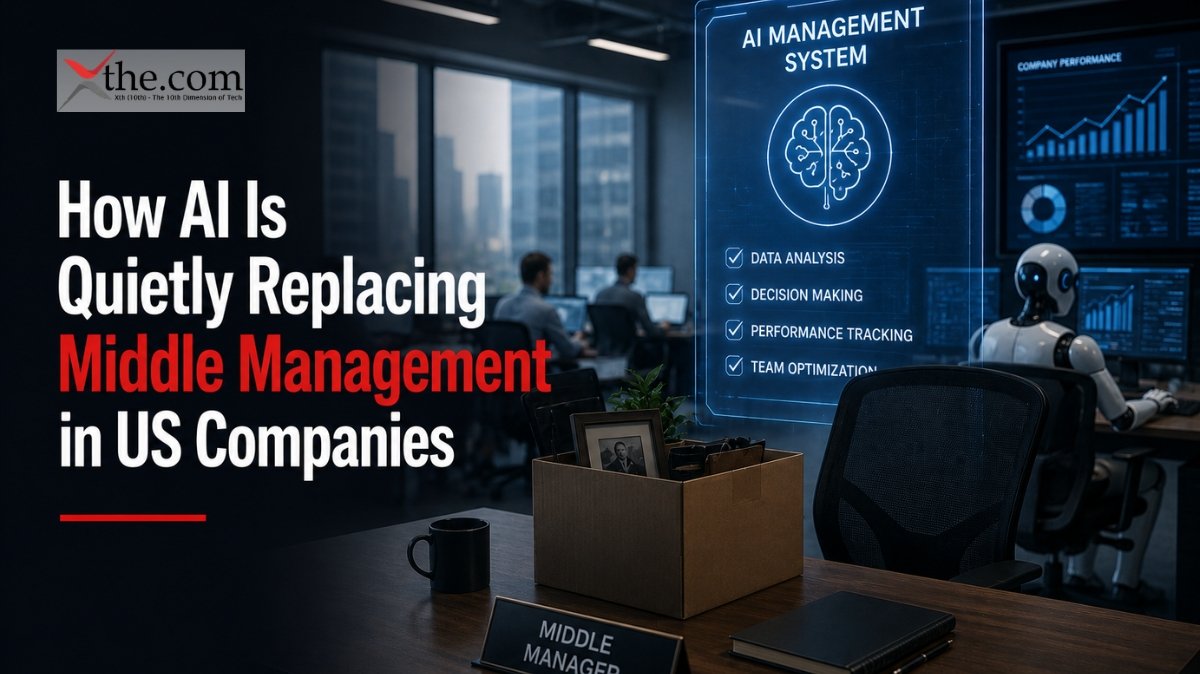
The title of “middle manager” has never been glamorous. But for decades, it was secure. Someone had to sit between the executives making decisions and the employees doing the work — translating strategy into tasks, collecting reports, running check-ins, monitoring progress, and flagging problems before they reached the top floor.
In 2026, AI does most of that. AI replacing middle managers is no longer a prediction — the org charts of major US companies are already changing to reflect it.
This is not a forecast anymore. The layoffs are already showing up in monthly tracking data. The companies restructuring around AI are not startups experimenting with new ideas — they are Amazon, Meta, Google, Microsoft, and Wall Street banks planning multi-year workforce reductions that are heavily concentrated in the management layer. Understanding what is actually happening, and what it means for anyone in or near a middle management role, is no longer optional.
What Middle Managers Actually Do — and What AI Has Already Taken
The honest starting point is understanding the job itself. A typical middle manager’s week, across most industries, breaks down into roughly four categories of activity.
Reporting — pulling data from multiple teams, formatting it into summaries, and presenting it to leadership. AI tools that connect directly to project management software, CRMs, and internal databases now generate these reports automatically, in real time, with more accuracy and zero time spent formatting.
Coordinating — scheduling meetings, assigning tasks, following up on deadlines, making sure the right people have the right information at the right time. Workflow automation tools and AI scheduling systems handle this without a human in the loop.
Reviewing — checking work before it moves up the chain, catching errors, ensuring quality standards are met. AI review tools now do this faster and with more consistency than a human reviewer who is distracted, pressed for time, or unfamiliar with one portion of the work.
Translating — taking executive decisions and turning them into team-level action items. This is the function most dependent on human judgment, and it is also the one AI is advancing into most aggressively through large language models that can interpret strategic direction and generate operational plans.
Research shows that roughly 60% of a typical middle manager’s week falls into these four buckets: reporting, coordinating, reviewing, and translating. AI handles all four. That is the core of what is happening.
The Numbers That Define What Is Actually Happening
This is no longer a theoretical conversation. The data in 2026 is specific and consistent.
Through the first half of 2026, US employers attributed 101,743 announced job cuts specifically to AI — nearly double the total for all of 2025. According to Challenger, Gray & Christmas, AI is now the single most-cited reason for job cuts in America, and has been for four consecutive months.
Gartner predicts that through 2026, 20% of organizations will use AI to flatten their organizational structure, eliminating more than half of current middle management positions.
Middle management positions declined 6.1% between 2022 and 2025, while job openings in this category remain down 42% from their peak.
MIT Sloan’s 2026 AI research shows that in companies deploying agentic AI at scale, span of control — meaning the number of direct reports per manager — has expanded from the historical norm of seven to as high as 15 in some divisions. When one manager can effectively oversee 15 people using AI tools, the math on how many managers a company needs changes dramatically.
McKinsey’s November 2025 report found that demand for AI fluency — the ability to use and manage AI tools — grew sevenfold in job postings between 2023 and 2025, faster than any other skill. The message from companies is consistent: we are not replacing management entirely, we are replacing management that cannot use AI with management that can.
Which US Companies Are Already Doing This
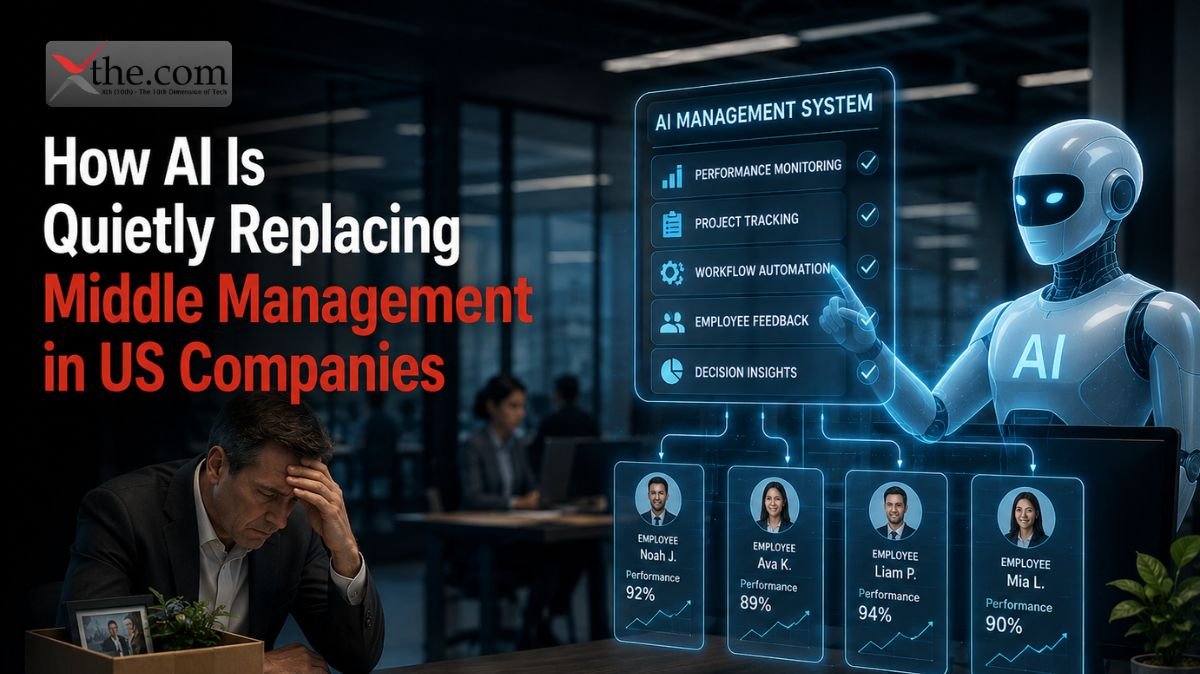
This is not happening at a handful of experimental startups. The companies restructuring around AI-enabled flatter hierarchies are some of the largest employers in the United States.
Amazon cut 14,000 corporate roles in 2025, explicitly citing AI-enabled efficiency as the justification. Workday, Meta, Google, and Microsoft have all publicly restructured to reduce managerial layers in 2025 and 2026.
Wall Street banks plan to eliminate approximately 200,000 roles over the next three to five years, heavily concentrated in middle-layer oversight functions. Goldman Sachs, JPMorgan, and Citigroup have each publicly discussed AI’s role in reducing headcount in roles that involve data analysis, reporting, and compliance monitoring — all functions that middle managers in financial services have traditionally owned.
The pattern is consistent across industries: companies are not announcing “we are replacing managers with AI.” They are announcing efficiency improvements, restructuring initiatives, and headcount reductions in corporate functions. The result is the same — fewer managers, more AI tools, and larger teams reporting to fewer human supervisors.
I Am a Middle Manager. Should I Actually Be Worried?
The honest answer: it depends on what you spend your time doing.
Research shows that 37% of employees report feeling directionless after their company removed middle management roles — which means the human functions of management have real value that AI has not replicated. The companies cutting managers are also discovering, sometimes painfully, that morale deteriorates and performance dips when the human layer disappears without a replacement for its non-transactional functions.
As Dr. Shannon Franklin, a licensed psychologist specializing in organizational behavior, put it: “Middle managers are typically in a position to interpret the emotions related to organizational change for their employees. They provide clarity regarding changes that employees do not understand, allow issues to be addressed before becoming major problems, and can establish an ‘us’ mentality that is difficult for technology to duplicate.”
The middle managers whose jobs are most at risk are those whose primary contribution is information routing — collecting reports, running status meetings, passing decisions up and instructions down. AI eliminates that function directly and completely.
The middle managers whose positions are most secure are those whose primary contribution is judgment, coaching, conflict resolution, and team development — the functions that require reading a room, understanding individual motivations, and making calls that cannot be reduced to a workflow.
The average span of control has grown to 12.1 direct reports, a 50% increase since 2013. Managers handling larger teams have less time for the human functions that justify their existence — which is part of why 45% of middle managers report burnout, higher than any other employee group. The role is being compressed from both sides simultaneously.
The Tasks AI Cannot Do — and What That Means for Your Job
Being clear about what AI actually cannot do well is more useful than generic reassurance about “human skills.”
Reading political dynamics. AI tools do not know that two team members have a history, that a project is politically sensitive for reasons that never appear in documentation, or that a particular executive will respond badly to a specific framing. Experienced managers navigate this constantly. AI does not.
Coaching through performance problems. Telling someone their work is not meeting expectations, understanding why, and creating a path forward is one of the most human and consequential things a manager does. AI can draft a performance review. It cannot sit across from someone and help them understand why they are struggling.
Making judgment calls with incomplete information. When a project has two viable paths and the right choice depends on team capacity, client relationship history, and business priorities that are partially undocumented, a manager makes a call. AI generates options. The responsibility for choosing belongs to a human.
Building the team identity that drives performance. According to Jeff Burnstein, president of the Association for Advancing Automation: “The people who thrive will translate business needs into technology decisions, coach teams through change, and use AI to make better operational decisions.” That is an accurate description of what secure middle management looks like in 2026 and beyond.
What Companies Are Getting Wrong About This Transition
The companies cutting fastest are not always cutting smartest. Several patterns are emerging that are creating problems for organizations that moved aggressively on flattening.
Cutting the human layer before AI is ready to replace it. AI tools for workflow management are strong. AI tools for the relational and judgment functions of management are not. Companies that eliminate managers before establishing what replaces those functions are discovering the gap quickly.
Confusing efficiency with effectiveness. A leaner org chart is cheaper to run. It is not automatically more effective. The 37% of employees who report feeling directionless after management cuts are less productive, less engaged, and more likely to leave — costs that do not show up in the headcount reduction announcement.
Treating middle management as overhead rather than infrastructure. The framing of “flattening hierarchies” presents management layers as bureaucratic waste. In healthy organizations, middle management is the connective tissue between strategy and execution. Removing it without replacing what it does creates a gap that shows up in missed deadlines, miscommunication, and declining morale.
The Middle Managers Who Are Thriving in 2026
Not all middle managers are under pressure. A specific profile is doing well — and understanding it is useful regardless of your current role or industry.
Managers who use AI as a tool rather than competing with it. These are the people who have offloaded their reporting and coordination functions to AI tools and reclaimed that time for coaching, relationship building, and strategic work. They are now doing the high-value parts of management more thoroughly than was possible before, because the low-value parts no longer consume their days.
Managers who develop AI fluency alongside their teams. In organizations deploying AI at scale, managers who can help their teams navigate new tools, identify which AI outputs to trust and which to verify, and adapt workflows to take advantage of what AI does well are indispensable. This is not a technical skill — it is a leadership skill applied to a technical transition.
Managers who build explicit human value. The managers who survive restructuring are typically those whose teams visibly advocate for them, because the relationship has real value that the team can articulate. Building that relationship deliberately — through coaching, consistent communication, and genuine investment in team members’ development — is what makes a manager difficult to remove without consequence.
What Happens to the Teams When Managers Are Cut
The employee experience of management cuts is under-reported compared to the business case for them. The data that does exist is worth understanding.
Research shows 37% of employees report feeling directionless after their company removed middle management roles. Directionless employees are less productive, more likely to disengage, and more likely to leave. In a labor market where replacing an experienced employee costs six to nine months of their salary, the math on cutting management to reduce costs becomes more complicated.
The loss of a management layer also removes a career development path. Entry-level employees in flat organizations often have no visible progression route beyond their current role. Companies that flatten aggressively are discovering that retention problems follow — particularly among high performers who see no room to grow within the structure.
Frequently Asked Questions
1. Will AI completely replace middle managers?
No — but it is replacing specific functions that middle managers have traditionally owned. Reporting, scheduling, coordination, and basic performance monitoring are being automated. Judgment, coaching, conflict resolution, and team development are not. Middle managers who spend most of their time on the first category are at significant risk. Those whose primary contribution is in the second category are considerably safer.
2. Which industries are cutting middle management fastest because of AI?
Technology, financial services, and corporate functions within retail and manufacturing have moved most aggressively. Amazon, Meta, Goldman Sachs, and Citigroup have all made public statements connecting management layer reductions to AI adoption. Industries with high volumes of structured, data-driven management work — compliance, reporting, process oversight — are experiencing the steepest cuts.
3. I am a middle manager and my company just announced an AI initiative. What should I do?
Two things immediately. First, become the person on your team who understands the AI tools being deployed — not as a technical expert, but as the person who helps the team use them effectively. Second, invest deliberately in the relational work that AI cannot do: regular one-on-ones, genuine coaching conversations, and team culture. The managers who survive restructuring are consistently those who are hardest to remove without damaging the team.
4. Does AI replacing middle managers mean fewer opportunities for younger workers to move up?
This is one of the most significant and under-discussed consequences of flattening. Middle management has historically been the first rung on the leadership ladder. As those positions disappear, the path from individual contributor to senior leader becomes less clear and less accessible. Companies that are not actively replacing that development pipeline with alternative paths are building a leadership deficit they will notice in five to ten years.
5. Are the companies cutting managers seeing better performance?
The data is mixed. Cost reductions are immediate and measurable. Performance impacts take longer to surface and are harder to attribute directly to the restructuring decision. Companies that cut management without replacing the coordination and coaching functions are seeing morale and retention impacts. Companies that thoughtfully transitioned management roles to focus on higher-value work are generally reporting better outcomes.
The Honest Assessment
Middle management in its current form — built around information routing, status reporting, and coordination — is being disrupted faster than most people in those roles are prepared to acknowledge. 46% of managers are, according to recent research, in denial about AI’s impact on their roles — a posture that is likely to be expensive.
What is replacing the old version of middle management is not nothing. It is a smaller number of managers who spend their time on higher-stakes work: building teams, making judgment calls, navigating complexity, and helping organizations make sense of what AI is producing. Those roles exist. They are not going away. But they require a different set of daily priorities than the management job of ten years ago.
The companies getting this transition right are not eliminating management — they are redefining what management is for. The companies getting it wrong are cutting headcount now and discovering what was lost later.
For anyone currently in a middle management role, the question worth asking is not whether AI is coming for your job. It is which parts of your job AI is already doing better than you, and what that frees you to do instead.