





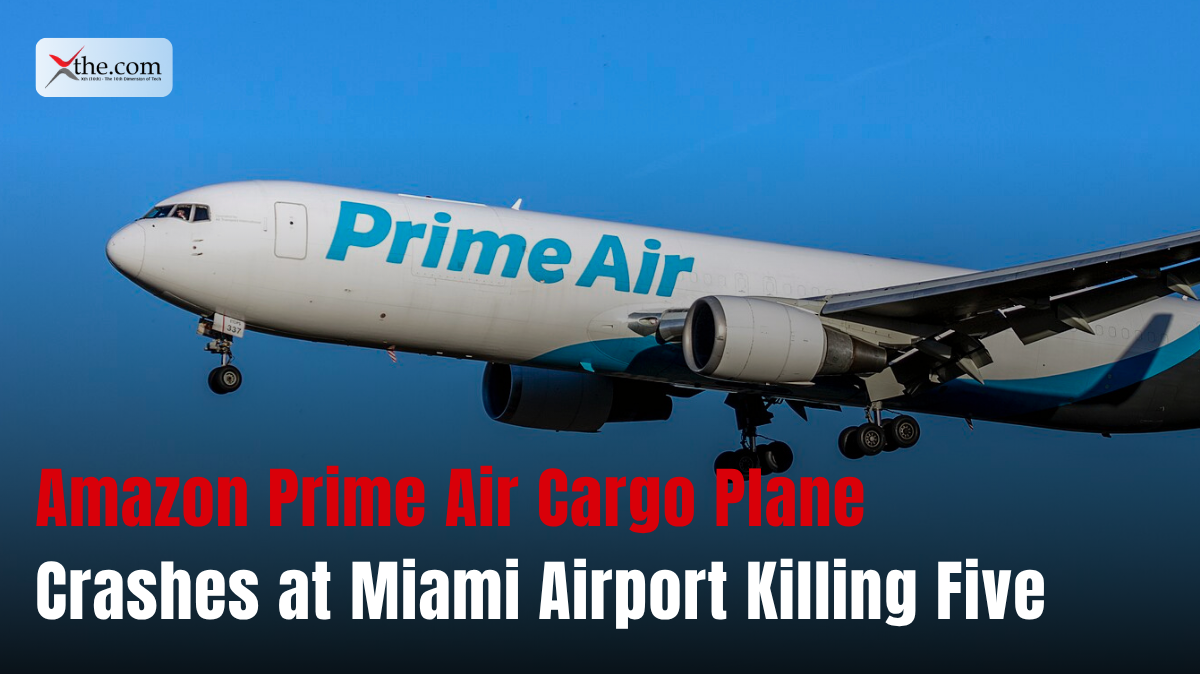
Amazon Prime Air Cargo Plane Crashes at Miami Airport, Killing Five
A devastating crash at Miami International Airport on Sunday killed at least five people and injured several others when an Amazon Prime Air cargo plane overshot the runway and barreled into a busy roadway, striking multiple vehicles. The tragic incident has once again raised serious questions about aviation safety in the rapidly growing cargo airline industry.
What Happened at Miami International Airport
The Boeing 767-300ERF, operated by Atlas Air on behalf of Amazon’s Prime Air cargo division, was arriving from Puerto Rico when it failed to stop on the runway. The aircraft crossed 67th Avenue, a major road adjacent to the airport, before coming to a rest in a cloud of smoke and debris. Emergency responders arrived within minutes, but the damage was already catastrophic.
Five people on the ground were killed as the massive cargo aircraft struck vehicles traveling on the roadway. At least three others were critically injured, while two more sustained less severe injuries. The flight crew survived the crash and was transported to local hospitals for evaluation. Miami-Dade County officials confirmed the casualties during a press conference Sunday evening.
“All runways and taxiways were temporarily closed as emergency crews responded to the scene,” the airport authority said in a statement. “Operations have since resumed on a limited basis.”
The Aircraft and Its Mission
The Boeing 767-300ERF is a wide-body freighter commonly used for medium- to long-haul cargo operations. Atlas Air, the world’s largest operator of Boeing 747 freighters, manages a significant portion of Amazon’s air cargo network under the Prime Air brand. The aircraft involved had been in service for several years and was part of Amazon’s growing logistics fleet, which the company has been rapidly expanding to compete with UPS and FedEx.
Amazon’s Prime Air division has become one of the fastest-growing cargo airlines in the United States. The company operates hundreds of daily flights through partnerships with Atlas Air and ATSG, transporting packages between fulfillment centers and across the country. The crash is likely to put a spotlight on the safety record of these rapidly scaling cargo operations.
Investigation Underway
The National Transportation Safety Board (NTSB) has dispatched a team of investigators to Miami International Airport to determine the cause of the crash. Initial observations suggest the aircraft may have experienced a mechanical failure or encountered adverse weather conditions during landing, though investigators have not confirmed any specific cause.
“We are in the early stages of a comprehensive investigation,” an NTSB spokesperson said. “The flight data recorder and cockpit voice recorder have been recovered and are being analyzed. We will also be reviewing maintenance records, pilot qualifications, and weather data from the time of the incident.”
The Federal Aviation Administration (FAA) has also launched its own investigation and will work alongside the NTSB. Meanwhile, Atlas Air has issued a statement expressing condolences to the families of the victims and pledging full cooperation with investigators.
Amazon’s Response
Amazon released a brief statement Sunday night confirming that the aircraft was operating as part of its Prime Air cargo network. “We are saddened by the news of the crash at Miami International Airport. We are working with our carrier partner, Atlas Air, and local authorities to gather more information. Our thoughts are with those affected by this tragedy.”
The company did not address questions about its cargo safety protocols or whether the crash would affect its air delivery operations. Industry analysts, however, expect Amazon to face increased scrutiny as the incident draws national attention to the safety standards of its rapidly expanding aviation fleet.
A Pattern of Cargo Airline Incidents
The Miami crash is not an isolated event. In recent years, the cargo airline industry has experienced several high-profile accidents as demand for air freight has surged. Amazon’s reliance on third-party operators like Atlas Air has drawn criticism from safety advocates who argue that the pressure to deliver packages faster has led to rushed maintenance, pilot fatigue, and insufficient training.
In 2019, an Atlas Air Boeing 777 crashed in Trinity Bay, Texas, killing all three crew members on board. The NTSB determined that pilot error was the primary cause. In 2020, a UPS Boeing 747 made an emergency landing in Louisville after an engine caught fire shortly after takeoff.
The Air Line Pilots Association (ALPA), which represents cargo pilots, has long advocated for stricter safety regulations in the cargo industry, arguing that passenger airlines face far more rigorous oversight. “Cargo pilots and crews deserve the same level of safety protection as their counterparts in passenger aviation,” ALPA said in a statement following the crash.
Impact on Airport Operations and Traffic
Miami International Airport is one of the busiest cargo airports in the United States, handling billions of dollars in freight annually. The temporary closure of all runways caused significant delays for both cargo and passenger flights throughout Sunday evening and into Monday morning. The airport authority said that full operations were expected to resume by late Monday.
Local traffic on 67th Avenue was also severely impacted, with authorities closing the road for several hours to allow investigators access to the crash site. Drivers reported delays of up to two hours in the surrounding area.
What Comes Next
The NTSB investigation is expected to take several months, with a preliminary report likely to be released within 30 days. In the meantime, the crash is expected to intensify calls for stricter safety regulations in the cargo airline industry. Members of Congress have already begun asking questions about the oversight of Amazon’s Prime Air operations and whether the FAA is doing enough to ensure safety.
For the families of the five victims, the investigation offers little immediate solace. “My brother was just driving home from work,” said one relative of a victim, who asked not to be identified. “He never thought a plane would come out of the sky and hit his car.”
The crash serves as a stark reminder that the convenience of same-day delivery comes with real risks, and that the aviation industry must do more to protect both the pilots who fly these missions and the communities that live in the shadows of America’s busiest airports.