






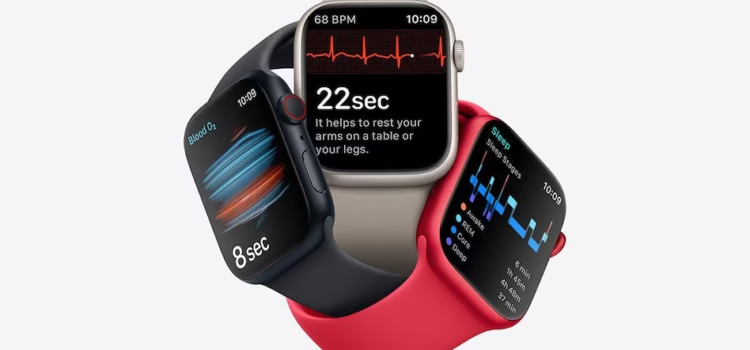
Apple is working on a non-invasive blood glucose monitoring system for the Apple Watch that could let users check their blood sugar without piercing their skin. The project began over ten years ago and was at the proof-of-concept stage as of 2024.
Key aspects of Apple’s glucose monitoring technology are detailed below, outlining how the system works and where the project currently stands.
- Technology approach: Apple uses silicon photonics and optical absorption spectroscopy. The system sends certain wavelengths of light, possibly in the terahertz range, into the fluid under the skin. Glucose absorbs the light, and the sensor measures the reflected signal.
- Secretive Development Cologne. The project is part of Apple’s Exploratory Design Group (XDG), a very secretive team similar to Google X. It was previously known by the codename E5. The work began after Apple bought the startup Rare Light in 2010.
- Current progress: the technology is functional, but too large for a smartwatch. At this stage, engineers are working to shrink the prototype from its current iPhone-sized form, which can be strapped to a person’s bicep, to a size suitable for an Apple Watch. Development is ongoing as of 2024.
- Target audience: The aim is to give people an early warning if they are pre-diabetic so they can make lifestyle changes and avoid developing type 2 diabetes.
- Human trials over the past decade. Apple has tested the system on hundreds of people starting soon after the project began and continued through 2025. These include participants with pre-diabetes and type 2 diabetes.
- Potential launch: Although significant progress has been made, the technology is unlikely to be available to consumers before 2027. Some estimates indicate a possible launch that year, depending on final development and regulatory approvals.
Challenges And Competition
- Accuracy: Non-invasive monitoring is affected by factors such as skin tone, hydration, and temperature, which can affect readings.
- Competition: Other companies, such as Know Labs, Hagar, and Rockley Photonics, are also developing non-invasive methods.
- FDA advises: The FDA has previously warned customers not to use unapproved smartwatches or rings to measure blood glucose levels, noting that current approved systems still require skin penetration.
Note that the FDA has not yet approved or cleared any smartwatch that provides non-invasive direct blood glucose measurements.
The Apple Watch Series 13, expected in 2027, is rumored to be the first model with blood sugar monitoring. Apple has reportedly been working on this feature for years; in 2021, after the Series 7 reports surfaced, Apple was developing a blood sugar system set to launch. Nothing came of that, and in 2024, Apple was said to be trialing such an Apple Watch app for health data-collection studies rather than for public release.
Now, analyst Jeff Pu says that blood sugar monitoring will be the main feature of the Apple Watch Series 13 in 2027. It might be called the Apple Watch with blood monitoring, but he gives no further details.
According to social media reports, Pu has only provided dates for this feature. It is unclear if his information comes from supply chain sources or if he is making predictions based on his earlier reports about Apple.
Some of Pu’s earlier reports have been accurate, but he also has a history of making release predictions that turn out to be wrong.
Apple has steadily added health features to the Apple Watch, including blood oxygen level monitoring. However, this feature is currently disabled on Apple Watch models sold in the US because of a patent dispute. Rarely is Apple the only company attempting to develop a non-invasive blood sugar monitoring system. In January 2025, PreEvnt previewed a clip-on device that works via breath analysis.