






Cupertino, California.
If you’ve ever tried to answer emails in a moving Uber while wearing a mixed reality headset, you know the feeling. Your eyes say you’re sitting still, but your inner ear disagrees. After 10 minutes, nausea usually sets in.
Apple thinks it has a solution in its latest visionOS updates, which introduce real-time vehicle motion cues for Apple Vision Pro. This feature adds subtle visual indicators around your field of view, helping your brain process movement more naturally when you’re in a car, train, or airplane.
The goal seems simple: make spatial computing work outside of a stationary office or living room, but the technical challenge is much more complex.
Why VisionOS Updates Center on Motion Sickness
Motion sickness is one of the main reasons people hesitate to use immersive headsets. While short demos can be fun, using these devices for longer periods during travel time often leads to enough discomfort that people don’t want to try again.
This problem becomes especially noticeable in moving vehicles.
When you’re in a car, your body senses acceleration, braking, and turns. But if your headset shows a steady virtual workspace, your senses get mixed signals. This mismatch often leads to lightheadedness, headaches, and nausea.
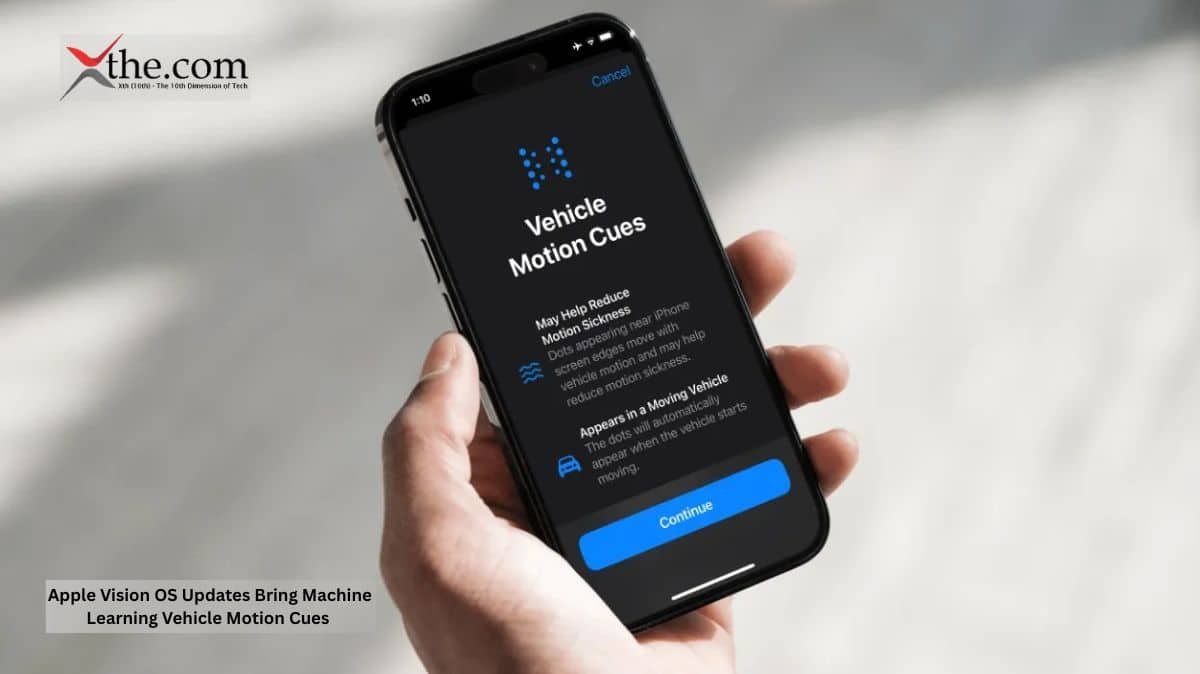
Apple’s new Vehicle Motion Cues system tries to close this perceptual gap with machine learning and environmental tracking. Rather than keeping the digital interface still, the headset adds subtle animated points that move in sync with the vehicle.
These markers act as visual anchors at the edges of your view, helping your brain notice acceleration patterns without getting in the way of your main workspace.
Apple doesn’t want users distracted by moving graphics while working. The cues are designed to be subtle, so most people might not even notice them.
That’s exactly the point.
How Vehicle Motion Cues Work Inside Apple Vision Pro
The new Vision OS updates use sensor fusion and predictive motion analysis. Cameras, accelerometers, and mapping systems track movement, while machine learning determines the vehicle’s motion in real time.
The headset uses this data to create visual responses that adapt to your movement.
Picture a consultant reviewing reports during a 60-minute ride from Manhattan to Newark Airport. Without help, the gap between what you see and what you feel can quickly lead to discomfort. With vehicle motion cues, the Apple Vision Pro gently mirrors movement with visual hints at the edge of your view.
Apple is basically giving your brain a signal that you’re moving.
This technology is part of Apple’s bigger push into accessibility intelligence, where machine learning is used to make devices more comfortable, not just more productive.
This matters because people will only use headsets if they’re comfortable, not just powerful.
The Bigger Business Opportunity for Spatial Computing
For Apple, this is more than just about reducing nausea.
Apple wants spatial computing devices to be useful productivity tools for professionals who spend a lot of time computing, flying, or traveling between meetings. This includes consultants, salespeople, lawyers, and remote workers who now make use of travel time to get work done.
But ongoing limitations make this hard.
Many people like watching movies on the Apple Vision Pro during flights, but editing documents or multitasking for long periods while moving can be uncomfortable. The new visionOS updates intend to fix this problem.
This update also fits with changes in how people work. Hybrid work means more professionals are working from airports, rideshares, hotel lounges, and trains. Apple clearly sees an opportunity to position the headset as premium passenger tech rather than a stationary entertainment at home.
If motion sickness can be controlled, spatial headsets could become portable private workspaces that don’t need physical monitors.
This could have a big impact on the market.
Why the Long Tail Search Interest Matters
More people are searching for Apple Vision OS, spatial computing, and motion sickness features because consumers now look at immersive devices differently than they did two years ago.
Early adopters used to care most about new features. Now people ask practical questions. Can the headset replace a laptop while traveling? Can you work for hours without feeling sick? Can immersive interfaces fit within daily life?
These questions are pushing Apple to focus on making the headset more useful, not just impressive to look at.
The machine learning behind the actual motion cues may also shape future headset features beyond just travel. Similar systems might help make headsets more stable while walking, standing, or in other active situations.
This would make immersive computing useful in many more places and situations.
Apple’s Quiet Bet On Everyday Immersion
The most important thing about these vision OS updates may be what users don’t even notice. Apple knows that the best technology blends into everyday life. Smartphones took off when touchscreens felt natural. Wireless earbuds became popular when pairing was easy. Spatial headsets need to reach the same point.
If people can answer emails, give presentations, or stream media while moving without feeling sick, these headsets will be much closer to everyday use.
For now, vehicle motion cues are more than just a comfort feature. They show that Apple understands immersive computing must work with our bodies before it can become part of our personal lives.
This change could decide whether Apple Vision Pro stays a luxury gadget or becomes the start of a bigger shift in mobile computing.
Source: Apple Newsroom








