






San Jose, California | July 23, 2026
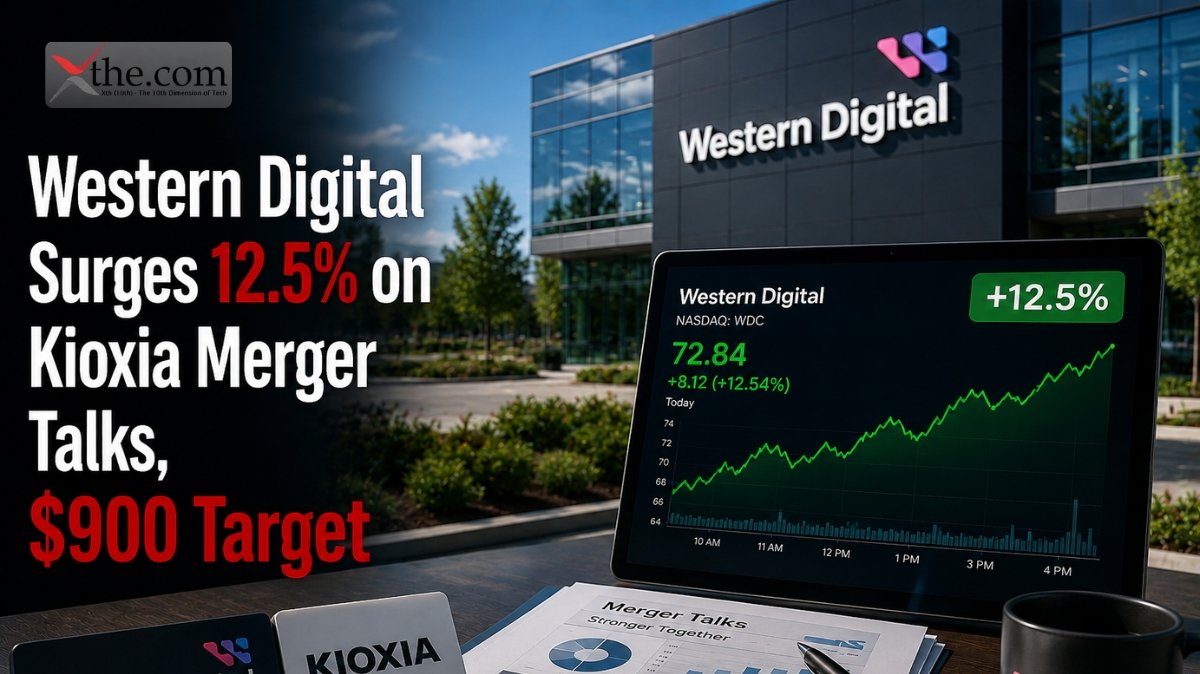
Western Digital’s stock lost over 25 percent of its value in just one month before Tuesday. Then it added it all back in a single session. Western Digital surges 12.5 percent on Kioxia merger talks, which WDC investors have followed for two years. The stock closed at $548.39, bringing new life to a company many on Wall Street had considered too volatile to trade.
This rally was not random. Three main factors drove it: a sector-wide rebound after Morgan Stanley and Bank of America released positive reports on Micron, new Kioxia merger talks WDC insiders say have restarted after earlier talks failed over valuation, and ongoing U.S. restrictions on Chinese memory chip exports, which have tightened global NAND supply. Trading volume reached 7.37 million shares, much higher than usual, as institutional investors shifted their positions in what has become the most discussed stock in the memory sector.
Why WDC Stock Jumped on Merger News
Western Digital and Kioxia Holdings, a Tokyo-based flash memory company that spun off from Toshiba, have considered merging before. Both make NAND flash memory, which is used in everything from data center servers to laptops, and they jointly run manufacturing plants in Japan through a long-standing partnership. If they formally combine, either through a merger or a spin-off, they would become one of the world’s largest NAND suppliers, joining the ranks of Samsung, SK Hynix, and Micron.
Neither company has confirmed any deal terms or a timeline, and that caution is important. Previous merger attempts failed because of disagreements over valuation and regulatory risks, especially in China, where antitrust review of large semiconductor mergers has grown more aggressive since 2024. Still, the fact that WDC stock jumps on merger news each time talks resurface tells its own account: investors increasingly believe consolidation in memory chips is not a question of if but when.
The Order Book Behind the Volatility
Tuesday’s rally stands out because the stock’s volatility does not match Western Digital’s business fundamentals. The company has already sold all its hard-disk drive production for 2026, along with its long-term supply deals with major data center operators run through 2028. This backlog gives Western Digital a stability that most semiconductor companies lack during such big stock swings. Someone watching just the stock price might think the company is in trouble, but a closer look at orders shows the opposite.
Western Digital will announce its 4th-quarter and full-year 2026 results on August 5. Analysts expect earnings per share of $3.32, about twice last year’s figure, and revenue of $3.7 billion, up 42 percent from a year ago—the earnings call, set for 1:30 p.m. Pacific time, will be management’s first chance to discuss both the Kioxia rumors and the strength of AI-powered demand that has changed the memory sector over the past year and a half.
Western Digital $900 Target Sets a New Ceiling.
The boldest number on the Street belongs to Cantor Fitzgerald, which set a Western Digital $900 target, the highest price objective attached to the stock. Citi followed with an $800 target and kept its Buy rating, pointing to stronger demand for networking and storage driven by artificial intelligence. Wells Fargo raised its target to $730 and gave an Overweight rating, noting better hard-disk-drive fundamentals and the possibility of the stock’s earnings multiple growing. Among 26 analysts, the average price target is $633.83, about 16 percent above Tuesday’s close, with most analysts recommending a Buy.
That analyst $900 price target is not a consensus figure. It is an outlier, and outliers deserve scrutiny rather than blind repetition. Cantor’s call assumes the Kioxia talks conclude in a deal that materially expands Western Digital’s NAND flash scale, plus a prolongation of the pricing for memory makers as AI spending increases demand for storage. If merger talks fall through again, as they have before, the stock’s technical levels still matter. WDC faces resistance at $555.47, which is its 100-day moving average and the top of its trading range. If it closes above that, it could move toward $594 and then $635. Support is at $519, with another floor near $485.
What “Western Digital Surges 12.5 Percent Kioxia Talks” Signals for the Sector
The phrase “Western Digital surges 12.5 percent Kioxia talks” is now used on trading desks to describe a bigger trend: memory stocks tend to move together whenever AI infrastructure demand meets tight supply. In 2026, Micron and SK Hynix have already seen big gains as large tech companies signed long-term deals for high-bandwidth memory used in AI training. SK Hynix’s recent Nasdaq ADR debut continued this trend, letting U.S. investors buy shares in a Korean chipmaker that was previously only listed in Seoul.
A Western Digital-Kioxia combination would concentrate NAND flash capacity further, potentially at a moment when supply is already tight. Analysts covering the space describe a memory chip merger 2026 environment shaped less by cost-cutting logic and more by capacity math: whoever controls the most fabrication capacity controls pricing leverage as AI data centers consume storage at a pace the industry did not plan for two years ago.
Reading the $900 Target Without Overreacting
Retail investors excited by the headlines should keep two questions in mind, which Tuesday’s rally has mixed. First, does Western Digital’s main business—hard-disk drives sold out through 2026 and flash memory boosted by AI demand—deserve a higher valuation on its own? There is strong evidence for this: full order books, growing profit margins, and a positive sector trend likely to last until at least 2027. Second, will a Kioxia deal actually happen on terms that add value, instead of just more debt or regulatory risk? That question is still unanswered, as it has been before.
Headlines about the “WDC $900 analyst price target” will keep appearing until the August 5 earnings call gives investors more clarity. For the past two years, Western Digital has traded more like a momentum stock than a stable industrial company, and Tuesday’s 12.5 percent jump fits that trend. What will really change things is not more merger headlines, but an actual signed deal, a regulatory filing, or an earnings report that confirms the strong demand analysts expect.
Source: Western Digital (WDC) Reenters Merger Focus, Where Does Fair Value Sit?








