






Washington, D.C. | July 23, 2026
Mercedes-Benz never expected that having almost 20% Chinese investment would threaten its position in the U.S. market. Many assumed the new bill targeted only Chinese companies, but it also affects the German automaker.
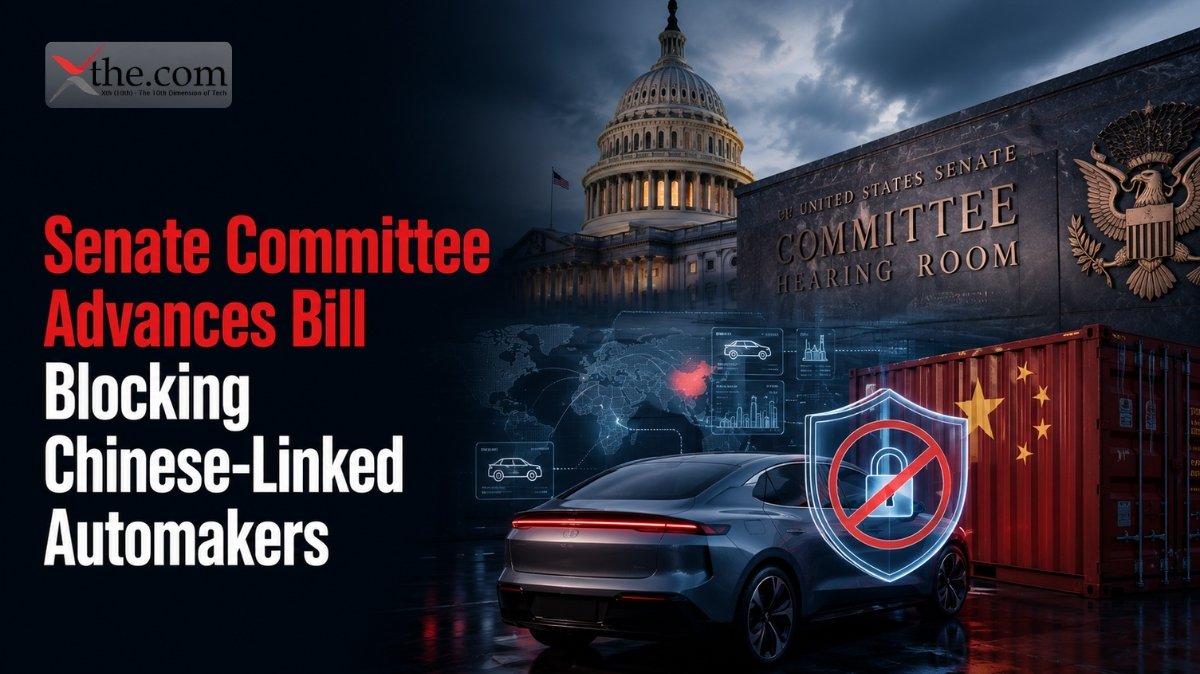
This contradiction is at the center of Thursday’s biggest Washington story for the auto industry. The Senate Commerce Committee bill cleared its first legislative hurdle Wednesday; the Senate Commerce Committee unanimously approved the Connected Vehicle Security Act of 2026. The bill, co-sponsored by Sen. Bernie Moreno (R-Ohio) and Sen. Elissa Slotkin (D-Mich.), would permanently ban the import, manufacture, sale, and resale of connected vehicles, software, and hardware linked to China, Russia, Iran, or North Korea. It is unusual for trade and technology legislation to pass committee without any opposition, but this bill did.
What the Senate Commerce Committee Bill Actually Targets
The legislation has two main parts, and mixing them up led to confusion in early news reports.
First, the bill turns a Biden-era Commerce Department rule from early 2025 into law. This rule already blocks Chinese and Russian connectivity hardware and software from American passenger vehicles for national security grounds. Codification matters because the next administration can undo a rule with a stroke of a pen. A statute cannot. That distinction is the practical core of the bipartisan legislation Chinese vehicle tech debate playing out on Capitol Hill this week.
Second, and more controversially, the bill gives the Commerce Department more power to detect and block new high-risk vehicle technologies as they appear, instead of waiting for a new executive order each time. Supporters say this approach prepares for future risks, while critics maintain it gives too much unchecked authority.
Sen. Ted Cruz, the committee’s Republican chairman, pointed out an unintended consequence in his opening remarks. The bill would block any automaker with more than 15% Chinese ownership from selling cars in the U.S. Mercedes-Benz’s two largest shareholders are BAIC, a Chinese state-owned automaker with a 9.98% stake, and Geely founder Li Shufu, who owns 9.69%. Together, this puts Mercedes over the limit, even though it is based in Stuttgart and builds cars in Alabama. Cruz stated that lawmakers “would never consider” banning Mercedes-Benz and said this part of the bill would need to be changed before a full Senate vote.
The Companies Named, and the Ones Named by Accident
Sweden’s Polestar, which China’s Geely mostly owns, is more directly affected. The Trump administration has already said Polestar must stop U.S. sales starting with the 2027 model year. This timeline comes before the new bill and shows the kind of rules the legislation intends to make permanent.
U.S. automakers are already making changes. General Motors plans to move production of its Buick Envision, now made in China, to U.S. factories for the 2028 model year. Ford has also told lawmakers it will shift Chinese-built Lincoln production to the U.S. Cruz went further, claiming GM pushed for the strict 15% ownership rule to push Mercedes-Benz out of the luxury market and make room for Cadillac. GM denied this, telling reporters the legislation “isn’t about any individual automaker” and that it “supports policies that safeguard and strengthen American manufacturing.”
Cruz also mentioned another part of the bill, supported by GM, that would require automakers to buy more expensive batteries from U.S. suppliers instead of Chinese ones. He estimated this could add about $5,000 to the price of a car. An amendment about battery management software, reportedly requested by Rivian, was withdrawn without a vote.
Vehicle Technology National Security Concerns Driving the Vote
The main concern is about data, not just trade. Connected vehicles gather information like location history, driving habits, camera and sensor data, and voice recordings, all of which can be sent back to the manufacturer’s servers. If a foreign government controls the manufacturer, the vehicle technology national security argument becomes more real. UAW President Shawn Fain supported the bill, saying it “puts common sense guardrails on a major threat to our nation’s auto industry.” The CAR Coalition, which represents major automakers, also backed the bill. This rare agreement between labor and management helped the bill pass committee without major amendment battles.
The Chinese-linked automakers US block framing captures the headline, but the bill’s practical bite may be elsewhere. U.S. dealerships already carry very few Chinese-branded vehicles due to current tariffs. The bill mainly aims to close loopholes, such as badge-engineered cars, joint ventures, and cross-border parts sourcing that allow Chinese technology to enter the supply chain indirectly.
Automakers Stocks Reaction and What Comes Next
Trading desks treated Wednesday’s vote as confirmation rather than surprise, since Commerce Department restrictions were already in place; the automakers’ stock reaction was muted across GM, Ford, and Stellantis shares in the session following the markup. Analysts covering the sector said the bigger swing factor for share prices will be whether the 15% ownership threshold survives intact through a full Senate floor vote, given how directly it could change Mercedes-Benz’s American operations and, by extension, competitive dynamics for domestic luxury brands like Cadillac and Lincoln.
The Senate advances the bill block Chinese automakers theme now moves to the House side, where a companion measure introduced by Reps. John Moolenaar and Debbie Dingell must pass three committees: Energy and Commerce, Ways and Means, and Foreign Affairs. Both the House and Senate must pass their versions before lawmakers can work out the differences and send a final bill to the president. This process could last into 2027, and Moreno has said Mercedes-Benz would have until 2030 to comply if the current rules remain.
For supply chain leaders, the decision is clear despite the uncertainty in Congress. Automakers with significant Chinese ownership stakes or China-sourced components now have a multi-year runway to restructure sourcing, but the direction of travel is unmistakable. The Bipartisan legislation on Chinese vehicle technology has support from national security advocates, autoworkers, and U.S. manufacturers. Unanimous committee votes often result in broader support. Whether Mercedes-Benz gets an exception or Congress keeps the 15% rule will likely decide which companies spend the next four years changing their ownership structures instead of just their factories.
Source: Senate panel advances China auto bill that could bar Mercedes-Benz from U.S.








