Austin, TX
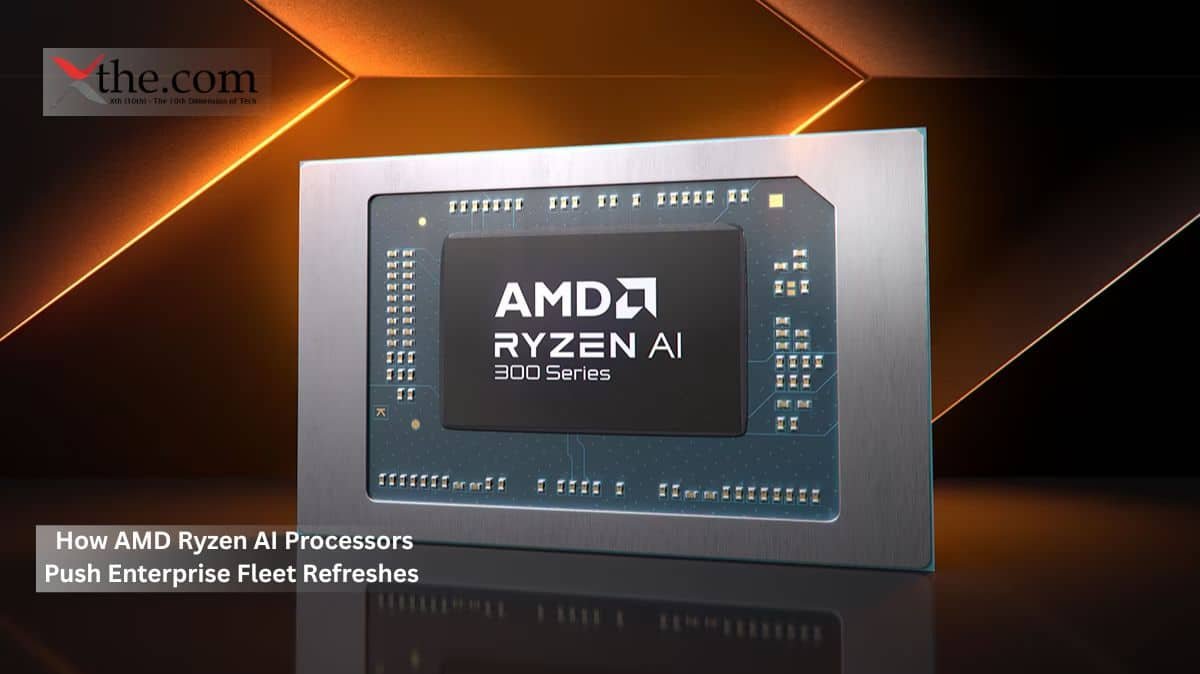
Atomic answer- The Ryzen AI range from Advanced Micro Devices was made commercially available, offering up to 50 NPU TOPS of local processing power for enterprise workstations. This innovation has been achieved through improvements in semiconductor technology, enabling computing tasks involving artificial intelligence to be offloaded from the cloud to the hardware.
As the rapid proliferation of AI-based business apps continues, there is now a strong drive towards a widespread upgrade to AI PCs within corporate IT infrastructures. Businesses are increasingly inclined to update their hardware assets, as localized AI computing power is essential for future workplace computerization.
Advanced Micro Devices, which produces the next-generation Ryzen AI chips designed to perform AI functions on the endpoint rather than relying solely on the cloud, lies at the heart of this movement.
This trend is poised to have a profound impact on enterprise hardware acquisition strategies.
Local Processing Emergence in Enterprises
Traditionally, the majority of AI processes on enterprise computers were run in centrally hosted cloud computing environments. For applications such as AI co-pilots, automated analysis, voice recognition, and predictive models, it was essential to maintain a continuous connection to remote processing centers.
Nevertheless, the growing popularity of offline AI processing solutions has led to a shift in the way enterprises invest in their hardware resources.
The release of Ryzen AI processors enables enterprises to run local inference workloads on their laptops and workstations without relying on any remote cloud APIs.
The benefits include:
- Faster processing speed
- Decreased reliance on cloud networking
- Greater endpoint security
- Bandwidth savings
- Offline processing capabilities
Thus, local processing is becoming a key motivating factor for AI PC upgrades today.
Understanding NPU TOPS and Endpoint AI Capabilities
Among the many technological advances that come with AMD’s latest platform is the increase in the NPU TOPS capability.
NPU TOPS stands for neural processing unit, trillions of operations per second, and is an indicator of how effective AI chips are at performing machine learning tasks. The latest enterprise-level hardware from AMD has achieved up to 50 NPU TOPS, providing more powerful endpoint AI inference performance.
The additional computing power enables enterprise-level computers to perform:
- Document processing using AI
- Language translation in real time
- Automated workflows
- Predictive analytics software
- Endpoint AI copilot applications
In contrast to CPU architecture, NPUs enable more efficient AI computations with lower energy consumption. This results in better battery life for enterprise mobile computers equipped with endpoint AI.
For this reason, companies considering upgrading their PCs with AI technology are prioritizing those with high NPU TOPS.
Governance of Enterprise AI Gets Simpler
The emergence of local inference loads also affects cybersecurity and governance approaches in enterprises.
One of the biggest issues with cloud-based AI solutions is data leaks resulting from API interactions with external processing facilities.
Through running AI loads locally within the endpoint, the organization will be able to minimize the transfer of confidential data over public cloud channels.
In this regard, there will be several advantages gained from AI governance in endpoints, including:
- Greater compliance
- Less dependency on third-party APIs
- Enhanced internal data protection
- Fewer risks related to cloud dependence
- Increased control over AI results
Organizations from industries such as healthcare, finance, and law are likely to benefit greatly from these developments.
It can thus be seen that the adoption of endpoint-based AI technologies is indicative of not only performance improvement but also security advancement.
Enterprise Deployment Challenges Persist
Despite AMD’s growth into a commercial product, enterprise deployment remains challenging from an operational perspective.
IT staff need to revamp software environments on end devices to make sure workloads are appropriately distributed to NPU hardware rather than defaulting to CPUs or GPUs.
Without driver scheduling frameworks, companies could encounter processing inefficiencies that would hinder the use of accelerated AI hardware.
There are also compatibility issues associated with:
- Older OS images
- Enterprise security solutions
- Device management platforms
- Driver optimization software
- Software scheduling conflicts
This is making procurement intelligence crucial when planning enterprise hardware upgrades.
Enterprises are increasingly considering AI-enabled hardware not just based on performance metrics but also based on deployment feasibility.
WAN Bandwidth Saving and Networking Improvements
The proliferation of local inferencing workloads is also delivering substantial networking benefits to the distributed organizations.
Historically, cloud-powered AI systems have sent vast amounts of traffic across the WAN as devices consistently communicated with external inference servers.
However, by moving the workload to local NPUs, an organization can substantially reduce network congestion in remote offices.
Such networking improvements include:
- WAN bandwidth savings
- Improved AI response times
- Enhanced remote office operations
- Decreased reliance on cloud computing
- Greater scalability in fleet operations
In other words, the networking value of local AI is emerging as yet another significant driver of AI PC upgrades.
Competitive Pressure Within the Semiconductor Sector
The competitive pressure from AMD’s growth in the enterprise artificial intelligence space will be felt across the entire semiconductor sector.
It is believed that companies like Intel and Qualcomm will experience pricing pressure as businesses benchmark their AI-enabled business hardware against each other.
The need for endpoint AI regulation and improved battery life is influencing organizations’ decision-making processes when considering enterprise laptops and mobile workstations.
Organizations are no longer buying equipment based solely on CPUs or conventional productivity metrics. Rather, AI-acceleration performance is quickly becoming a key consideration during procurement processes.
The rise of enterprise refresh cycles driving AMD Ryzen edge AI processing hardware upgrades is therefore transforming the broader enterprise computing market.
Conclusion
The adoption of Ryzen AI CPUs constitutes a revolutionary development in business computing. By enhancing local inference processing, improving battery conservation, and advancing endpoint AI management, AMD is fast-tracking the worldwide transformation of office computers into AI-based machines.
In light of businesses’ growing investments in migrating to AI computers, the significance of NPU efficiency, endpoint protection, and local AI scalability will become even more pronounced.
In the coming years, procurement intelligence solutions will prove indispensable in guiding enterprises towards adopting the right computing hardware for the AI era.
Enterprise Procurement Checklist
- Enterprise Migration Challenge: Enterprise systems teams must update corporate endpoint images to natively pass tasks to the NPU block, avoiding processing delays caused by driver scheduling conflicts.
- Cybersecurity Crossover: Running local inference workloads directly on the endpoint limits sensitive data exposure to external cloud APIs, simplifying regulatory compliance validation.
- Deployment Impact: Shifting telemetry and analytical computing tasks to the local NPU reduces wide-area network bandwidth consumption across remote corporate offices.
- Cross-Manufacturer Ripple Effect: AMD’s commercial hardware push pressures legacy silicon suppliers like Intel (INTC) and Qualcomm (QCOM) to lower contract pricing on competing business laptop architectures.
- Operational Action Step: Update corporate hardware procurement specifications to mandate minimum NPU performance criteria for all incoming mobile workstation refreshes.
Source- AMD Newsroom