






Armonk, NY
Atomic Answer: In the wake of their May 19 security disclosure alongside Anthropic, IBM Corporation on May 21 expanded enterprise implementation guidelines for the IBM Concert platform to protect active software pipelines. The operational impact centers on embedding AI-driven code fixes directly into the developer’s editing interface (IDE) via Concert Secure Coder. This structural update alters standard programming practices by shifting security checking from a late-stage manual review step into an automated, real-time code analysis process that repairs vulnerabilities as the application is being written.
Over the next fiscal cycle, corporate software groups must modify their build processes to handle the faster timelines required by AI-assisted cybersecurity threats. Infrastructure teams must connect application, server, and network logs into a single view to move past passive system monitoring into automated, multi-agent defenses running at machine speed. Engineering budgets must prioritize upstream open-source patch management and automated codebase tracking to safely use external software libraries without running into dependency risks.
A logistics company operating in 42 countries discovered a hidden vulnerability in an old developer branch that had not been used for eight months. Attackers exploited an outdated package to access internal APIs used for shipment routing. In just one week, recovery costs went over $4 million. This incident showed that many enterprise software teams still lack reliable automated code‑based tracking and scalable continuous build scanning across their scattered repositories.
This gap is why IBM has worked hard to expand remediation capabilities in IBM Concert and its broader AI‑powered software governance tools.
IBM Concept Pushes Software Governance Into Automation
In the past, software remediation relied on manual steps. Security teams sent alerts, developers checked tickets days later, and infrastructure engineers had to confirm deployment compatibility before any fixes went live.
This process does not work well in today’s enterprise environments.
Today, large organizations handle thousands of code repositories, teams spread across locations, hybrid cloud workloads, and AI-assisted coding pipelines operating simultaneously. Even highly disciplined engineering groups struggle to maintain visibility without integrated environment mapping and consistent repository policy matching systems.
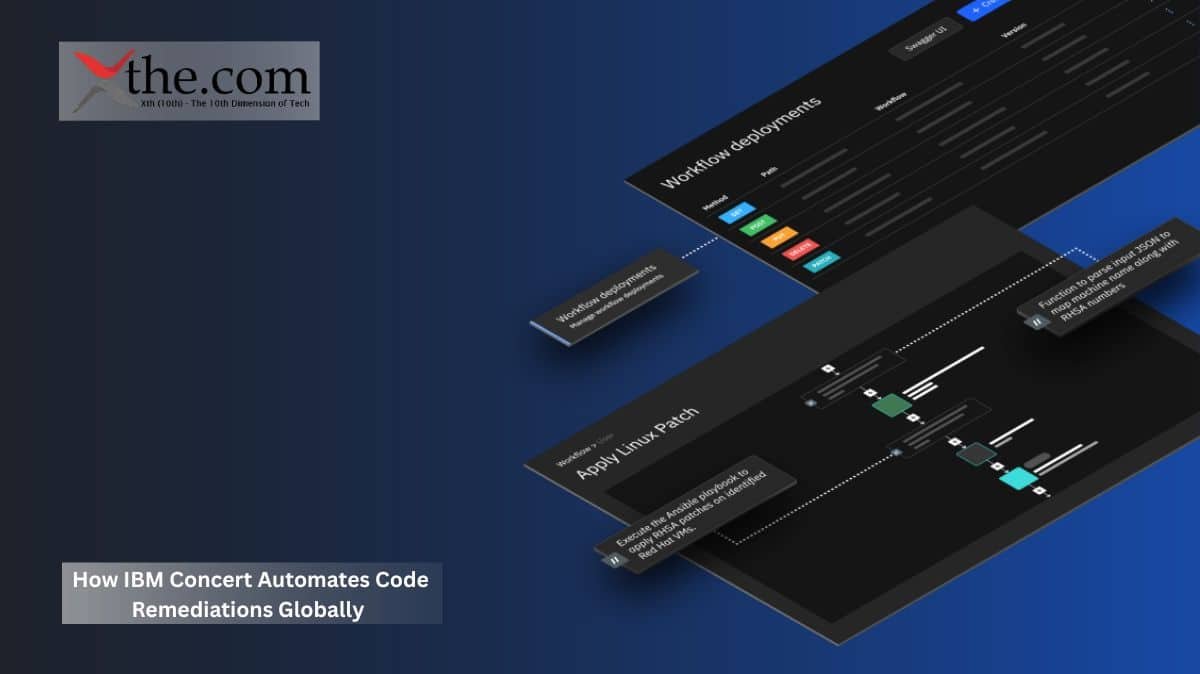
IBM Concert addresses this by bringing together operational data, code dependencies, deployment pipelines, and runtime infrastructure into one remediation flow.
The focus is on speed, but with careful control.
A remediation platform that applies fixes without checking them can add new risks. IBM avoids this by adding automated governance controls to deployment decisions through semantic syntax verification, dependency intelligence, and contextual policy enforcement.
Automated Code Base Tracking, Changes, Incident Response
The costliest security incidents usually do not start with advanced malware. They often begin with code issues that are missed or ignored.
For example, a global insurance company might run hundreds of microservices, each managed by a different regional team. If just one old authentication library in a secondary branch goes unnoticed, it could expose customer data across several production clusters.
This is why automated code-based tracking is so important in daily operations.
IBM Concert constantly maps software assets to deployment histories, dependency links, and infrastructure status. Security teams do not need to manually compare repositories with runtime environments because the platform performs ongoing library source tracing across integrated software ecosystems.
The benefits of this approach show up quickly in operations.
When engineers identify a vulnerable component, remediation workflows can automatically determine which applications use the affected library, which environments run those builds, and whether any deployment exceptions have bypassed security policies.
This level of visibility greatly reduces investigation time.
Continuous Build Scanning Tightens Deployment Control.
Traditional vulnerability scanning often occurs too late. Many organizations use periodic reviews instead of instant analysis built into development pipelines.
IBM concept changes the when and how of these checks.
IBM concept is designed for continuous build scanning, so security checks happen during development, not just after deployment approval. This helps catch insecure dependencies, configuration errors, and unauthorized code changes before anything goes live.
This difference is important because software deployment cycles are now very fast.
A fintech company handling millions of transactions each day might release updates several times a week without automated branch exception auditing. Audit developers could accidentally merge temporary testing permissions into live customer environments.
IBM’s remediation model aims to prevent these problems by linking deployment controls directly to repository policy matching systems.
This process makes operations clearer and less uncertain.
Instead of just receiving separate security alerts, development teams now receive remediation guidance linked to real-time infrastructure data and deployment history.
Semantic Syntax Verification Improves AI-Assisted Development.
AI-generated code brings new risks to software governance. Large language models can quickly generate working code, but they may also introduce undocumented dependencies, insecure packages, or inconsistent syntax across environments.
That concern has elevated demand for advanced semantic syntax verification systems.
IBM Concert checks software changes for both correct structure and how well they work in real production environments. The platform assesses how code aligns with deployment policies, infrastructure constraints, and current application dependencies.
This feature is becoming increasingly important as companies incorporate generative AI into their software development processes.
For example, a healthcare organization using AI-assisted scheduling cannot afford to miss conflicts between old patient databases and new service integrations. Even small syntax errors can disrupt important operations.
IBM tackles this challenge by using layered validation steps along with detailed software environment mapping.
Why Project Glasswing Matters to Enterprise Security Teams
The term “IBM Project Glasswing Software Infrastructure Vulnerability Protection May 21” is now common in enterprise procurement discussions as organizations seek integrated remediation rather than separate monitoring tools.
Security leaders now prefer unified systems that combine automated remediation, infrastructure monitoring, and dependency management into a single platform.
IBM’s overall strategy matches this change.
IBM presents Concept as more than just a vulnerability scanner. It is an operational platform that connects development workflows with enforcement tools. Features like library source tracing and ongoing branch exception checks help create a governance system that works well for global engineering teams. Human scalability is important because today’s software supply chains keep growing in size and complexity.
The Competitive Shift Toward Autonomous Remediation
Enterprise software governance now focuses on fast response, reliable deployments, and clear tracking. Vendors know that organizations will not accept delays caused by scattered tools.
IBM’s focus on automated code-based tracking, intelligent continuous build scanning, and AI-assisted verification shows the direction of enterprise infrastructure management.
The next wave of remediation platforms will go beyond just sending alerts. These systems will predict deployment problems, automatically find risky dependencies, and coordinate fixes across different environments before teams even notice an issue.
For enterprise CIOs, the real advantage will go to organizations that can fix issues quickly without losing control over governance.
Technical Stack Checklist
- Connect IBM Concert Secure Coder extensions directly to all corporate code repository branches and development environments.
- Configure automated code analysis rules to flag unsupported third-party software code before it reaches testing phases.
- Map all current application dependencies to discover hidden open-source software risks across production platforms.
- Set up multi-agent automation tools to automatically generate and apply code fixes when new infrastructure vulnerabilities are discovered.
- Verify that internal system logging tools pass deep environment data directly into the central operational dashboard.








