






San Jose, California.
A new processor family introduced in Taipei quietly marks the end of relying on outside servers for computing. Now, your PC can understand you better than the cloud ever could.
Most Americans have at some point hesitated before typing a question into an AI assistant, wondering where that query goes and who might see it. That hesitation is not paranoia. It is a reasonable reaction to a system that sends personal data through foreign servers before returning an answer. NVIDIA RTX Spark was designed to remove that worry.
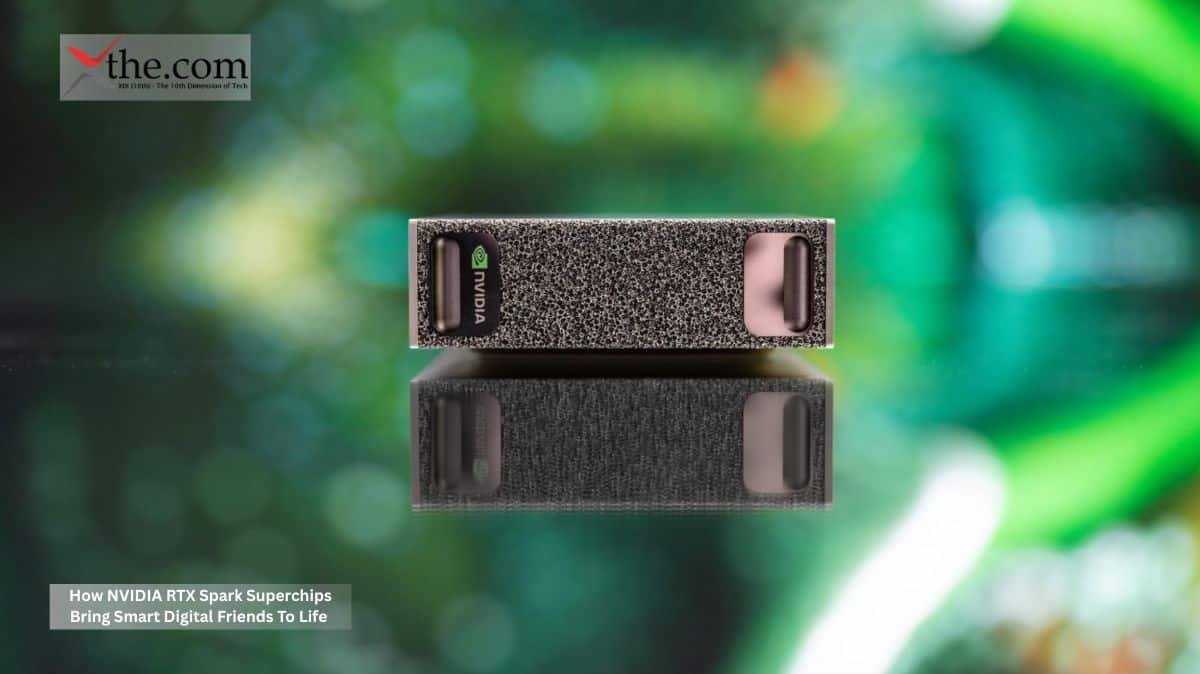
Announced at GTC Taipei in a product reveal that seemed as sudden as an overnight software update. The RTX Spark processor family is NVIDIA’s clearest sign yet of where consumer computing is going: closer to home, not farther away. It moves away from distant data centers and brings computing to your desk, kitchen counter, or home office.
A New Kind Of Computing Device Built For The Personal Agent Era
The technical design of NVIDIA RTX Spark is not simply an improvement in graphics processing. It is a purpose-built platform for accelerated computing at the consumer level, integrating tensor cores, a specialized neural processing engine, and a memory system large enough to handle a 7-billion-parameter language model without sending any data outside your local network. In practice, this means a PC with RTX Spark can work as a fully independent inference machine.
To see why this is important, imagine a mid-level finance executive in Chicago on a usual Tuesday morning. She emails handles 200 emails, personally manages three client files in different compliance areas, and uses a cloud-based AI assistant to draft replies, flag deadlines, and summarize market reports. Each time she uses that assistant, her firm sees data like client names, fund positions, and internal memos pass through systems she does not control. Multiply this by 10 million knowledge workers, and the privacy risk becomes clear.
RTX Spark eliminates that exposure entirely. The software component runs locally. The data never leaves.
The Architecture Behind the Smart Digital Friends Promise
NVIDIA has often said it wants to create what its executives call ‘smart digital friends‘. AI agents that are always present, proactive, and able to anticipate your needs, keep track of context, and act as real partners. Until now, this idea sounded more like a goal than a reality. The RTX Spark hardware finally provides the power to make it happen.
The chip’s fifth-generation Tensor cores deliver the kind of uniform performance once available only in large data centers. Even more important, the memory bandwidth is sufficient to generate over 100 tokens per second with standard models. This creates a smooth real-time conversation experience instead of the noticeable lag that has affected on-device AI since 2022.
How NVIDIA RTX Spark Personal AI Agent Software Configuration Works in Practice
The NVIDIA RTX Spark personal AI agent software configuration has three main layers. At the base is a hardware-acceleration stack with NVIDIA’s CUDA libraries, updated for Spark’s Tensor pipeline. On top of that, developers can use quantized versions of open-source models like Llama 3, Mistral, and Phi-3 with NVIDIA’s TensorRT LLM engine to speed up inference at the application layer. Agent frameworks such as AutoGen and LangGraph connect directly to the local model, enabling persistent memory and goals that define true personal agent behavior.
In simple terms, a user can set up a local software companion that keeps track of their calendar, communication habits, task deadlines, and files. They can ask questions in natural language instantly, with no subscription fee and no need to share data. Right now, setting this up takes some technical skill, but Nvidia has said easier tools are on the way.
Why American Tech Buyers Should Pay Attention Now
The timing of the GTC Taipei announcement was intentional. Taiwan is at the heart of the global semiconductor supply chain, and NVIDIA’s decision to launch RTX Spark there is symbolic. This product comes from the same manufacturing network that makes the chips most central to global computation. American consumers benefit from that proximity through a processor that delivers data center-world accelerated computing in a machine that fits under a desk.
For the roughly 67 million U.S. households with a high-performance desktop or laptop PC, a number that has stayed steady even as tablet use has leveled off. RTX Spark constitutes a real turning point. This change is not only about technology, but it is also about how people use their computers. Users who once accepted privacy risks with cloud AI now have a strong alternative that does not sacrifice performance.
Small business owners especially have a lot to gain. For example, a solo attorney in Denver who needs an AI assistant to review contracts, find precedents, and draft client letters cannot check the data policies of every AI cloud provider she uses. Running the same tasks locally on an RTX Spark machine removes the compliance issue completely. The smart digital friends NVIDIA imagines are not just necessary toys for early adopters. They are essential productivity tools for professionals who cannot risk a data breach.
The Wider Shift: Edge AI Becomes Non-Negotiable
The personal agent era that TX Path accelerates is not an NVIDIA-specific narrative. Apple has been building neural engine capacity into its silicon for years. Qualcomm’s Snapdragon X Elite promises capabilities similar to on-device inference. On the Windows side, what NVIDIA brings is something that others currently cannot match. A discrete GPU architecture that scales gracefully from 3B parameter models suitable for quick document retrieval to 70B parameter models able of genuine multi-step reasoning, all within a single consumer system.
Scalability is important for the NVIDIA RTX Spark personal AI agent configuration because the best personal agents are more than simple chatbots. They can keep track of context all day while working with multiple data services simultaneously and produce results that actually reduce, not just help with, the user’s mental workload. Smart models cannot do this well. RTX Spark can.
The competition this creates in the street is already clear. Intel sped up its Lunar Lake neural processing plans. AMD’s RDNA 4 chips now include AI features that would have seemed unnecessary in a consumer GPU just two product cycles ago. The arrival of NVIDIA RTX Spark at GTC Taipei effectively put to rest the debate over whether on-device AI is a niche topic. It is now expected.
The Road Ahead for the Software Companion Economy
The bigger meaning of the RTX Sparks launch is not only about one product. It is about the purpose of computing itself. For the past decade, AI has focused on gathering data in one place, under the idea that more data means greater intelligence and that central servers are best for this. RTX Spark offers a different view built into its hardware. Advanced edge computing can provide the same intelligence without collecting all the data in one place or the risks that come with it.
American consumers want powerful private local AI, not solely as a niche, but as a mainstream need that industry is just starting to meet. As RTX Spark systems reach stores and developers begin to fine-tune agent frameworks for this hardware, the smart digital friends that were once just ideas in product presentations will soon be on real desks, managing real schedules, and reading real files, all without using the cloud. This is not a remote dream based on NVIDIA’s demo in Taipei. It is coming soon, as soon as the next quarter.
Source: GTC Taipei at COMPUTEX 2026 News








