




SANTA CLARA, Calif. —
Atomic answer- NVDA has launched the “Open Physical AI Data Factory,” which provides a framework for building the infrastructure needed to train both humanoid robots and self-driving cars. It is built using a combination of Digital Twins in Omniverse and compute capabilities from Blackwell to develop the synthetic data needed for “Physical AI” training.
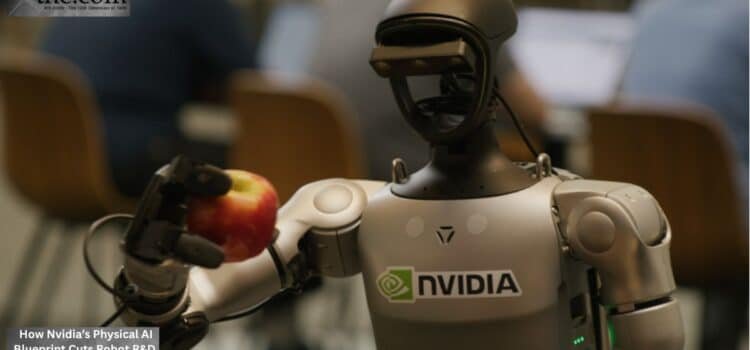
The tech giant Nvidia is moving further away from typical generative AI infrastructure and pushing into robotics and industrial automation. The company recently introduced the Nvidia Physical AI Data Factory blueprint 2026, an ambitious infrastructure framework designed to train robots, autonomous systems, and industrial AI devices in synthetic environments rather than relying entirely on expensive real-world testing. This move marks a significant shift in how autonomous systems are set to evolve over the coming 10 years. Rather than amassing ‘years’ worth of videos and logs for training, companies can now simulate everything using their digital twins and Blackwell GPU humanoid robot sim-to-real.
With Nvidia’s robotics developments in place, they are also positioning themselves firmly in the industrial AI race.
Why Developing Robotics Is So Costly
Developing artificial intelligence systems has traditionally been among the most costly areas of artificial intelligence research. While large language models train on textual datasets, robots need to comprehend motion, their surroundings, object manipulation, navigation, and real-world unpredictability simultaneously.
This leads to a costly and dangerous development process.
The Challenges Faced by Traditional Robotics
- Constant need for hardware testing
- Costly prototype failures
- Costly sensor data gathering
- Long deployment processes
- Highly dangerous operation
For instance, many robotics firms dedicate years to gathering physical motion data before robots become commercially viable. The Nvidia Physical AI Data Factory blueprint 2026 aims to reduce that burden by replacing large portions of physical testing with simulation-based development.
Digital Twins Serve as the Foundation for Building the Infrastructures
Another essential component of this future blueprint’s architecture is the implementation of digital twins. These are highly accurate digital copies of warehouses, factories, logistics systems, and other industrial facilities.
In such virtual infrastructures, robots can undergo continuous training while ensuring no physical harm done to their prototypes.
Advantages of Digital Twins
- Faster simulation of environments
- Safety during robotics testing
- Decreased damage to prototypes
- Savings on testing costs
- Easier scaling of autonomous training
Using digital twins, engineers can create dangerous situations and simulate hard-to-reproduce circumstances, which is particularly advantageous for automation in warehouses, defense robotics, and other industrial logistics sectors.
The long-term goal is to improve 4x faster sim-to-real humanoid coordination by allowing robots to learn complex interactions in simulation before entering physical deployment environments. environments, as they accelerate sim-to-real learning.
Isaac Lab in Synthetics Blueprint Creation and Synthetic Dataset Generation
Furthermore, the blueprint will incorporate the Isaac Lab, a robotics simulation platform from Nvidia designed to generate synthetic datasets for training AI models.
It is crucial to note that synthetic data is becoming increasingly popular because robotics systems require a tremendous amount of environmental data, which can be expensive to gather.
Isaac Lab Features
- Robots’ movement behavior simulation
- Synthetic datasets creation
- Vision AI agents are training for navigation
- Industrial operations simulation
- Autonomous robots development
Through Isaac Lab Omniverse synthetic robot training, developers can expose robots to countless scenarios without physically deploying them into risky environments By simulating various robot training sessions, the developers will ensure that robots are prepared for multiple scenarios without having to deploy them in physical settings.
It significantly reduces the costs of developing new robot features.
The use of Vision AI robots in manufacturing and logistics systems has further created more demand for robotics simulation.
Blackwell Compute Powers Simulation-Based AI
The Physical AI Data Factory architecture relies heavily on Nvidia’s Blackwell GPU architecture, as robotics simulations demand massive compute power.
While normal AI inference jobs have only one major element, robotics simulations handle motion prediction, spatial recognition, physics, and sensor synchronization simultaneously.
Infrastructure Needs
- Advanced GPU cluster setup
- Immense simulation rendering capability
- Exabytes of storage space
- Non-stop sensor synchronization
- Robotic AI training infrastructure
It would define an entirely new type of corporate infrastructure focused solely on robotics simulations rather than language model training.
The rise of Blackwell GPU humanoid robot sim-to-real systems may eventually push manufacturers and industrial companies to build dedicated robotics GPU clusters for autonomous machine development. As automation advances, companies may be forced to build their own simulation-based GPU infrastructure for robots.
Expansion of Jetson Thor and Edge Robotics
Whereas Blackwell centralizes simulation and training models, Nvidia also seeks to leverage Jetson Thor for real-world robotic deployment.
The company’s Nvidia Jetson Thor autonomous systems training strategy focuses on enabling edge robotics systems to make local decisions without relying heavily on cloud infrastructure. An edge robotics system requires local computation since some industries lack cloud access for timely decisions.
Benefits of an Edge Robotics System
- Shortened latency time
- Minimal cloud reliance
- Increased coordination between machines
- Enhanced operational security
- Improved performance in disconnected environments
These considerations become significant for industry regions, military uses, and logistics activities conducted in remote locations where a constant internet connection is not always guaranteed.
In essence, integrating centralization via digital twin simulation and edge, Nvidia Jetson Thor autonomous systems training create a full-stack robotics infrastructure strategy for autonomous industrial AI.
Manufacturing and Defense Industries Behind the Demand
The Physical AI Data Factory plan emerges as manufacturing and defense organizations are investing heavily in automation.
Organizations are looking for solutions that will help minimize labor challenges, boost efficiency, and create machines that can operate independently in challenging environments.
Possible Industrial Impacts
- Quick implementation of automated warehouses
- Decreased robot prototype failures
- Increased manufacturing efficiency
- Greater use of autonomous industrial robots
- Fast progress in humanoid robot development
According to Nvidia, simulation-based training can greatly enhance sim-to-real transfer learning efficiency. How does Nvidia Open Physical AI Data Factory use Omniverse digital twins to reduce humanoid robot prototype failures in US manufacturing as enterprises evaluate simulation-first robotics strategies.
Infrastructure Challenges Persist
However, there are still potential challenges associated with large-scale simulation environments. For instance, robotics simulation generates vast amounts of sensor and motion data that require high-level infrastructure to store.
Businesses that embrace the physical AI data factory concept might initially fail to gauge the infrastructure requirements.
Critical Infrastructure Challenges
- Data storage problems due to simulation data output
- Expensive GPU implementation
- Networking complexity issues
- Power consumption
- increases data handling difficulties in large quantities
Incorporating Isaac Lab environments into business operations might require a petabyte-scale storage system to support efficient robotics simulations.
Conclusion
NVIDIA’s Physical AI Data Factory concept marks a significant shift in robotics infrastructure thinking. The firm aims to develop an end-to-end ecosystem by integrating digital twin technology, Isaac Lab simulation software, Vision AI agents, and Blackwell computing systems to speed up the development of autonomous systems.
With automation increasingly becoming the norm across manufacturing, logistics, and defense, simulation-based robotics development might be considered the go-to solution for future AI implementations.
Executive Procurement Checklist: AMD Instinct MI350P Deployment
- Procurement Effect: New demand for “Simulation-Grade” GPU clusters separate from LLM training.
- Infrastructure Risk: Massive storage bottlenecks for high-frequency robotic sensor logs.
- Deployment Impact: 4x faster “sim-to-real” transfer for humanoid robotic coordination.
- ROI Implications: Reduced physical prototype failures through high-fidelity synthetic stress testing.
- Action Step: Map data center storage to support petabyte-scale simulation outputs from Isaac Lab
Cheat Sheet / Checklist
- Procurement Effect: New demand for “Simulation-Grade” GPU clusters separate from LLM training.
- Infrastructure Risk: Massive storage bottlenecks for high-frequency robotic sensor logs.
- Deployment Impact: 4x faster “sim-to-real” transfer for humanoid robotic coordination.
- ROI Implications: Reduced physical prototype failures through high-fidelity synthetic stress testing.
- Action Step: Map data center storage to support petabyte-scale simulation outputs from Isaac Lab
Source- NVIDIA Names Suzanne Nora Johnson to Board of Directors