






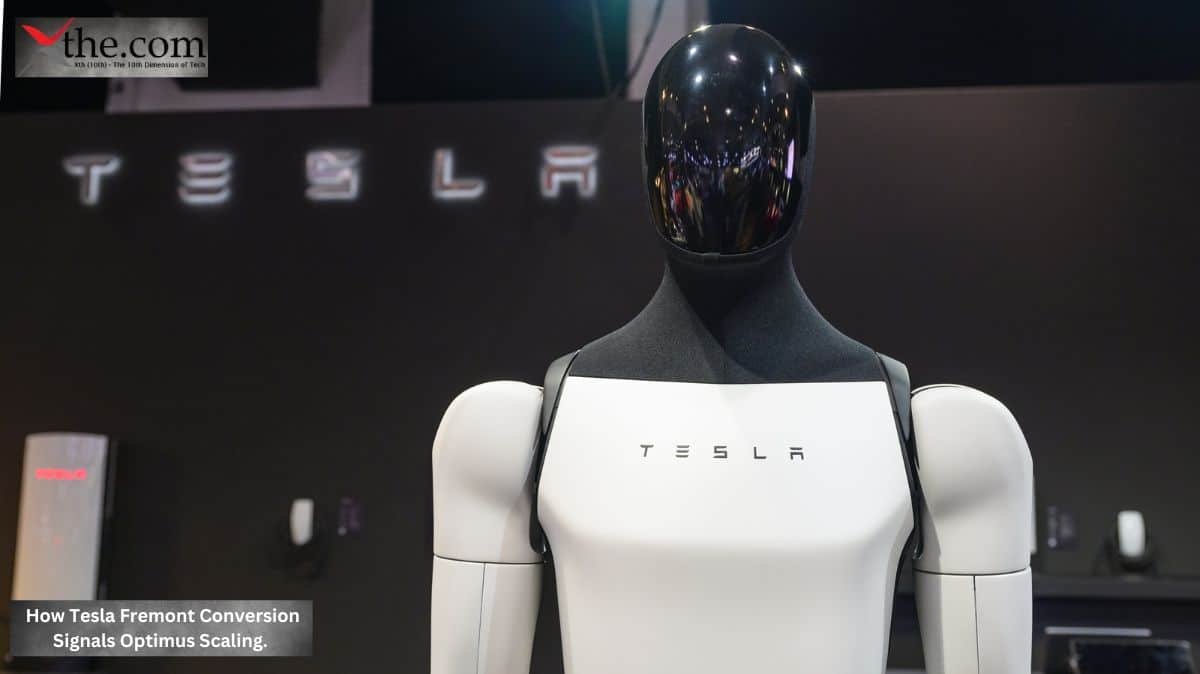
Fremont
Atomic answer: Tesla has officially begun converting the legacy Model S and Model X production lines in Fremont into dedicated manufacturing hubs for Optimus humanoid robots. This signals the end of low-volume prototyping and the start of Gen 2 infrastructure deployment.
A modern auto plant can lose a million dollars if it shuts down even for an hour. A single stalled conveyor, a late parts delivery, or a labor shortage can disrupt production for weeks. This pressure is why Tesla Optimus is important beyond just robotic demos or viral videos. When news of changes at Fremont Factory surfaced, industry analysts noticed something bigger: Tesla might be getting its manufacturing ready for robots to take on more labor.
People often focus on the spectacle when talking about humanoid robots. Investors think of home assistants. Consumers imagine robots from science fiction, but manufacturing leaders see something more practical: steady, reliable labor.
This difference could shape the future of industrial automation.
Why the Fremont Factory Matters to Tesla’s Robotics Strategy
The Fremont factory is already one of the most tightly packed production sites in the auto industry. Tesla brings cars, battery systems, and software-driven hardware there, even though the facility was designed for less intense production. Space is at a premium.
Supporting Tesla Optimus shows a new direction. Tesla is no longer treating human-artificial robots as a far-off research project. Instead, the company seems to be adding robots directly to its daily manufacturing processes.
This is important for $TSLA because labor costs and unpredictable production still threaten profits. Even the most automated factories depend on people for repetitive tasks such as moving materials, conducting inspections, and staging assemblies.
If a humanoid robot can handle these jobs, it could change the way factories grow and control costs.
The Economics Behind Humanoid Robotics
Most industrial robots work in fixed locations. They weld, lift weights, or repeat the same motions inside safety cages. Humanoid robots bring something new: flexible, adaptable labor.
This flexibility is important in busy factories where layouts often change. A humanoid robot could navigate spaces built for people without requiring costly changes to the building.
Tesla has suggested that Tesla Optimus could one day handle repetitive work in warehouses and factories, such as moving totes, restocking shelves, and conducting inspections. These tasks might seem simple, but they are actually very important.
Big car factories often hire thousands of people just to move things around inside. Replacing even some of the logs with robots would make the factory much more efficient over time.
The impact goes beyond just Tesla cars.
Warehouse Automation Is Becoming A Competitive Requirement
More and more manufacturing leaders see warehouse automation as a necessity, not just something to try out. Labor shortages, higher insurance costs, and shipping delays are putting pressure on factories everywhere.
Companies like Amazon, Hyundai, and BMW have already added more robots to their logistics and manufacturing. Tesla now seems focused on building automation systems that integrate software, robots, AI, and factory equipment.
This sets Tesla apart from competitors who rely mostly on outside robotics suppliers.
At the Fremont factory, this setup creates a strong feedback loop. Each robot movement produces data. Every mistake helps improve the training models. Over time, Tesla can fine-tune how robots work together by learning from real factory conditions rather than relying solely on computer simulations.
This is where AI factories start to play a key role.
Why AI Factors Depend on Physical Intelligence
Usually, AI factories refer to data centers used for training large models. Tesla seems to see it differently. The company is working on applying artificial intelligence to real-world operations.
This makes it take more than just software.
A humanoid in a car factory must understand space, temperature, movement, obstacles, and timing simultaneously. Even small mistakes matter. If it misjudges an object’s weight or applies too much force, it could break expensive parts or stop production.
This is why Tesla invests in systems for robotic thermal and energy use. Humanoid robots working nonstop in factories generate significant heat, especially when they repeatedly lift or move objects.
Heat limits how well batteries work, how long robots can run, and how efficient they are. Solving these problems is key if Tesla wants to widely deploy Tesla Optimus in its factories.
Tesla Fremont Factory Conversion For Optimus Mass Production
The idea of converting the Tesla Fremont factory for optimized mass production might seem like a guess right now, but several signs indicate Tesla is preparing to deploy these robots on a larger scale.
Tesla has already shown how it can use humanoid robots inside the company. It also controls key components of the robotics system, such as batteries, AI manufacturing software, and actuator design. Not many competitors have this much control over their technology.
A real-world launch would probably start with carefully managed tasks within the company, not with public jobs. For example, Tesla Optimus robots could first handle repetitive warehouse routes at the Fremont factory, especially during overnight shifts when fewer workers are on duty and fatigue is higher.
If these deployments work, Tesla gets more than just money from selling robots. It gains a way to boost its manufacturing power.
A factory run by partly autonomous humanoid robots could increase production without needing to hire as many people. The idea is one reason investors are paying more attention to $TSLA and robotics projects.
The wider market impact could come sooner than many leaders think. Once humanoid robots prove they can work reliably inside busy factories, other companies will feel pressure to catch up. Factories that rely solely on human workers might soon seem as old-fashioned as plants before robots transformed car production decades ago.
Tesla’s next big step might not happen on the road. It could happen quietly in a factory with a robot carrying parts between assembly lines.
Enterprise Procurement Checklist
- Infrastructure Redesign: High-density robotics lines require 3x the power-per-square-foot of standard EV assembly.
- Thermal Scaling: Managing heat from 24/7 robot “break-in” testing requires industrial-grade liquid cooling loops.
- Deployment Bottleneck: Shortages in custom actuators are currently the primary constraint on 2026 delivery targets.
- Procurement Risk: Piper Sandler notes that “free” Optimus value is contingent on Q4 2026 Unsupervised FSD targets.
- Action Step: Begin site-surveys for “Robot Charging Bays” in logistics centers ahead of 2027 pilot programs.
Source: Investor’s CornerTesla Optimus is already benefiting investors, top Wall Street firm says








