






Palo Alto, California.
The Cloud Bill That Finally Got Someone Fired
A mid-sized pharmaceutical company in New Jersey used a major cloud provider to run its internal drug interaction model for 14 months. Each month, they paid about $340,000 for computing. When their legal team noticed a clause in the provider’s terms allowing the provider to retain training data for model improvement, they ended the contract within a week. The company then spent the next quarter looking for an alternative, but none were available at the time.
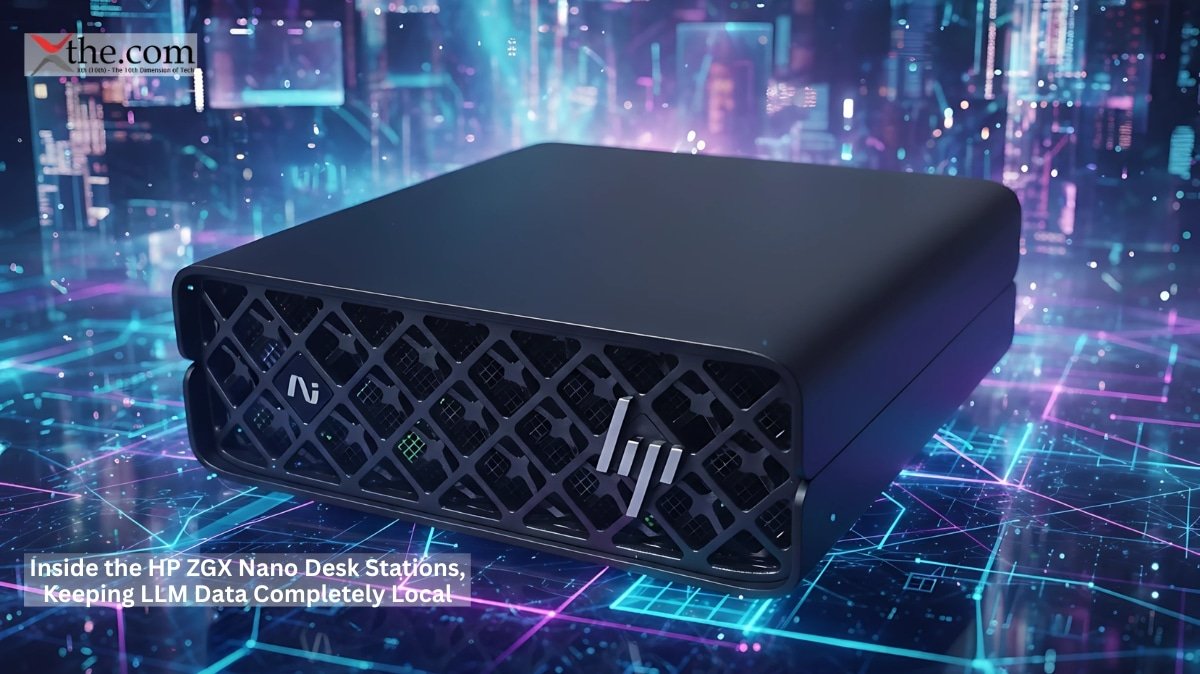
The HP ZGX Nano G1N AI station is now available. It completely changes how companies can solve that problem.
For the first three years, enterprise AI teams had aimed to keep LLM data completely local. Until now, doing this at scale required a dedicated server room, facility-level uploads, and high power consumption. The ZGX Nano, however, is small enough to fit on a desk.
What the HP ZGX Nano Actually Contains
The engineering begins with the NVIDIA GB10 Blackwell superchip, specifically the Grace Blackwell setup, which combines a 72-core ARM-based Grace CPU and a Blackwell GPU on a single chip. This isn’t a computer GPU added to a workstation. The unified memory design lets the CPU and GPU share 128 GB of memory, eliminating data transfer delays that typically slow down large-scale inference.
The 128 GB of memory is important. Running a 70-billion-parameter model at full FP16 precision typically requires over 140 GB of memory on standard hardware. Thanks to the GCX nanos, unified memory, and the NVIDIA GB10 Blackwell chip’s ability to run models in compressed formats without sacrificing accuracy, a single desktop unit can now handle 200 billion trillion-parameter models. Just a year ago, this was only possible in a data center.
The unit comes with DGX OS architecture, NVIDIA’s Ubuntu-based operating system designed for AI workloads. This means a data scientist can use the same software stack from an enterprise DGX H100 cluster on the desktop without needing to reconfigure the environment. There is no need for a new toolchain or compatibility fixes. The CUDA libraries, container runtime, and MLflow integration all remain the same.
DGX OS Architecture and the Compliance Argument
For organizations that must comply with HIPAA, FedRAMP, or SEC data rules, the DGX OS architecture offers something cloud subscriptions cannot provide. It ensures that inference requests always stay on-site. For example, a hospital system using the ZGX Nano for clinical documentation summarization processes patient records on hardware in its own server closet, managed by its own IT team and checked by its own compliance staff.
Cloud inference APIs send data through the provider’s infrastructure, no matter what the contract says. This creates a regulatory risk that legal teams at banks and federal contractors are less willing to accept. The Mini AI Workstation solves this problem by keeping all data local.
The Prototyping Edge Node Use Case Nobody Expected
HP designed the ZGX Nano mainly for AI developers and data scientists who want to work with models locally and avoid cloud delays. This is a large and important group. However, another use case has appeared sooner than expected: using the device as a prototyping edge node.
Defense contractors and energy companies are installing ZGX Nano units at field sites, such as oil platforms, military bases, and factories. These places are where internet access is unreliable or security rules block cloud use. For example, a geophysical survey team working offshore can run seismic data models directly on the ship’s onboard hardware in the operations rooms without needing a satellite link to the cloud.
This brings the prototyping agile node idea to life. Now, enterprise-level AI inference can run wherever the work happens rather than waiting for data to be sent to a data center.
HP ZGX Nano G1n Secure Local Processing Architecture Specifications and What They Mean for Procurement.
Technology buyers requesting the HP ZGX Nano G1N secure local processing architecture specifications will find a unit drawing under 1,000 watts at full load, a fraction of the 6,000-plus watts a comparable rack-mounted GPU server requires. The thermal envelope fits standard office cooling infrastructure. The physical footprint is smaller than most enterprise switches.
For procurement teams used to explaining $2 million server room projects to finance committees, these numbers change the budget discussion. 8 AI engineers, each with a ZGX Nano, can provide more local inference power than many mid-sized companies get from cloud providers. This comes free of ongoing subscriptions, data transfer fees, or compliance risks.
Where Local Compute Goes From Here
The launch of the ZGX Nano denotes a turning point. Keeping LLM data completely local is no longer a compromise; it is now a competitive advantage. Organizations that adapt now by building workflows, compliance systems, and model governance around local inference hardware will have an edge over those still relying on the cloud, especially as federal data rules become stricter.
The small unit on the desk is not merely a convenience. It is a strong case for changing how infrastructure is built.
Source: AI Super-computing Goes Nano








