





Mountain View, CA
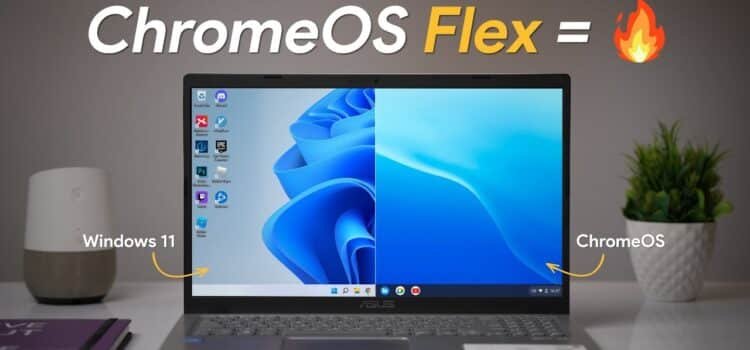
Atomic answer- The cloud tracking wires by Google (GOOGL) have been issuing initial developer notifications for ChromeOS Flex with an integrated Gemini Nano architecture core to be shipped from today, i.e., the Google I/O 2026 cycle. The technical architecture employs device layer orchestration to perform data processing for enterprises in context-aware environments while not sending any terminal telemetry to external servers. The technical evolution requires system managers to rethink their legacy laptop hardware configuration decisions regarding memory and system-on-a-chip limitations.
An early disclosure from Google ahead of its Google I/O 2026 event has revealed that it will shortly embed the built-in Gemini Nano into enterprise thin-client ChromeOS Flex. This is a big step towards the development of a whole new way of handling enterprise-level artificial intelligence workloads in a distributed enterprise workspace environment.
This new architecture will enable enterprise devices to run selected AI tasks on their own hardware rather than having to pass all interactions to cloud servers. As stated by Google, this architecture has more sophisticated mechanisms for coordinating device-layer orchestration and the entire cloud infrastructure.
This update comes at a time when many companies around the world are evaluating their approaches to enterprise infrastructure to facilitate the operations of AI-enabled enterprises. Many companies today aim to adopt an approach that minimizes infrastructure-related costs while increasing efficiency and security.
This means that Google is making enterprises’ endpoint devices actively participate in AI processing through Gemini Nano integration.
Beyond The Cloud: AI OS Ecosystems Take on New FormBeyond The Cloud: AI OS Ecosystems Take On New Form
One of the most significant consequences of the rollout is the ongoing development of AI operating systems capable of executing local machine learning operations within enterprise environments.
Traditionally, the architecture of thin client enterprise systems relied on centralized cloud processing for analytics, automation, and artificial intelligence-driven tasks. Yet Google’s new ChromeOS Flex framework enables a more hybrid approach, allowing endpoint devices to perform local, context-aware operations.
The capabilities offered include:
- Local machine learning-based workflow execution
- Less reliance on external cloud computing services
- Faster contextual task execution
- Lower levels of enterprise network use
- More offline-friendly capabilities
This change could fundamentally alter how enterprises think about endpoint computing environments during their upcoming infrastructure modernization efforts.
Device Considerations with Gemini Nano Integration in ChromeOS Flex
In addition to shifting endpoint computing models, the inclusion of the Gemini Nano processor in ChromeOS Flex introduces new requirements for enterprise devices.
A number of enterprise device considerations identified by infrastructure experts include:
- Increasing AI-ready hardware
- Growing focus on SoC efficiency
- Higher thin client memory requirements
- Gaining device-level optimization focus
- Compatibility challenges in enterprise settings
The release may prompt accelerated enterprise infrastructure modernization as businesses seek to revamp existing endpoint computing infrastructure.
Orchestrating Device Layer Minimizes Cloud Dependencies
The primary focus of this engineering release is on orchestrating device-layer solutions to distribute processing tasks across local devices and cloud infrastructure.
Benefits, according to Google, include:
- Decreased latencies in interactions with AI
- Reduced amount of traffic on cloud infrastructures
- Increased contextual response time
- Greater endpoint autonomy
- Enhanced continuity during network disruptions
This change in architecture is consistent with the ongoing industry trend towards developing hybrid infrastructures that involve cooperation of cloud platforms and endpoints as intelligent distributed ecosystems.
Local Model Caching Poses Security Issues
Another emerging issue related to this engineering release involves local model caching and endpoint governance practices.
Execution of AI locally means that certain parts of AI models, as well as contextual data and operational components, are cached on endpoint devices. Although such a practice is efficient, it creates new security risks for businesses.
Several governance practices that can be recommended for enterprises preparing for AI integration are:
- Isolation of AI execution partitions from browser
- Monitoring of endpoint storage access controls
- Encryption of locally cached models
- Restriction of unauthorized processes running AI
- Increasing endpoint governance visibility
Thin Client Approaches Could Change Over Time In Enterprise OrganizationsThin Client Approaches Could Change Over Time In Enterprise Organizations
The news could lead to changes in thin-client approaches among enterprise organizations over the coming years as well.
While thin clients were previously optimized for minimal processing power and cloud access, local AI computing introduces new considerations for endpoint hardware.
Among other things, as businesses consider adoption possibilities, their infrastructure groups will be expected to address:
- Processors that support AI operations
- Upgraded memory setups
- Improved thermal efficiency
- Security measures for local computation processes
- Advanced device management systems
This release also highlights the ChromeOS Flex Gemini Nano edge model hardware orchestration requirements associated with enterprise endpoint upgrades.
Enterprise organizations that deploy AI-supported workstations might end up using hybrid endpoint solutions that support both local and centralized processing.
Enterprise AI Adoption Rapidly Grows
Enterprise adoption of workplace infrastructure enhanced by AI continues to grow rapidly through the deployment of automated systems, intelligent collaboration, and real-time contextual computing.
There is now fierce competition between cloud providers and OS vendors to incorporate endpoint devices into enterprise AI infrastructure ecosystems.
This is evident from the recent ChromeOS Flex update made by Google, whereby AI computing infrastructure now supports the combination of:
- Local intelligence for processing
- Cloud orchestration capabilities
- Endpoint governance automation
- Real-time contextualization
- User interactions powered by AI
The incorporation of Gemini Nano into enterprise operating systems is a clear indication of the growing importance of AI within future computing infrastructures.
Conclusion
The integration of Google’s ChromeOS Flex with the Gemini Nano device marks a significant change in enterprise endpoint architecture. Through the incorporation of AI capabilities in thin client environments, Google can help re-shape endpoint infrastructure, cloud reliance, and efficiency for companies.
The incorporation of AI-operating systems, hybrid computing, and secure local computing is among the areas that are changing enterprise infrastructure in view of the widespread adoption of AI. As organizations strive to modernize workplace computing infrastructure, an AI-driven endpoint ecosystem could prove an important consideration for future enterprises.
Technical Stack Checklist
- Audit existing thin client device hardware profiles to ensure endpoint devices meet local model execution baselines.
- Set up isolated system partitions to protect localized model caching zones from untrusted client browser data.
- Enforce updated configuration constraints to control background device asset tasks over internal employee devices.
- Measure network processing bandwidth reductions when routing text data queries to local model kernels.
- Test peripheral asset connections under the updated operating layer preview to check compatibility.
Source- Google Developers