






Austin, Texas.
A Fortune 500 retailer that uses a computer‑support chatbot in 40 countries can spend millions each year on API fees, often without knowing exactly where the money goes. Every query, retrieval, and response adds to the cloud provider’s billing dashboard. Now, CFOs are beginning to question whether public AI infrastructure remains cost-effective for workloads that remain within the company’s own network.
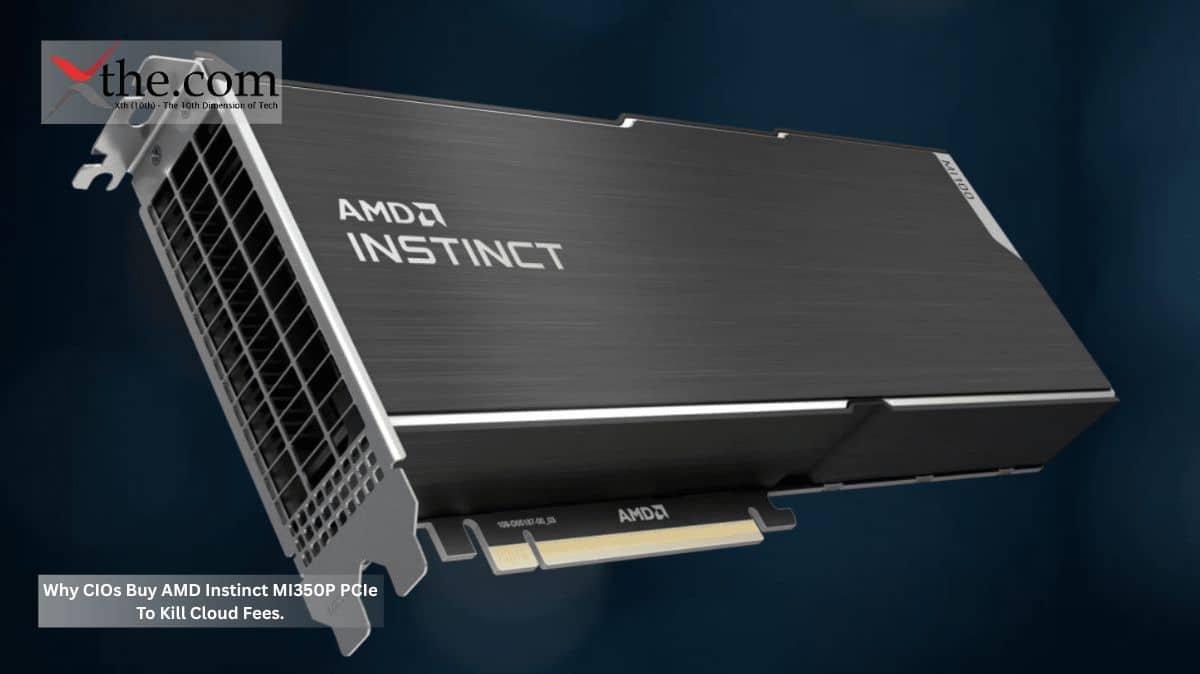
This pressure is driving a sudden surge in demand for the AMD Instinct MI350P PCIe accelerator.
AMD did not design this card as a showy AI lab project. Instead, it is aimed at enterprise teams struggling with high inference costs, strict data rules, and cooling challenges in older facilities. The message is clear: bring large‑language‑model inference back in‑house, stop paying ongoing cloud fees, and avoid major datacenter upgrades for liquid cooling.
The Enterprise Math Behind AMD Instinct MI350P PCIe
The main reason to choose the AMD Instinct MI350P PCIe is not impressive benchmarks, but real‑world cost savings.
Many enterprise AI projects struggle to grow because current GPU setups incur additional costs. High‑density AI servers often require liquid‑cooling upgrades, additional power, and specialized airflow solutions. As a result, CIOs often find that running AI on‑site can be almost as expensive as using the cloud.
AMD addressed this problem with an air‑cooled data‑center GPU that fits into typical enterprise setups.
The card features 144 GB of HBM3E memory and delivers up to 4 TB/s of bandwidth. This makes a big difference for enterprise workloads that rely on frequent data retrieval. Large vector databases, RAG pipelines, and AI assistants with long context can stay in memory, avoiding slowdowns from data movement.
The value of HBM3e memory bandwidth and AMD’s architecture is clear during busy periods. For example, a legal services platform analyzing thousands of contracts simultaneously cannot afford delays caused by slow memory. The higher bandwidth helps prevent slowdowns when models need to access embeddings, rank documents, and generate outputs during RAG pipeline operations.
For enterprises, bandwidth is not just a technical detail. It directly affects the cost of each inference query.
Why Air Cooling Matters More Than Raw FLOPs
Data center executives may not talk much about cooling in public, but infrastructure teams focus on it constantly.
A pharmaceutical company with three regional data centers might have enough electricity capacity for AI work, but not the plumbing or floor modifications needed for liquid‑cooled racks. This means every GPU deployment becomes a facilities project, not just a simple hardware upgrade.
The MI350p’s air-cooled GPU approach helps address many of these obstacles.
Because the card fits into dual-slot PCIe slots, companies can upgrade their current servers rather than build new AI clusters from scratch. This is important since many CIOs now prefer smaller, step-by-step upgrades that show clear improvements in operating margins.
The MI350 matches this new approach to buying technology.
MXFP4 Precision Performance Changes Enterprise Inference Density.
How efficiently inference runs will run will determine whether on‑premises AI is financially successful.
AMD’s focus on MXFP4 precision performance meets the growing need for compressed inference models in enterprises. Most companies do not need the biggest training setups; instead, they want steady, reliable performance for internal co‑pilots, search tools, compliance checks, and customer‑support automation.
Running models at lower precision lets each accelerator handle more models without sacrificing the accuracy needed for inference. This is especially useful in retrieval‑augmented generation setups where speed is more important than perfect accuracy.
In a secure enterprise setup, MXFP4 precision performance enables more inference sessions to run simultaneously without requiring additional racks or much more power.
A bank rolling out internal AI research assistants for 20,000 employees does not judge success by benchmark scores. Instead, it looks for faster responses, lower costs, and stronger security.
The Rise Of On-Premises LLM Inference Hardware
Relying on public cloud AI has created a dependency issue.
Companies have sent proprietary documents, customer data, engineering diagrams, and legal records to third-party platforms because there was no better option. Now, regulators, boards, and security teams are pushing back against this setup.
The growing demand for on-premises LLM inference hardware signals a broader shift in enterprise AI strategy. Organizations want to keep inference close to their own data and maintain direct control over governance.
This need is even greater in fields such as healthcare, defense, finance, and manufacturing, where moving sensitive data can pose compliance risks.
The AMD Instinct MI350P PCIe helps solve this problem by enabling dense inference deployments to run fully within company firewalls. Enterprises can run RAG pipelines on-site, index sensitive documents internally, and avoid sending proprietary data through external APIs.
This is the real solution to the growing question of how to deploy AI inference on-site without paying cloud fees.
This approach no longer requires massive AI infrastructure budgets. Enterprises can set up inference clusters using their current air‑cooled racks, PCIe servers, and regular workflows.
CIO Priorities Are Shifting Fast.
The way boardroom talk about AI has changed over the past year.
Executives are no longer debating if AI is important. Instead, they are asking why cloud AI bills keep rising faster than productivity. This new focus is changing how companies buy technology.
The companies adopting on-premises LLM inference hardware first are not against the cloud. They just realized that ongoing inference costs can eventually exceed the cost of owning the infrastructure themselves.
AMD saw this turning point early on.
The AMD Instinct MI350P PCIe is more than just another accelerator database. It makes a strong financial case for bringing inference costs back under company control. As language models become a regular part of operations, owning the infrastructure will decide which companies can scale AI profitably and which get stuck with rising API bills.
Source: AMD Instinct™ GPUs








