Austin, Texas —
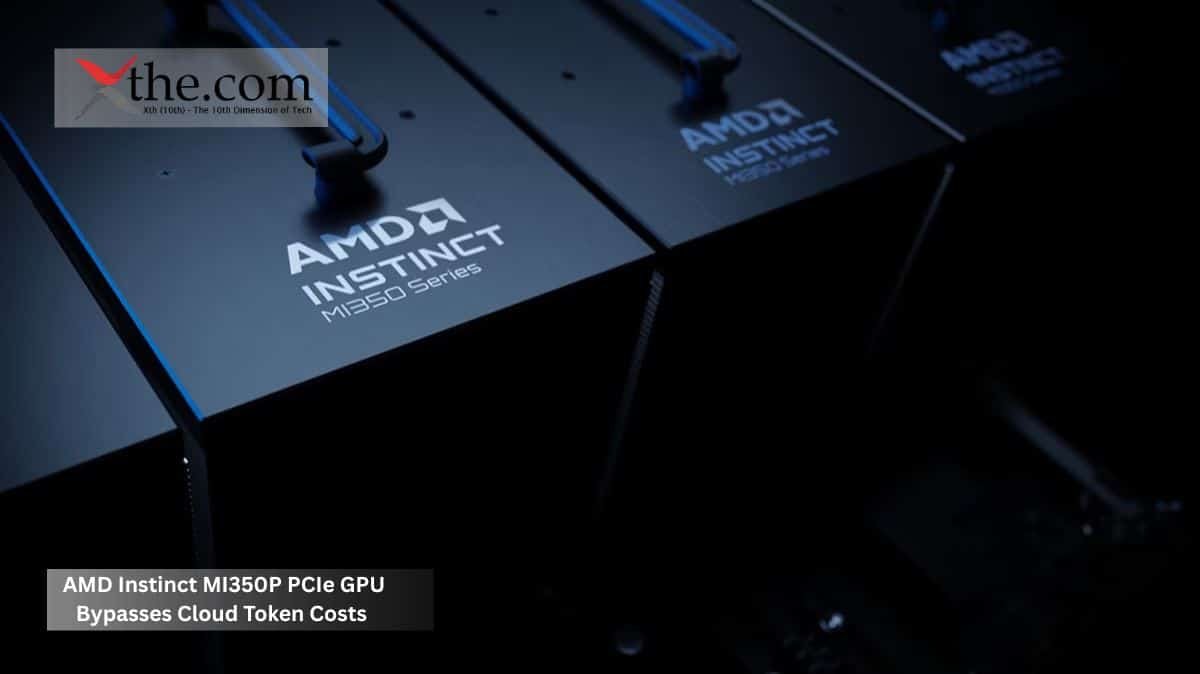
The new AMD Instinct MI350p PCIe accelerator is intended exclusively for corporations seeking to break free from the ever-rising costs of AI inference in the cloud. Rather than continuing to pay for recurring API token costs, companies can now run their large language models in their own data centers. This change will mark a significant shift in operations for financial, healthcare, manufacturing, and government organizations that run massive AI workloads every day. At the same time, enterprise technology discussions are increasingly being shaped by infrastructure developments such as AMD Instinct MI350P PCIe on-premises LLM inference, which is redefining how businesses approach AI security, operational privacy, and compute control inside enterprise ecosystems.
AMD Concentrates on On-Premises AI Hardware Infrastructure
While most new-age accelerators come with liquid cooling and specialized hardware, AMD’s approach focuses on compatibility with typical business setups. The dual-slot PCIe design allows companies to use the hardware in existing server infrastructures without requiring changes to cooling solutions or increased rack density.
This compatibility provides a considerable edge to businesses. Companies can use their existing hardware assets while incrementally implementing accelerated AI processes. Scalable on-premises inference hardware is enabling businesses to take back control over their hardware infrastructure rather than relying on hyperscaler infrastructure.
Data sovereignty and compliance management are other concerns many enterprises are considering when deploying AI hardware infrastructure. Many types of data, such as legal documents, software code, medical information, and financial datasets, do not always flow freely outside organizational premises due to security concerns.
High-Bandwidth Memory Affects the Performance of Enterprises
One of the key aspects that makes the platform so unique and stands out from competitors is its large memory configuration. The GPU comes with 144GB of HBM3E memory, with a bandwidth of up to 4 TB/s. It is essential to have such a high bandwidth because enterprise-level AI models continue to grow and require a more context-driven retrieval pipeline.
Increased hbm3e memory bandwidth and architecture help enterprises handle prompts and vector database retrievals with lower latency and without bottlenecks. This is why enterprise adoption of HBM3E 144GB air-cooled GPU cloud token bypass infrastructure continues to rise among organizations handling sensitive AI workloads.
Enterprise AI copilots should be able to run multiple tasks, such as indexing documents, performing contextual search, and summarizing. Slow memory will cause problems for these processes, leading to inference delays. Modern deployments powered by AMD HBM3E 4TB/s bandwidth LLM enterprise server architecture are helping organizations maintain higher throughput and lower latency during enterprise inference operations.
Increased Inference Density through MXFP4 Precision
AMD continues to push the GPU as highly efficient for computations as well. Specifically, the GPU supports native MXFP4 precision, enabling optimized low-precision inference without loss of quality in enterprise applications.
This particular architecture will provide a huge boost in efficiency and inference density. Enterprise adoption of AMD MI350P MXFP4 4600 TFLOPS RAG pipeline infrastructure is accelerating because companies want greater AI throughput without relying heavily on cloud-based token billing systems.
Some of the benefits of this architecture are:
- Rapid large language model inferencing
- Enhanced efficiency in retrieval pipelines
- Reduced infrastructure operating costs
- Efficient workload consolidation on servers
- High scalability for enterprise deployment
- Less energy use per server rack
The second mention of mxfp4 precision performance highlights AMD’s broader effort to boost enterprise throughput without forcing companies to invest heavily in new infrastructure. Growing demand for on-premises AI inference Fortune 500 cost savings strategies is also encouraging enterprises to deploy local inference hardware instead of relying entirely on hyperscale cloud platforms.
Significant Procurement Benefit of Air Cooling
There is no denying the significance of thermal compatibility. Companies are simply not ready to retrofit their existing data center facilities to adopt liquid-cooling solutions for high-density computing. AMD’s strategy of using air cooling for data center GPU is a direct response to this challenge.
Existing enterprise infrastructure relies on conventional airflow management solutions. Liquid cooling solutions require extra hardware, such as plumbing, cooling distribution units, and advanced maintenance techniques. The adoption process can take significantly more time and require a larger budget.
With AMD keeping thermal requirements in line with current air-cooling practices, companies can accelerate the adoption of AI solutions without major renovations. Businesses considering AMD MI350P drop-in dual-slot rack no liquid cooling deployments view this compatibility as a major operational advantage.
AI Sovereignty and Infrastructure Purchases
Businesses are becoming more dependent on their ability to remain independent of hyperscaler price changes and restrictions on API access.
Those who look at ways to implement AI inference on-premises and without cloud payments will find that local implementation is more predictable and gives companies better control over their business processes.
Organizations are increasingly researching how does AMD Instinct MI350P PCIe with 144GB HBM3E allow enterprises to run on-premises LLM inference and bypass expensive public cloud per-token API billing as cloud AI operating expenses continue rising across industries.
The third mention of the AMD Instinct Mi350p PCIe shows how aggressively AMD markets its products to businesses that want to limit their dependence on cloud inference tokens while maintaining the performance of their enterprise-class AI.
Conclusion
The new phase of enterprise AI development is when not only the capabilities of AI matter, but also the efficiency of operational processes. The latest AMD product enables enterprises to implement AI solutions locally and cost-effectively, reducing cloud token payments amid rising cloud costs.
Enterprises pursuing on-premises AI inference Fortune 500 cost savings initiatives are expected to continue investing in scalable local inference infrastructure. In addition, the product’s features make this solution cost-effective for many enterprises, as it offers high memory density, high throughput, and flexible implementation.
Source- AMD Instinct™ GPUs