SANTA CLARA, Calif. —
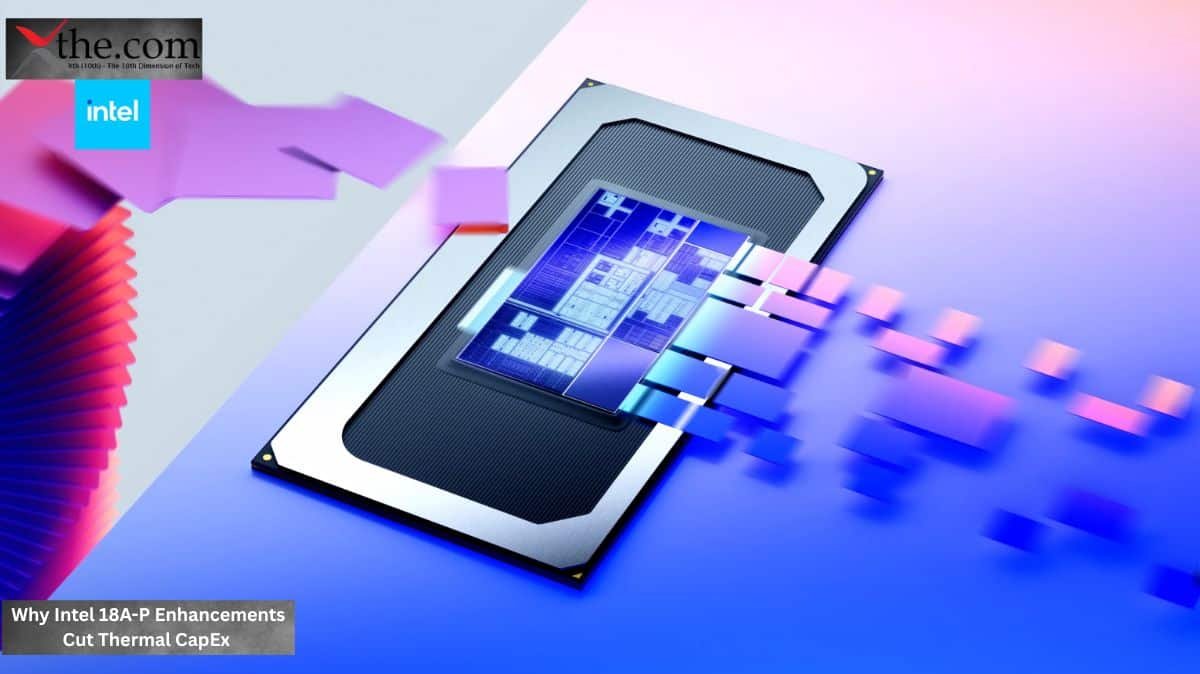
Atomic Answer: Intel (INTC) has confirmed that the 18A-P process node increases performance by 9% while improving thermal conductivity by 50% compared to baseline 18A. This architectural improvement allows enterprise AI PCs to maintain peak NPU clock speeds for longer periods without thermal throttling, reducing cooling infrastructure requirements for high-density laptop deployments.
The Intel 18A-P process node thermal enhancement introduces a new phase in the company’s mobile computing operations, as businesses now demand better thermal management, continuous AI capabilities, and lower costs for their extensive laptop systems.
The increasing demand for real-time processing from local AI sources in business processes is putting manufacturers under pressure to build systems that can keep running without loud fan noise, excessive heating, or draining the system’s battery.
Thermal Efficiency Becomes a Procurement Priority
Enterprises now consider the thermal sustainability performance of AI mobile hardware in assessments, rather than just benchmark results.
Today’s enterprise AI notebook NPU cooling architecture challenge is evolving due to the continued pressure on local Neural Processing Units (NPU) from the increasing number of runtime AI workloads, such as inference, retrieval, and automated task management.
Thermal systems that use traditional methods fail to keep high NPU frequencies active for extended periods, resulting in throttling that reduces the AI system’s actual responsiveness.
Intel’s 18A-P node solves the problem by enhancing silicon-level thermal conductivity, enabling more efficient heat dissipation while maintaining consistent processing performance. The new approach enables enterprises to reduce their dependence on large cooling systems, enabling them to develop slimmer products that generate less heat during operation.
Sustained NPU Performance Improves Enterprise AI Operations
To support autonomous workloads locally on enterprise AI PCs with CPU clock speeds below 20 GHz, enterprise installations of AI-PCs with autonomous workloads will require stable NPU clock speeds.
The throttling problem with NPU clock speed on enterprise AI-PCs has emerged as a primary operational bottleneck, as inconsistent inference performance directly correlates with the reliability of workflow automation.
To function effectively, various tools depend heavily on continuous, low-latency inference, including autonomous productivity agents, local copilot assistants, real-time summarization tools, and many types of cybersecurity assistant applications. With NPU throttling due to thermal saturation, enterprise users will see increased response times to system events, poorer-quality automated workflows, and greater difficulty completing multiple tasks.
With improved thermal performance, Intel has been able to provide devices that maintain higher NPU clock speeds for longer periods, enabling greater real-time AI interaction and less variability in capability across a wide range of systems, depending on how they are implemented across the enterprise.
Power Reduction Changes Mobile Workforce Economics
The Intel 18A-P power-reduction mobile workstation advantage also carries significant financial implications for enterprise mobility programs.
According to Intel, the node consumes 18% less power while maintaining equivalent performance, resulting in better battery life during AI-intensive fieldwork.
The adoption of artificial intelligence technologies has enabled organizations to increase efficiency across the enterprise by leveraging AI solutions through their consultancy teams in every department, including logistics operations, health systems, engineering, and field services.
Organizations that use these technologies efficiently will achieve two benefits: reduced energy use, as their fleets experience lower overheating risk, and higher performance when using multiple AI systems simultaneously.
RibbonFET Architecture Strengthens Thermal Scaling
Intel’s superior transistor technologies drive performance enhancements for its manufacturing process.
The RibbonFET 1.8nm 9% performance boost 2026 advancement improves transistor performance by reducing power loss and thermal buildup during long-term operation. The node distributes AI workloads through its advanced power-delivery system while maintaining control over thermal output from processing operations.
This matters because enterprise AI PCs are expected to run increasingly complex local inference workloads over the next several years as organizations reduce dependence on cloud-only AI execution models.
Efficient thermal scaling, therefore, becomes a competitive differentiator for enterprise device manufacturers targeting next-generation AI productivity systems.
Yield Risks Could Affect Early Enterprise Rollouts
Procurement teams need to consider production risks, even though technical advantages can benefit their work.
The Intel 18A-P yield Q1 2027 shipping risk will cause temporary supply disruptions during its initial production period as Intel increases manufacturing output.
When advanced semiconductor process nodes were introduced into production for the first time, the yield differences observed were largely due to new transistor and packaging designs used during this period.
It is possible that businesses will have to undergo large-scale replacement cycles of AI laptops, especially in 2027. Businesses will likely need to implement different procurement strategies to prevent shipment delays as they begin their phased rollout of Group 1 laptops. Companies that rely on synchronized deployment schedules for AI laptops will need systems to monitor production status, but should not make any firm commitments until they have first-wave hardware available.
Enterprise Cooling CapEx Begins to Decline
The broader importance of Intel 18A-P lies in how thermal improvements reduce enterprise infrastructure costs beyond individual devices.
The question of how Intel 18A-P’s 50% improvement in thermal conductivity reduces cooling CapEx for enterprise AI laptop fleet deployments becomes increasingly relevant as organizations scale AI hardware adoption.
Lower device temperatures create less need for office cooling systems, docking areas, and high-performance workstation systems.
When fans operate at lower speeds, they produce less sound in busy corporate spaces and extend the operational life of portable devices.
The operational efficiencies in this system deliver multiple benefits for enterprises that implement it across their entire operations, resulting in reduced total ownership expenses throughout the lifespan of their hardware.
18A-P Positions Itself as the Enterprise Default
Intel’s latest process improvements suggest that thermal optimization is becoming just as important as raw compute scaling for enterprise AI hardware strategy.
The question of why Intel 18A-P will become the default target node for 2027 enterprise mobile AI workstations, rather than the baseline 18A, reflects growing demand for systems capable of sustaining autonomous AI workloads without aggressive cooling requirements.
Organizations now place greater importance on evaluating mobile hardware with AI capabilities based on three criteria: consistent performance, battery life, and efficient operation.
The 18A-P system shows potential as a next-generation enterprise AI solution, combining enhanced performance with reduced power requirements and improved thermal management.
Conclusion: Intel 18A-P Reshapes Enterprise AI Laptop Design
The introduction of the Intel 18A-P process node thermal enhancement system represents a significant shift in how enterprise AI laptop systems are engineered.
With this new technology, Intel has solved a critical operational issue in current enterprise AI computing by designing a device that offers higher thermal conductivity, requires less energy, and delivers improved NPU performance for a longer period.
By implementing the new cooling architecture for NPUs in enterprise AI laptops, organizations will save on cooling equipment costs, expand options for mobile deployment of AI workstations, and enable slimmer form-factor workstations that maintain uninterrupted inference.
Companies evaluating Intel 18A-P-powered mobile workstations and their implementation strategies will see thermal efficiency as one of the most important factors in evaluating enterprise AI infrastructure, a trend that will continue through 2027.
Source: Tom’s Hardware
Executive Procurement Checklist: Intel 18A-P Enterprise Deployment
- Procurement Effect: 18A-P becomes the target node for 2027 enterprise mobile workstations.
- Infrastructure Risk: Yield variability in early 18A-P production could impact Q1 2027 shipping volumes.
- Deployment Impact: Thinner device profiles possible without increasing fan noise or heat signatures.
- ROI Implications: 18% power savings at equivalent performance extends battery life for mobile agents.
- Action Step: Prioritize 18A-P based hardware in procurement cycles for high-compute field teams.