




Santa Clara, Calif.
NVIDIA (NVDA) and Corning (GLW) have finalized a multi-year partnership to scale US-based manufacturing of high-density optical interconnects. This technical shift optimizes GPU-to-GPU communication in Blackwell-based AI factors, replacing signal latency while lowering the thermal overhead associated with traditional copper cabling in high-wattage racks.
A single AI training cluster can consume more electricity than a medium-sized manufacturing plant. This reality has forced executives to rethink where data center budgets go. The conversation no longer focuses only on GPUs. It focuses on power density, cooling economics, and the hidden cost of moving data between accelerators fast enough to keep trillion-parameter models productive. This is where the NVIDIA-Corning partnership began to reshape assumptions across the broader AI market.
For a long time, large technology companies saw fiber connections as a minor detail. Most of the planning focused on computing power. Now, fiber is a key topic in boardrooms because poor network design can slow training, hurt profits, and delay projects. The rise of NVIDIA Blackwell fiber-optic procurement intelligence shows that network design now determines whether AI operations run smoothly or struggle with infrastructure issues.
The New Economics Of AI Infrastructure
The costs and requirements for AI infrastructure have changed a lot since NVIDIA’s backup systems arrived 10 years ago. A typical rack server used about 10 to 15 kilowatts. Now, AI racks often use over 120 kilowatts each, and some large setups go even higher.
The big jump in power use leads to a series of engineering challenges.
More power generates more heat. More heat requires more aggressive liquid cooling systems. More cooling increases facility redesign costs and drives higher thermal CapEx commitments before a single module reaches production. Companies that once budgeted primarily for compute silicon now face significant spending on mechanical systems, power delivery upgrades, and networking density.
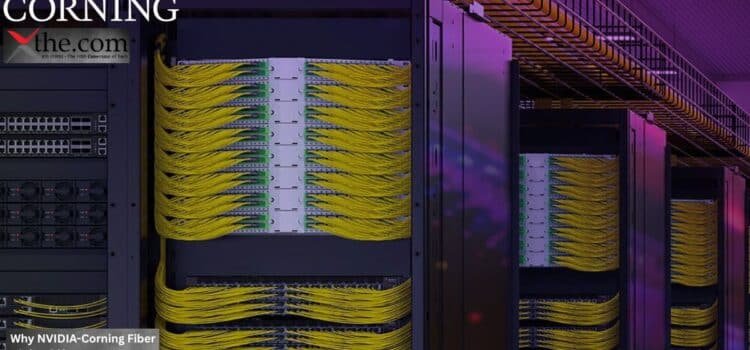
The Nvidia Corning partnership addresses a key problem: the efficient movement of data. Blackwell systems need very fast connections between GPUs, switches, and storage. Copper cables can’t keep up at these speeds and distances. They lose signal quality, create more heat, and make rack setups harder to manage.
Fiber provides a better solution.
By expanding high-density optical interconnects, Nvidia and Corning reduce signal loss while allowing longer cable runs with reduced thermal overhead. That matters because every watt removed from networking translates into a power cooling demand throughout the facility.
Why GPU Networking Became a Financial Problem
Many executives don’t realize how much poor GPU networking can cost. They often think that faster GPUs will always lead to better AI results. In reality, weak networks can leave costly GPUs sitting idle while they wait for data to catch up.
Imagine a company running 20,000 GPUs across several clusters. If network problems reduce capacity by only 8%, the business wastes millions of dollars in GPU power each year. These issues get even worse during training large language models, where delays in data synchronization slow everything down.
That’s why big tech companies are choosing optical interconnects over old copper ones. Fiber allows for faster data transfer and reduces interference in crowded server rooms. Even more, it lets companies scale up without using a lot more power.
The Nvidia-Coney partnership comes at a time when large tech firms can’t afford to waste resources. Companies like Microsoft, Meta, and Amazon, as well as government-backed AI projects in Europe and the Middle East, are competing for limited energy. Speed is important, but saving energy is even more critical.
How Liquid Cooling and Fiber Strategy Intersect
People outside of engineering often miss how closely liquid cooling and networking are linked, but the link is simple.
Higher bandwidth requirement. Equipment stretched out, higher bandwidth. Network equipment produces considerable thermal output. Traditional copper-heavy architectures introduce additional heat loads, forcing operators to aggressively expand cooling systems as racks approach extreme kW-per-rack density. Even modest thermal reductions can produce meaningful operational savings.
Fiber systems help lower these heat problems. Meanwhile, Corning’s role in the alliance focuses heavily on advanced fiber manufacturing that supports ultra-dense AI deployments. NVIDIA contributes to the compute and networking ecosystem surrounding Blackwell systems. Together, they target one of the industry’s fastest-growing operational expenses: carbon CapEx.
This focus on cooling is important because it often decides if an AI project gets approved. Boards might accept high GPU costs if the expected revenue is strong, but they are much less willing to support projects if upgrading data centers doubles the budget.
The growing focus on NVIDIA Blackwell fiber planning shows how buying decisions have changed. Companies no longer buy GPUs alone. They now look at power use, cooling needs, and whether fiber networks can grow with them before making a deal.
AI Factors Demand Optical Interconnects At Scale
NVIDIA CEO Jensen Huang often calls new data centers AI factories. While this may sound like marketing, it makes sense when you look at how these centers actually work.
Factories are designed to move products quickly, remove slowdowns, and use resources fully. Modern AI clusters follow these same ideas.
In these setups, GPU networking works like a conveyor belt in your factory. If the network is slow, performance suffers, no matter how powerful the computers are. That’s why big tech firms are moving to fast fiber connections that can handle massive workloads.
This change also affects global competition.
Global fiber demand has surged alongside the expansion of AI. Supply chains for specialized optical components already face pressure from hyperscale procurement cycles. Companies that develop stronger NVIDIA Blackwell fiber-optic procurement intelligence may secure strategic advantages by obtaining components earlier than competitors.
This situation is similar to what happened with computer chips during the pandemic. Companies that acted early got what they needed, while those that waited paid more or had to delay their projects.
Thermal CapEx Becoming the Real AI Constraint
Many readers think that getting enough chips is the main barrier to advancing AI, but more and more, the real limits are emerging in other areas.
Energy availability, cooling capacity, and physical networking infrastructure now shape deployment speed more than raw GPU access. A hyperscaler may secure thousands of Blackwell GPUs but still delay deployment because the facility cannot sustain the required kW-per-rack density.
That’s why more investment in AI infrastructure now goes to support systems like cooling and networking, not just to buy more computational power.
Cooling companies see huge increases in demand. Power utilities are now making long-term deals directly with AI companies. Fiber makers have become key players in AI supply chains. The NVIDIA-Fanning partnership is part of this bigger industry shift.
Leaders planning new AI projects should watch these changes closely. The next big advantage may not come from better AI models, but from building the most energy-efficient, well-connected, and fiber-connected AI centers.
That makes NVIDIA Blackwell’s fiber optic procurement intelligence more than a niche operational concern. Its concern constitutes a strategic discipline that will shape the economics of large-scale artificial intelligence over the next decade.
Source: NVIDIA Names Suzanne Nora Johnson to Board of Directors