






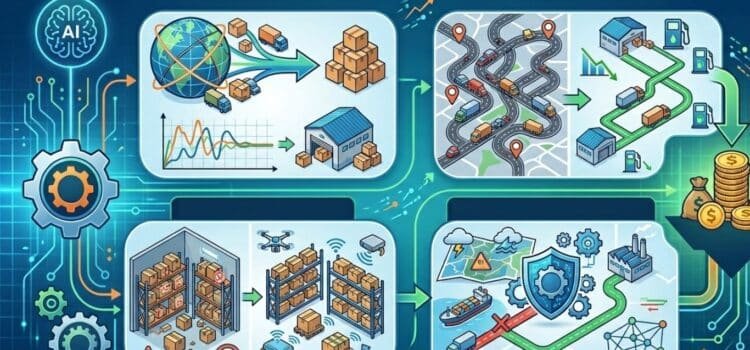
Using an OMP application provides businesses with a forecast of product shortages; this data can be utilised as a market-based forecast so there will not be any price increases throughout the United States. Users of this system will have access to the forecasting required inventory levels and procurement strategies by analysing past sales history, present market conditions, and the distribution systems of each individual company. Currently, AI is being utilised in the supply chain marketplace to help businesses operate more efficiently, reduce costs, and quickly adapt to market changes.
Leveraging AI to Predict Shortages
This AI solution leverages advanced algorithms and machine learning to help organisations identify disruptions by providing visibility into trends and anomalies in their supply chains. By analysing transportation delays, changing demand trends, and supplier reliability, you can predict potential shortages weeks or months in advance.
By using these predictive capabilities, businesses can adjust their purchasing strategy, reallocate inventory, or reroute shipments, helping mitigate the likelihood of price increases or lost sales. Additionally, by taking a proactive approach to resolving supply chain problems rather than a reactive one, companies can create value through their supply chain operations.
Enhancing Operational Efficiency
Along with predicting potential stock shortages today, the AI-based supply chain solution will help create efficiencies across the entire supply chain. With automated data analysis, organisations can gather actionable data more quickly and, therefore, make informed, timely business decisions on inventory management, production scheduling, and procurement. By using AI to provide advanced predictive analytics, organisations can minimize.
The added efficiency of automation also allows supply chain managers to devote more time to strategic planning and supplier negotiation, creating a more flexible, responsive, and efficient supply chain ecosystem.
Supporting Pricing Stability
Predictive supply chain technology provides businesses with a key benefit by enabling them to maintain stable pricing throughout their operations. When a business is aware of the future earlier in the process, it can implement strategies to mitigate sudden price increases, protecting both the business and consumers from large price swings.
With AI-based insights, a business can also negotiate more effectively with suppliers, as it can more accurately project its purchasing requirements and the timing of those purchases. Being proactive will drastically reduce the need for panic buying, stockouts, and last-minute shipments, all of which tend to increase prices.
Real-Time Data and Continuous Learning
Real-time, actual sales (including logistics and suppliers) data feeds are available through the OMP tool for consistent forecast updates. Furthermore, machine learning models improve predictions as new data is received, allowing the OMP tool to adjust quickly to ever-changing conditions.
With continuous learning capabilities, the OMP tool will provide businesses with meaningful insights that can be applied to both current and future conditions as market dynamics evolve.
Integration Across Supply Chain Functions
The platform is designed to connect to all current enterprise systems of record, such as ERP systems, inventory management systems, and procurement solutions. Enables businesses to integrate AI insights directly into their normal operational flow, generating predictive analytical results from automated processes.
Forecasting will be integrated into day-to-day operations, enabling companies to maximise restocking schedules, reduce surplus inventory, and foster greater supplier collaboration, thereby developing a more integrated, resilient supply chain.
Competitive Advantage in a Volatile Market
In the US, supply chains are still experiencing problems such as transportation bottlenecks (delays caused by too much freight trying to pass through a single location), global trade issues, and changing consumer preferences. AI technology helps businesses avoid shortages before costs rise, allowing them to act quickly and maintain service levels unaffected by unpredictable conditions.
Businesses using data-driven tools have an advantage over those that do not, as they can reduce costs, improve profitability, and enhance customer satisfaction, thereby establishing a benchmark for proactively managing supply chains.
Challenges in Deployment
The use of Artificial Intelligence (AI) poses many obstacles to supply chain management’s high-quality, comprehensive datasets, and businesses must ensure their internal systems can provide accurate data to feed AI models.
In addition, integrating AI recommendation systems with the human decision-making process will require proper planning and training. Supply chain managers must be able to interpret AI output effectively and take decisive action to benefit from predictive analytics.
Future Outlook
The use of AI for supply chain forecasting will expand as both AI technology advances and more data becomes accessible. The upcoming developments will bring better supplier collaboration, predictive pricing functions, and automated logistics system integration.
As companies increasingly adopt AI-powered solutions, the ability to predict shortages and optimise processes will be a major advantage in the marketplace.
Source: OMP highest on both Ability to Execute and Completeness of Vision


