

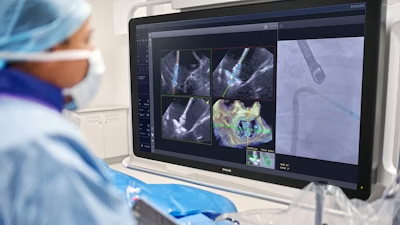




The US Food and Drug Administration (FDA) has approved the NEXUS Aortic Arch Stent Graft System from Endospan for minimally invasive treatment of thoracic aortic arch disease, including chronic aortic dissections. It is intended for patients with dilative lesions in or near the aortic arch who face high risks with traditional open chest surgery.
Key Points about the NEXUS System Approval:
- Approval and indication: The FDA approved the NEXUS system for high-risk patients with aortic arch disease, offering a less invasive alternative to traditional open-heart surgery.
- Study data (TRIOMPHE): approval was based on one-year results from the TRIOMPHE investigational device exemption (IDE) study. For patients, this means a 90% survival rate from lesion-related death, 90% were free from disabling stroke, and 98% did not require additional procedures to address leaks, all within one year of treatment.
Technical Highlights
- Bimodular design: features two modules engineered to conform precisely to the ascending aorta and aortic arch anatomy.
- Low profile delivery: employs a 20F delivery system currently the lowest in its class to minimize vascular access complications.
- Pre-shaped catheter column enables single-pass access to the arch, minimizing device manipulation and reducing stroke risk.
- Integrated branch: contains a dedicated branch for the brachiocephalic trunk to preserve blood flow to critical upper-body vessels.
Artivion Inc. announced that, following FDA approval, it now has the option to acquire Endospan within 90 days of the clearance date.
The NEXUS system has already been available in Europe (CE mark) and now provides patients in the US with a specialized, off-the-shelf endovascular solution that offers a minimally invasive alternative to open surgery. This advancement gives patients who were previously limited to open procedures access to a potentially safer, faster recovery option.
With FDA approval, Artivion may acquire an endorsed plan within 90 days and has arranged financing if it chooses to proceed with the company. The company is reviewing its acquisition option following this approval, which was earlier than expected.
NEXUS is a branched endovascular stent graft system approved in the US for the minimally invasive treatment of aortic arch disease. Approval was based on the TRIOMPHE study, which showed strong survival, stroke-free rates, and low reintervention rates, as summarized above.
NEXUS receiving FDA approval ahead of our expectations is an exciting milestone for patients with aortic arch disease, for our partner Endospan, and for Artivion, said Pat McKin, Chairman, President, and Chief Executive Officer. The TRIOMPHE data have continually demonstrated the clinical value of this technology, and we are proud to have supported Endospan on this journey. We have proactively put the financing in place to support a potential acquisition, and we are moving carefully to finalize our considerations around the options. We look forward to providing an update to shareholders soon.
About Aritvion Inc.
Artivion Inc. is a medical device company based in suburban Atlanta, Georgia. Its main products include aortic stent grafts, surgical sealants, mechanical heart valves, and implantable cardiac and vascular human tissues. Artivion sells its products in over 100 countries. For more information, visit www. Artivion.com.
About Endospan Ltd.
Endospan is a privately held company based in Herzilia, near Tel Aviv, Israel, and a pioneer in endovascular repair of aortic arch disease, including aneurysms and dissections. Endospan received CE mark approval to market the NEXUS stent graft system in Europe, the first half-shelf endovascular system for treating aortic arch disease. This system offers hope to patients with dilative lesions in or near the aortic arch who have been underserved, providing a minimally invasive repair that can lower risk, shorten hospital stays, and speed recovery. While minimally invasive endovascular repair is standard for abdominal aortic aneurysm, patients with aortic arch disease have often only had open chest surgery as an option, which comes with more risks, longer hospital stays, and longer recovery times. For more information about Endospan, visit www.endospan.com.


