






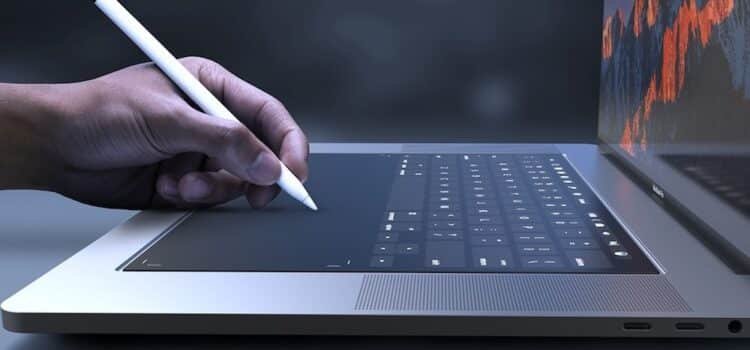
Apple has patented technology for virtual MIDI or surface-based keyboards that feel like real keys. Over several years, Apple has developed air feedback and advanced haptics to improve typing on future devices.
Main Features Of The Patented Technology
- Air-driven feedback: One patent describes a keyboard that blows gentle streams of air onto your fingertips through tiny holes, making it feel like you are pressing an air key.
- Proximity sensing: the system detects when your finger is just above a key, allowing the air feedback to start even before you touch the surface.
- Electrostatic haptic feedback: other patents mention a system called Static Pattern Electrostatic Haptic Electrodes. It delivers small electric charges and vibrations on a touch surface to mimic the feel of a mechanical keyboard, allowing you to touch-type on a smooth surface.
- Localized haptics: instead of vibrating the whole device, this technology creates small vibrations right where you touch, letting you feel as if you are pressing individual keys or sensing friction.
- Application areas: these technologies target future laptops, iPads, and potential mixed reality systems that lack a physical keyboard
These patents show that Apple is looking for ways to eliminate physical keyboards and create thinner, more flexible, and even virtual interfaces while still preserving the satisfying feel of typing. However, as with many patents, there is uncertainty about whether this technology will be implemented in future products.
Apple doesn’t just want you to see digital elements in the real world with Vision Pro; The company aims to unify augmented reality with haptic feedback for a full sensory experience, including touch.
Building on this sensory focus, a newly granted patent shows that Apple has been looking into smart rings, sometimes called the Apple Ring. This follows recent rumors that a ring could be coming soon as Apple works to expand its lineup of wearables.
Despite references to smart rings, the patent titled “Finger-Mounted Device with Sensors and Haptics” primarily aims to enable deeper user integration into Apple’s AR world through fingertip sensors, with only minor mentions of rings.
Expanding on this idea, sometimes the patent describes sensors on every fingertip to enhance both air–object interaction and haptic feedback. While Apple isn’t stopping anyone from buying ten smart rings, the descriptions highlight the connection between augmented reality and tactile sensation, even beginning with a comparison to gloves.
Electronic equipment, such as computers and head-mounted display systems, is sometimes controlled using input-output devices such as gloves. It says a glove may have sensors that detect user hand motions.
However, using wearable devices to gather input for controlling electronic equipment can pose challenges, Apple says. If care is not taken, a device, such as a glove, may impair a user’s ability to feel objects in the user’s surroundings, the patent says. It may be uncomfortable to use or may not gather suitable input from the user.
As an answer to these challenges, Apple’s proposed solution is a variable device, such as a finger-mounted device, that may be used to gather input from a user’s fingers as the user interacts with surfaces in the user environment and may be used to provide clicks and other haptic output during these user interactions.
For example, if someone tosses you a virtual ball while you are wearing Apple Vision Pro, the haptic sensors in your fingertips could make it feel like you’re actually catching it. Or, if you’re using the virtual keyboard in visionOS, you could at least feel when you press a key.
These apparatuses not only send sensations to the user, but they can also send information back to the system based on how the user interacts with them.
The input gathered in this way may include information about how firmly a user is pressing against objects. (finger press input), says Apple. It may also include finger tap input from light taps of a user’s finger against a surface. There is lateral finger movement information, such as shear force, indicating how firmly a user presses their finger against a surface. The system can also gather other user input.
This Shear Force information could also be interpreted as input to an application. This allows the user’s own fingertip to be used as a point. The device (e.g., as a joystick) can continue the patent that controls an on-screen cursor or other adjustable system feature in the device.
The new patent lists 12 inventors, including Paul X Wang, who is known for his work on haptic touch feedback for the Apple Pencil.
Source: Apple wants you to be able to touch and feel things in AR or VR


