






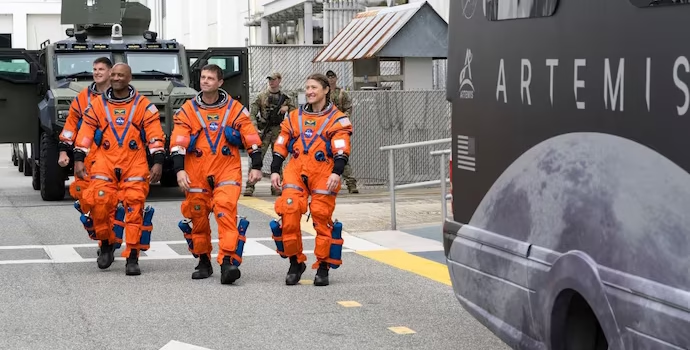
NASA’s Artemis 2 mission has achieved a historic milestone by sending astronauts to their farthest point from Earth since the Apollo missions of the early 1970s. The team accomplished a lunar flyby, showcasing the operational capabilities of the Artemis spacecraft, the Space Launch System (SLS), and its deep-space exploration life-support systems. NASA has established its new sustainable lunar exploration mission through this accomplishment, which will enable upcoming missions to Mars and other deep-space destinations.
Breaking Distance Records
The Artemis 2 Mission was a significant milestone in human spaceflight, as it sent the first astronauts farther from Earth than at any time in almost 50 years. The mission will take astronauts on a ‘loop’ around the moon before returning them to Earth and will test navigation, communications, and spacecraft performance under deep-space conditions (i.e., the distance from Earth creates new challenges for signal delay, radiation exposure, life support, etc.).
The data gathered from this record-breaking journey will be extremely valuable for future long-duration missions and will provide insight into spacecraft operations, astronaut health, and system reliability. By going beyond what Apollo missions did, Artemis 2 shows that NASA is capable of expanding humanity’s footprint into our solar system.
Testing Spacecraft and Systems
This mission is a major evaluation of NASA’s unified Artemis systems. The Orion spacecraft, which features new propulsion, navigation, and environmental control systems, has proven ready for the complex operations required to enter orbit around the Moon and beyond. The Space Launch System (SLS), the world’s most powerful rocket, provided the thrust to enable astronauts to safely follow a high-energy path.
During this mission, tests were conducted on life-support systems, radiation shielding, and onboard communications to the extent permitted by the time and distance of the journey. These tests will ensure that all future Artemis missions, including human-crewed Artemis missions to orbit the Moon and eventually Mars, can operate safely and efficiently for long periods weeks or months.
Crew Experience and Human Factors
The Artemis 2 crew is being tracked to assess how they respond physiologically and psychologically during deep space travel, including exposure to microgravity, long periods of time away from Earth (isolation), and reduced visibility of Earth. Information collected during this experiment will be used to develop astronaut training programmes, design future spacecraft, and plan long-duration missions (greater than 30 days).
The astronauts participating in this study have also been involved in experiments on the efficiency of life support systems, health monitoring during tasks under remote operational conditions, and decision-making under limited information during operational tasks. The emphasis on a human-centric approach ensures that advances in technical capability are aligned with crew safety, comfort, and productivity.
Lunar Flyby and Science Opportunities
While Artemis 2 serves mainly as a test flight, its lunar flyby also gives scientists many opportunities to gather data and make observations. Instruments aboard have gathered data on radiation levels in deep space, how space weather behaves, and how spacecraft behave there. The trajectory of Artemis 2 through the lunar flybys will provide unique vantage points to study the Moon’s topography and how the Earth and Moon interact.
The information gathered during the lunar flybys will help establish plans for the Artemis programme, improve scientific understanding of lunar topography, enhance mission design, assist in identifying resources, and aid in risk mitigation strategies for crewed missions to the Moon and Mars.
Implications for Artemis Programme Goals
The goal of the Artemis programme is to facilitate permanent human exploration on and around the Moon by enabling a sustainable lunar exploration programme. Artemis 2 is an important milestone in the success of Artemis 3, which will land humans on the surface of the Moon. The objectives of Artemis 2 include verifying deep-space travel capabilities and verifying the integrity of spacecraft systems, both of which are necessary to provide the infrastructure to support prolonged missions of weeks or months.
The Artemis missions include significant contributions from international partners in the form of technology, research, and operational support and knowledge transfer among programme participants and maximise scientific return.
Advancing Space Technology
The Artemis Program is the next step for NASA to showcase advanced technologies that will help to develop new discoveries on the Moon, as well as technologies that can be incorporated into future missions beyond the Earth’s orbit, such as food and water systems, power systems, communications systems, and environmental control/modular, adaptable technology that will support longer-duration, greater-distance flights than Artemis 2 can achieve.
The Artemis 2 mission highlights the criticality of leveraging data in decision-making, employing automation, and building redundancy into spacecraft systems to protect crews against unexpected events in deep space.
Inspiring Public Engagement
Artemis 2 is more than a major technological/scientific achievement for NASA; it represents an inspirational milestone for people everywhere as humanity journeys to new frontiers through exploration. Artemis 2 exemplifies what humanity can achieve when it invests in science and technology, encouraging young people and their communities to pursue these goals through educational programmes, live broadcasts, and public outreach.
The success of Artemis 2 is revitalising interest in travelling to the Moon, and there are many possibilities for humanity to travel to Mars and beyond.
Supporting Long-Term Human Exploration
The Artemis 2 mission will be instrumental in providing data to support the development of safe, long-term human activities in space. Data gathered will help understand how astronauts can work in deep space for long periods by monitoring radiation levels, assessing how well life support systems perform, and evaluating how crews will perform under conditions of isolation.
The information gained from this mission will inform the design of vehicles, habitats, and operational protocols for future human-rated deep-space exploration missions. Specifically, the planning will focus on sustaining human life for months or years, away from Earth.
International Collaboration and Partnerships
NASA’s Artemis program is collaborating with countries and businesses to develop technologies, operational processes, information-sharing, standards, and best practices for the successful joint exploration of the Moon and Mars by providing a platform for Artemis II to validate the technologies and processes necessary for these missions.
These partnerships will result in technology exchanges, research collaborations, and economic growth.
Future Directions in Deep-Space Exploration
Artemis 2 represents the path towards more ambitious missions, such as exploring the Moon’s surface, establishing lunar orbiting stations, and sending humans to Mars. NASA is also looking to use information gained from Artemis 2 to improve spacecraft design, mission planning, and crew support systems.
Artemis 2 will also contribute to NASA’s long-term goal of sustainable operations in space, enabling scientific discovery and supporting commercial and research activities in orbit around the Moon and beyond.
Conclusion: Humanity Pushes Farther Into Space
Artemis 2 marks a landmark event in the history of human space travel; it has broken distance records since the Apollo programme and has tested all the capabilities needed for long-duration human missions in outer space. Conducting successful tests of spacecraft systems, evaluating crew performance, and demonstrating operational protocols are key accomplishments that advance NASA’s efforts to develop a long-term plan for exploring the Moon and sending astronauts to Mars.
This milestone demonstrates our ability to extend our reach into the universe through human ingenuity, innovative technologies, and international cooperation. This new era of discovery will allow us to better understand both space and our place within it.
Source: https://www.nasa.gov/news/


