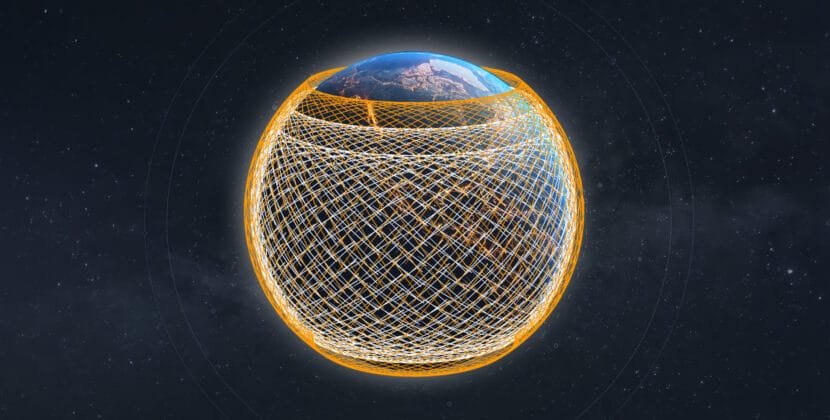






The Kuiper project, one of Amazon’s latest satellite initiatives, is also a significant factor in the company’s plan to develop commercial services for businesses and government. Kuiper will provide low-latency, high-speed internet service to business customers and public entities in the U.S., especially in rural and underserved areas where access to broadband networks capable of supporting high-capacity connections is limited.
Since Amazon began to develop its Kuiper satellite constellation, an effort that represents one of the largest private-sector efforts to build a large-scale LEO satellite constellation, it has shifted to focus on enterprise and AI-driven connectivity, rather than just consumer broadband. An example of this shift was Amazon’s announcement last month of the launch of its first five satellites in the Kuiper constellation and plans to launch 19 additional satellites in the future.
Building a Space-Based Internet Backbone
Kuiper will use a system of many satellites to continuously connect the globe, rather than a single stationary satellite in geostationary orbit, providing better service and lower latency than today’s traditional satellite services.
Kuiper’s performance model is geared towards the needs of today’s businesses: real-time access to their data, integration with cloud computing, and the use of AI to make decisions, all of which require a reliable, high-speed internet connection. Kuiper’s design will enable low-latency, more reliable networks for businesses operating in areas with limited infrastructure.
Amazon has stated that this is a business-focused network to provide a better solution than the traditional consumer broadband offerings.
Expanding Enterprise Connectivity Across the US
Satellite internet has primarily been limited to remote areas until now; however, Project Kuiper is positioning itself as a provider of connectivity solutions for enterprises across the US. This includes multiple industries such as logistics, energy and agriculture, defense, and disaster response.
Many enterprises have redundant systems in place to ensure their business operations continue in the event of issues with their existing network or disruptions, because outages and interruptions occur frequently and unexpectedly. Kuiper offers businesses a backup or primary source of connectivity through its satellite-based architecture, enabling connectivity for businesses operating in remote, geographically isolated, and/or infrastructure-deficient locations.
The trend toward hybrid telecom networks is becoming the standard model for large-scale networks, in which fiber, wireless, and satellite-based connectivity systems will connect end users.
Competing in the LEO Satellite Race
In a very competitive new industry that already has successful players like SpaceX’s Starlink network, Amazon is entering the race to deploy LEO (low Earth orbit) satellite constellations. The push for increased global broadband and more reliable internet connections continues to grow exponentially.
LEO satellite constellations are the first step toward solving this problem, but building them comes with high costs; for example, an LEO constellation requires high upfront costs to set up manufacturing and launch logistics, and then the cost to cover all ground infrastructure will be very high. Once the system is operational, they are relatively less expensive to implement, since the satellites can scale and reach areas that would normally be too expensive to build fiber networks.
Amazon is placing significant emphasis on integrating the Project Kuiper system into its existing cloud infrastructure. This could give Amazon an advantage in providing enterprise services to its current customers who already use its cloud technologies.
The Role of Satellite Internet in the AI Era
Increasingly, the need for low-latency/high-bandwidth networks is driven by the growing use of artificial intelligence. AI systems require continuous data communication across multiple devices, edge systems, and cloud computing centers.
In this environment, satellite internet is rapidly emerging as an important infrastructure element within this ecosystem. For sectors currently using AI at scale (e.g., autonomous logistics, remote sensing, and smart agricultural products), connectivity issues can significantly reduce overall performance.
Project Kuiper directly addresses these issues by ensuring consistent connectivity where traditional networks either fail or do not exist; this is especially important for AI-based organizations that cannot afford any downtime or data delays.
Integration with Cloud and Edge Computing
The primary benefit of Kuipers is its easy integration with AWS (Amazon Web Services) and its cloud computing services. Connecting satellite communications directly to a cloud-based infrastructure enables Amazon to provide an end-to-end solution that integrates data collection, transmission, storage, processing, and analysis with AI.
Amazon can also leverage the trend toward edge computing and use its satellites as intermediary nodes to transmit data from remote sensors, vehicles, or industrial systems directly into cloud-based AI models, rather than processing all the data centrally via traditional cloud servers.
This type of integration is critical for applications such as disaster monitoring, defense communication, and manufacturing process automation that require immediate feedback from multiple data sources within milliseconds of occurrence.
Infrastructure Challenges and Deployment Scale
Though it has great potential, Project Kuiper faces many difficult engineering and logistical challenges. Putting a complete satellite constellation into operation requires launching many rockets simultaneously, each satellite reaching the correct orbit, and a robust ground station network.
One of the major hurdles to manufacturing satellite systems on a large scale is ensuring an efficient, well-streamlined production process that can produce large quantities of advanced satellite systems while maintaining consistency and controlling costs.
Amazon has made substantial investments in creating manufacturing facilities and forming rocket launch partnerships to propel satellite deployment times, but we won’t see a complete global footprint for many years.
Regulatory and Spectrum Considerations
The expansion of satellite Internet largely depends on the satellite regulatory authority (RA) related to satellites, such as spectrum allocation, orbital slots, and frequencies, to minimize interference among competing satellite networks.
As more companies enter the LEO market, international coordination becomes increasingly complex. Regulators are also paying closer attention to issues such as space debris, orbital congestion, and long-term sustainability of satellite constellations.
Satellite Internet, Inc.’s (SII) success will be determined in part by how it navigates the regulatory landscape as it grows its business.
Economic and Industry Implications
If Project Kuiper is successful, it will have far-reaching effects on telecommunications and enterprise technology markets. New models of connectivity may reduce the need for traditional fiber infrastructure in many parts of the world and provide greater agility for businesses.
With Project Kuiper, enterprises can expect increased redundancy, improved uptime, and additional access to remote locations for operations. There is also potential for new competitors to enter the telecommunications market and change how pricing and service are structured.
Finally, by entering the satellite broadband market, Amazon demonstrates that cloud computing, artificial intelligence (AI) infrastructure, and global connectivity are converging into a single technology stack.
The Future of Satellite-Powered Connectivity
With the increasing prevalence of AI-enabled applications that require connectivity as much as, or more than, computational capability, Project Kuiper aims to help ensure that how we access networks keep pace with the development of data-intensive technologies driven by AI.
Satellite constellations will increasingly become an essential means of providing a global digital infrastructure over the next few years, creating a seamless link between disparate urban and rural areas while enabling the deployment of new AI-based workloads.
As such, Project Kuiper has the potential to be an essential part of the infrastructure for building what will undoubtedly be one of the most significant new economies based upon AI, with applications for enterprise logistics, autonomous systems, and global cloud services.
Conclusion: A New Layer of Digital Infrastructure
The expansion of the Project Kuiper network indicates a new way of thinking about connecting with one another in an era dominated by AI. Instead of being just a backup option for remote areas, satellite internet is becoming a primary component of the infrastructure that enterprises and cloud-based systems rely on.
From Amazon’s perspective, this is both a technological and strategic gamble: it believes that the future of connecting with each other will be through space, will utilize artificial intelligence in the connection, and will become entrenched in operating global enterprises.
As Kuiper deployment proceeds, it has the potential to transform how businesses connect, compute, and expand in a world that increasingly depends on artificial intelligence.
Source: Amazon Leo mission updates: Amazon Leo completes ninth mission, two more on deck


