






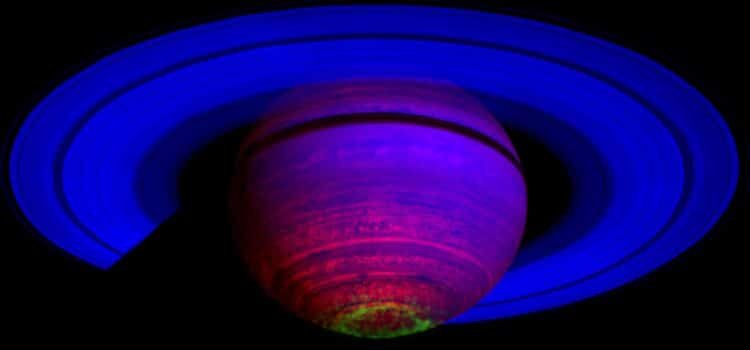
NASA and other research institutions have been studying Saturn’s behaviour and the composition of its atmosphere. The atmospheric properties of Saturn will provide scientists with essential knowledge to forecast weather on other celestial bodies, study how atmospheric systems develop, and test theories of planetary formation and evolution.
Uncovering Atmospheric Changes
Fresh data from Saturn shows significant modifications to its gaseous envelope, particularly when looking at the spread of temperatures across the globe and how clouds appear throughout Saturn’s atmosphere. Jet streams have fluctuated dynamically, including very vigorous storm systems, demonstrating that Saturn has undergone changes in its planet-wide atmospheric cycles over time, in conjunction with jet streams and storm systems.
These unique phenomena have important implications for understanding how gas giant planets operate, given the complexity of the interactions among heat generated within the planet, solar energy reaching the planet, and chemical reactions in its atmosphere. The new information gathered gives researchers an extensive view of how various inputs (both internal and external) contribute to the overall development of gas giant planet weather systems on a grand scale.
Shifts in Storm Activity
The latest data highlight differences between storms across Saturn’s atmosphere and provide scientists with new insights into how they function. Researchers can track changes in the intensity and frequency of large-scale storm systems on Saturn, as well as how these storms have changed over time.
These findings demonstrate that the long-term cycles affecting Saturn’s atmospheric behaviour their understanding of how energy flows on Saturn and how the various atmospheric systems change over time. Additionally, these findings create opportunities for comparison between Saturn’s weather systems and those of other worlds, such as Jupiter and Earth.
Temperature and Chemical Variations
Temperatures and chemistries throughout the planet Saturn’s atmosphere are shown to be greatly varied in the data as well. Several gases, including hydrogen, helium, and other trace gases, undergo changes in atmospheric chemistry as their molecular states shift. Changes in atmospheric chemistry can have an impact on the formation of clouds and energy transfer within Saturn’s atmosphere.
Data shows differences in temperature across layers. This will inform scientists in determining how internal heat, as well as external sources such as solar energy, contribute to these temperatures, providing a more accurate model of how gas giants maintain equilibrium and behave under changing conditions.
Implications for Planetary Science
Saturn’s atmosphere has undergone significant changes, with broader consequences for planetary science, particularly for understanding gas giant exoplanets within & outside our solar system. Studying Saturn enables scientists to build models applicable to similar gas giant exoplanets.
The data from this research may contribute to models that address how gas giants form & evolve, and how their atmospheres evolve. This information is critical in understanding what is happening in distant planetary systems and will help to explain the many differences between planets.
Advancing Observation Techniques
Technological innovations and improved data analysis techniques are now providing valuable insights into Saturn’s atmosphere. For example, high-resolution imaging, spectroscopy, and long-term monitoring now enable scientists to monitor changes in Saturn’s atmosphere more precisely than ever before.
Using these technologies will allow researchers to observe small-scale changes in atmospheric activity, thereby gaining new insights into how planets behave. Technology improvements should further aid understanding of gas giant planets and other celestial bodies, creating more opportunities for planetary science research.
Comparing Saturn with Other Planets
A major benefit of Saturn’s atmospheric dynamics is the insight it provides into other planets in the solar system. Gas giant Jupiter has an atmosphere comparable to Saturn’s, but because of differences in size, composition, and energy sources, the atmospheres exhibit very different characteristics.
Finding and studying these differences among planets helps identify basic principles or rules governing planetary atmospheres and also highlights the unique characteristics of each planet’s atmosphere. us conditions.
Long-Term Climate Cycles
There may be significant atmospheric trends reflecting long-term climate cycles spanning multiple years. These long-term variations can be extremely difficult to discern solely from short-term climate observations, without accounting for the full spectrum of climate change.
A way to better understand these long-term cycles is to accumulate long-term observations until we begin to develop an understanding of the structure of atmospheric variability. The accumulation of extensive datasets allows scientists to develop predictive capabilities for future trends and better understand the forces driving atmospheric variability. Ultimately, this knowledge is essential to the development of accurate models of planet-wide climates and their development over time.
Impact on Exoplanet Research
The recent discovery of Saturn has implications for all planetary systems of the universe. Hundreds of new exoplanets have been discovered in the last few years, and most are gas giants like Saturn, with atmospheres very similar to Saturn’s. Therefore, by applying data from Saturn, scientists will be able to enhance their interpretation of discovered exoplanets.
This link between nearby and distant planetary systems underscores the importance of using our solar system as a basis for studying planets from an astronomical perspective, both near and far.
Future Exploration and Research
NASA intends to continue using both observational missions and analysis of existing data to extend its existing research on Saturn and other gas giants in our solar system. Future missions may reveal much more precise information than previously gathered about atmospheric composition, weather patterns, and the internal structure of these planetary bodies.
Ongoing efforts will continue to provide accurate models, broaden our understanding of the universe’s fundamental processes, and answer new questions raised by current information. This research will require collaboration among national and international space programmes.
Looking Ahead: Expanding Planetary Knowledge
The new information from Saturn has vastly improved our understanding of planetary atmospheres. The new data show that the atmospheres of planets can change over time and that many different processes take place within those atmospheres, leading researchers to realise that earlier theories about the behaviour of gas giant planets may not be accurate, thus providing new areas for further study.
Ongoing investigation of this data should yield additional research findings that contribute to our current knowledge base on gas giant planets and planetary systems.
Conclusion: A Dynamic View of Saturn
NASA’s recent findings demonstrate that Saturn is a constantly changing planet with atmospheric processes far more complex and intricate than we originally thought. The major changes in Saturn’s atmosphere demonstrate that there is still much more to discover about our solar system through continued exploration and analysis of data.
The findings of this study will not only expand our knowledge of Saturn but also further our scientific understanding of how planets work, how climates develop, and the behaviours of other worlds in our universe.


