




News Summary
- Blueprint organizes and processes large data, generates synthetic data, applies reinforcement learning, and evaluates physical AI models for vision agents. Robotics and self-driving vehicles.
- Cloud service providers such as Microsoft Azure and Nebius use Blueprint. They turn large-scale computing power into agent-driven data. Production tools are ready for use.
- Top physical AI developers are using the blueprint to speed up the development of robotics, vision AI agents, and self-driving vehicles.
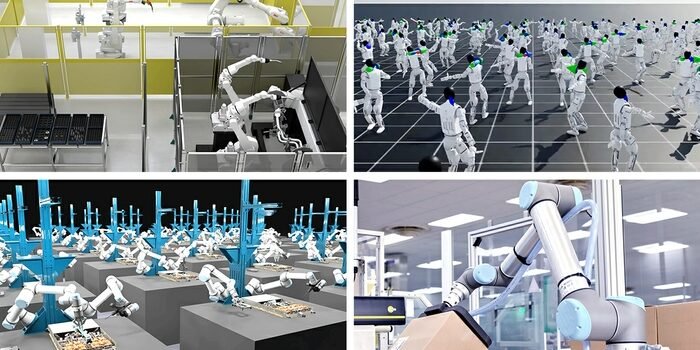
At GTC, NVIDIA announced the NVIDIA Physical AI Data Factory Blueprint. This open reference architecture automates and unifies training data generation, improvement, and evaluation, reducing cost, speeding up processes, and simplifying large-scale physical AI training.
With the blueprint, developers expand small training datasets into large, varied ones using Nvidia, Cosmos, Open World Base models, and top coding agents, including rare cases that are costly or difficult to collect in real life.
NVIDIA is working with Microsoft, Azure, and Nebius to connect the open blueprint to their cloud services. This lets developers use powerful computing resources to create large amounts of training data. Companies like FieldAI, Hexagon Robotics, Linker Vision, Milestone Systems, RoboForce Skild AI, Teradyne Robotics, and Uber are already using the blueprint to accelerate development of robotics vision AI agents and self-driving vehicles.
“Physical AI is the next frontier of the AI revolution, where success depends on the ability to generate massive amounts of data,” said Rev. Lebaredian, Vice President of Omniverse and Simulation Technologies at Nvidia. Together with cloud leaders, we are adding a new kind of agentic engine that transforms compute into high-quality data, enabling the next generation of self-governing systems and robots to come to life. In this new era, compute is data.
A Unified Engine for Physical AI Development
Physical AI improves as data, computing power, and model size grow. The Physical AI data factory blueprint acts as a single reference point. It helps teams turn raw data into training sets for models using automated workflows.
- Curate and search: Nvidia Cosmos Curator Manages, Improves, and Labels Large Real World and Synthetic (artificially generated) datasets
- Augment and multiply: cosmos transfer greatly increases and diversifies the selected data, combining real and simulated inputs to better cover rare and unusual situations across different environments and lighting conditions.
- Evaluate and validate Nvidia Cosmos Evaluator, which uses Cosmos Reason and is now on GitHub. Check scores and filter generated data by sensory accuracy and training readiness.
NVIDIA is using the Physical AI Data Factory Blueprint to train and test NVIDIA Alpamayo. Alpamayo, the world’s first open reasoning-based vision-language-action model for long-tail autonomous driving. Skild AI uses the blueprint to improve general-purpose robot-based models. Uber uses it to speed up autonomous vehicle development.
Agent Driven Orchestration At Scale
Many robotics developers do not have the resources to set up and manage complex AI systems needed to generate data at scale.
NVIDIA Osmo is an open source orchestration framework that brings these workflows together across multiple computing environments. It reduces manual work, allowing developers to focus on building their models.
Osmo now works with top-count agents like Claude Code, OpenAI Codex, and Cursor. This enables AI agents to manage resources, resolve bottlenecks, and accelerate model deployment at scale.
Powering The Global Physical AI Ecosystem
Cloud service providers are essential for fast AI infrastructure, machine learning operations, and orchestration services. Developers use these to build the process of the pro Build and launch physical AI at scale.
Microsoft Azure is adding the Physical AI Data Factory blueprint to an open Physical AI toolchain. Now on GitHub, the blueprint connects with Azure services such as Azure IoT Operations, Microsoft Fabric, Realtime Intelligence, and Microsoft Foundry to provide businesses with agent-driven workflows for quickly and at-scale training and testing of physical AI systems.
FieldAI, Hexagon Robotics, Inca, Vision, and Teradyne Robotics are among the first to try the Azure Physical AI tool chain. They use it to speed up and scale data generation, improvement, and evaluation for perception, mobility, and reinforcement learning systems.
Nebius has added Osmo to AI Cloud, enabling developers to use the blueprint to set up data pipelines ready for production and tailored to their needs. Navy S’s system supports the entire physical AI stack, combining NVIDIA RTX Pro 6000 Blackwell Server Edition GPUs with fast object storage, built-in data management and labeling, serverless execution, and managed inference.
Early users such as Milestone Systems, Voxel 51, and RoboForce are using the blueprint on Nebius infrastructure to accelerate the development of video analytics, AI agents, self-driving vehicles, and industrial humanoid robots.
The NVIDIA Physical AI Data Factory Blueprint launches on GitHub in April.


