

Tesla has recently announced a significant upgrade to the Full Self-Driving (FSD) operating system, which will use artificial intelligence (AI) to make decisions, thereby improving safety, efficiency, and overall driving performance. This latest release reflects Tesla’s commitment to continuously improving autonomous vehicle technology, as demonstrated by advanced neural networks, real-time data, and machine learning, to deliver more intelligent and reliable driving experiences.  

Advancing Autonomous Driving with AI  

Tesla’s full self-driving (FSD) uses artificial intelligence (AI) to understand complex road conditions, detect current situations, and offer alternative options while driving. The most recent update to the system has worked to improve the way that AI handles difficult driving situations like complicated intersections, merging onto highways, and driving through cities where traffic is unpredictable. 

By improving neural network performance, Tesla aims to enable its vehicles to make the necessary decisions to anticipate other drivers’ actions, react smoothly to changes, and reduce the risk of sudden movements. These are all important contributions towards improving both safety and efficiency in the creation of autonomous driving technology. 

Key Improvements in Decision-Making  

The new software update adds many improvements to how Tesla’s AI analyses and acts on driving data. Using advanced models, the system can predict vehicle, pedestrian, and cyclist behaviour more accurately, enabling it to optimise speed, lane changes, and navigation around obstacles.  

The update has also improved the AI’s ability to interpret traffic signals, signs, and road markings, helping increase compliance with traffic regulations and improve route planning. The improvements have been made to create smoother, more human-like driving behaviour, thereby enhancing passenger comfort and safety.  

Real-Time Data Processing and Machine Learning  

The essential feature that makes Tesla’s updated fully self-driving (FSD) system successful is that it has the capacity to analyse AR data being fed into advanced machine-learning algorithms, which allow the car to constantly monitor its surroundings and alter its driving strategy on an ongoing basis.  

All this allows the vehicle’s AI to react quickly to unanticipated events, such as a vehicle braking suddenly, a vehicle entering its lane, or impending adverse weather. The combination of high-speed analysis and predictive modelling will yield consistently superior autonomous driving outcomes.  

Enhancing Safety and Reducing Human Error  

The system will help reduce the risk of modelling modeling and proactive movement, thereby reducing the likelihood of collisions and improving overall traffic flow.  

The updates will significantly improve the AI’s ability to react quickly to emergency situations, enabling it to respond more effectively to sudden hazards. Thus, these changes continue to push Tesla toward its goal of developing autonomous vehicles that can drive safely and efficiently without human intervention in many types of environments.  

Adaptive Learning and Continuous Improvement  

By employing an ongoing learning model based on total driving data from its combined fleet of vehicles over 1 million miles, Tesla can leverage actual in-vehicle experiences to evolve its AI function through a centralised training methodology. 

Through this process of adaptive learning, Tesla’s FSD software continues to improve as it learns to drive in diverse conditions (urban centers have different driving conditions than rural areas). FSD uses these improvements to deliver enhanced performance while driving on the road.  

Impact on Driver Experience  

The goal of the update is to enhance safety and convenience and reduce driver stress. The AI system in cars now makes better decisions; as a result, it can perform routine driving functions with less effort, giving the driver more time to observe and monitor the system rather than constantly needing to take control of the vehicle.  

By improving AI responsiveness and having smoother navigation routes, FSD cars will provide a more comfortable ride for passengers – especially when travelling f automation; however, it will still require the driver’s attention to ensure safety.  

Competition and Industry Context  

The field of robotic transportation is advancing rapidly, with numerous automotive and tech companies tapping AI advancements to develop robotic technologies. In particular, the continual updates to Tesla’s self-driving hardware put its product ahead of any other automaker’s efforts to develop a fully autonomous vehicle.  

The real-time decision-making of AI used for self-driving cars continues to improve, and combined with the fleet learning feature (meaning all Tesla vehicles “learn” as they use), Tesla will continue to develop and maintain a competitive edge while also showing technological advances in how well the technology will perform in normal day-to-day driving.  

Challenges and Limitations  

Autonomous driving systems still struggle with challenges, even with the many improvements; many systems need to handle complex and unpredictable situations, such as construction sites, inclement weather, and other unusual traffic conditions, which require careful artificial intelligence (AI) interpretation.  

The balance between automated and driver oversight is incredibly important at this time. In addition to AI issues, regulatory approvals, legal frameworks, and basic public acceptance can also affect the speed of autonomous vehicle deployment. As Tesla continues to move towards greater levels of autonomy, it is critical for them to maintain transparency, safety, and trust in their vehicles.  

Future Developments  

The company will also continue to refine FSD functionality through software updates, utilising data obtained from Tesla’s fleet and new AI modelling insights. Enhancements to FSD can include greater predictive capabilities, improved handling of uncommon edge cases, and better integration with other Tesla products that provide safety and automated functions.  

Innovation is crucial for achieving Tesla’s objective of manufacturing fully autonomous vehicles capable of being safely operated in a variety of driving scenarios.  

Looking Ahead: Smarter, Safer Driving  

Tesla has proven its intent to push the limits of your car’s capabilities with the new FSD updates. Combining AI and machine learning with real-time processing of sensor data has enabled Tesla to create cars that make better decisions while driving.  

With continuing advancements in technology, we will see improvements in your vehicle’s safety and a decrease in the amount of ‘work’ each driver must do to get from point A to point B. Ultimately, this will help fulfil the dream of an entirely autonomous, self-driving world. 
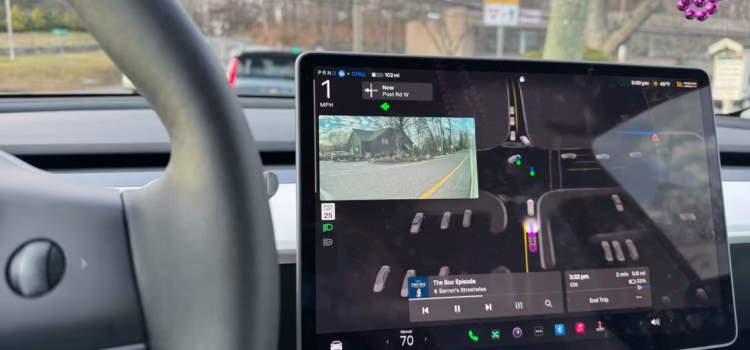
Source: Standardizing Automotive Connectivity 

Tesla is making progress on its full self-driving (FSD) software by testing it extensively in real-world conditions and adopting end-to-end neural networks by March 5, 2026. The software, now called full self-driving (supervised), had collected billions of miles of driving data from more than six million vehicles to boost security and performance.  

Key Developments Within Real-World Testing 

  • End-to-end neural networks, a type of artificial intelligence model that processes input data and generates outputs without separate, hand-coded rules, are central to version 12. Tesla replaced more than 300,000 lines of C code with neural networks trained on videos of real drivers. This change allows the car to handle complex situations by learning from real-world examples instead of following preset instructions.  
  • Elon Musk claims FSD version fourteen should surpass human driving by 2 or 3 times, while version 15 aims for 10 times better performance.  
  • Global expansion. Tesla has started piloting FSD internationally. Recent trials in China and Australia show FSD surpassed local competitors on highways and in urban areas, despite lacking initial local training data.  
  • Shadow mode. Every Tesla operates FSD in shadow mode, where the software silently predicts actions and compares them to the driver’s choices; discrepancies are identified for further learning.  

Technological Innovations 

  • A vision-only approach, unlike competitors who use LiDAR or RADAR. Tesla relies exclusively on eight cameras and artificial intelligence to interpret its environment.  
  • Tesla’s Dojo supercomputer processes vast video data, enabling fast updates and retraining of AI models.  
  • Occupancy networks are AI models that enable software to generate a real-time, three-dimensional bird’s-eye view of the road. This view maps the location of vehicles, pedestrians, and obstacles around the car, enabling the system to better anticipate the movement of surrounding objects and predict possible future events.  

Continuing Difficulties & Scrutiny 

  • The NHTSA is still investigating FSD’s performance in low-visibility conditions and driver supervision.  
  • Despite its name, Full Self-Driving (FSD) is classified as a Society of Automotive Engineers (SAE) Level 2 system. SAE levels range from 0 (no automation) to 5 (full automation), and Level 2 means the vehicle can control steering and speed but still requires the driver to supervise and be ready to take over at any time.  
  • Edge case issues, such as phantom breaking and the interpretation of ambiguous line markings, remain significant engineering hurdles. Test continues to address these challenges in ongoing evaluations.  

Tesla, the well-known electric car company known for its daring, sometimes debated automated driving technology, has just made a major change. to its full self-driving (FSD) software led by Elon Musk. The company is replacing its old F. FSD code with a new system as it prepares to launch its robotaxi service.  

This change replaces the old code with a neural network-based system that interprets and adapts to real driving situations. It marks a significant departure from the previous rule-based model.  

A Major Shift 

Previously, the old FSD software relied on a complicated set of rules to help cars manage different driving situations. While effective at times, it often struggled with the unusual or unexpected events that drivers encounter on the road. In contrast, Tesla’s new FSD uses deep learning, letting the car learn from vast amounts of real-world driving data by observing it. In many different situations, the system can better understand its surroundings and adjust its driving.  

With this transition to neural networks, several potential benefits emerge. The system can learn and improve over time without manual updates, continuously refining its decision-making as it experiences more types of driving situations.  

However, moving to a neural network also entails new challenges. It’s important to ensure people understand how the system makes decisions, which helps build trust in the technology. Regulators, safety experts, and consumers all want to know how the software decides what to do, especially if something goes wrong.  

People online have mixed opinions about the new system. CEO Michael Dell praised it on X, saying, “Super impressive. Tesla FSD v12.3 is like a human driver.” But some Reddit users had a different take: “I had my first experience with it, and it felt as if having a 15-year-old driver. It’s a very cool technical demo, but I feel like they have a long way to go to achieve their initial goal like at least 5 more years until they can even argue it’s level 4 or 5.”  

Tesla’s History With Safety and Autonomy 

Tesla began developing autonomous driving in 2014 with the launch of its Autopilot system. Initially, Autopilot featured adaptive cruise control and lane-keeping assist. Since then, Tesla has consistently refined and expanded Autopilot, aiming to eventually achieve full self-driving capability.  

Tesla’s push regarding autonomy has faced multiple challenges and controversies. The company has been criticized for marketing Autopilot and FSD features in ways that some say could mislead customers about what the systems actually do. There have also been several well-known accidents involving Teslas using Autopilot, raising concerns about the technology’s safety and reliability.  

Following these incidents, the National Highway Traffic Safety Administration (NHTSA) initiated an investigation into Tesla’s Autopilot system. In a statement, the NHTSA emphasized the importance of ensuring that vehicles with automated driving systems operate safely and as intended, necessary to maintain public trust and confidence in these technologies.  

Tesla’s decision to fully update its FSD software has drawn mixed reactions from specialists and safety advocates. Some people worry about the risks of rolling out new technology on a larger scale, especially given Tesla’s mixed track record with self‑driving technology.  

Experts say renaming “full self‑driving” to “supervised full self‑driving” clarifies the system’s capabilities. Pratik Chaudhari, an engineering professor and former developer of autonomous taxis, noted that drivers have always been required to provide active supervision. The new name emphasizes this fact.  

Obstacles in Achieving Full Autonomy 

Chowdhury pointed out the shortcomings of current automotive driving technology, stating that there are still regular incidents in which Teslas and assistive autonomous cars from other car makers have behaved in an unsafe manner. The driver is expected to remain alert and intervene in the event of such incidents. He stressed the challenges of handling unforeseeable human behavior and of ensuring a car is 99.99% safe, given the vast diversity of situations that can occur on the roads.  

A major challenge for total autonomy is getting driverless cars to handle unusual or unexpected situations. Machine learning and computer vision have improved significantly in recent years, but these technologies still have a long way to go before they can match the way humans adapt and make choices on the road.  

Self-driving companies use various strategies to improve safety and reliability with real-world testing, exposing software to a wide range of situations. As Chaudhary noted, ensuring full safety remains difficult due to the sheer diversity of scenarios vehicles may encounter.  

Alternative Approaches to Automated Driving Technology 

Tesla mainly uses visible-light cameras and neural-network software for its automated driving technology, but other companies are adopting different approaches. Shawn Taikratoke, CEO of autonomous mobility startup Mozee, said he was impressed by Tesla’s choice to rebuild its FSD software. He explained that Tesla’s daring decision to rebuild its full self-driving suite reflects a culture that focuses on speed, originality, and responsiveness qualities that are critical as it works toward ambiguous, ambitious targets, such as deploying robotaxis.  

Mozee takes a different approach by using a broader range of sensors, including radar and infrared sensors. This ensures their vehicles work well in many settings. Taikratoke said our diverse sensor approach ensures our vehicles can function reliably across a wide range of environments. These include the planned pathways of university campuses and the unforeseeable streets of metropolitan centers. By maintaining this flexible and thorough approach, we ensure that our technology is adaptable and scalable. This reflects our customers’ diverse demands and the environments in which they operate.  

Mozee believes that for self-driving technology to succeed, vehicles and infrastructure must communicate seamlessly to form a connected network that enhances safety and efficiency. Taikratoke stressed the need for teamwork and partnerships to move the business forward. He said as we grow, this adaptivity will be critical not only to fulfilling but surpassing the expectations of our partners and the communities we serve. We are excited to partner with industry leaders like Tesla to shape the future of transportation and create a safer, more effective world for all.  

As the industry evolves, companies like Tesla, Mozee, and Waymo are leading the way in developing flexible, expandable solutions that prioritize safety, efficiency, and real-world use, although some people are concerned about Tesla’s complete overhaul of its FSD software. It demonstrates the company’s commitment to innovation and its readiness to tackle the challenges of building fully self-driving vehicles.  

To make fully self-driving vehicles a reality, more technological advances are needed, along with progress in regulations and community acceptance. Governments and regulators must set explicit rules and standards for the development, testing, and use of self-driving vehicles. Building community confidence is also important, since people need to feel confident in the safety and performance of these systems before they become common.  

In a 2020 interview, Elon Musk expressed optimism about self-driving technology. He said, “I am extremely confident that we will have the basic functionality for level 5 autonomy completed this year.” Still, he admitted there are challenges. “There are many small problems that need to be solved, and there’s the challenge of solving all those small problems and putting the whole system together.”  

As the self-driving industry grows, companies, researchers, and regulators will need to work together to develop self-driving technology safely and responsibly. By joining forces to address the technical, legal, and social challenges of self-driving vehicles, we can help establish a future in which self-driving transit changes how we live, work, and travel.  

As Chowdhari noted, achieving safe driving is also a slow march of the nines. This means making the system 99%. 99.9% safe, then 99.999%, and so on. The aim is always to improve and solve rare problems. It requires technological progress as well as progress on policy and infrastructure.

Source: Tesla’s new self-driving software throws out its old code entirely