



Round Rock, Texas
Round Rock, Texas, is at the heart of a major change in enterprise AI infrastructure. This shift isn’t about a big cloud deal, but about what Dell Technologies is doing locally, at the edge, away from large data centers.
Utilities and industrial operators no longer wonder if AI can improve grid management; that is already clear. Now, they are asking if the latency, data control, and costs of cloud-based AI are acceptable for systems where delays could cause outages for many customers. More grid operators are saying no, and the Dell AI Factory aims to solve this problem.
The Dell AI Factory and the Case for Local Inference
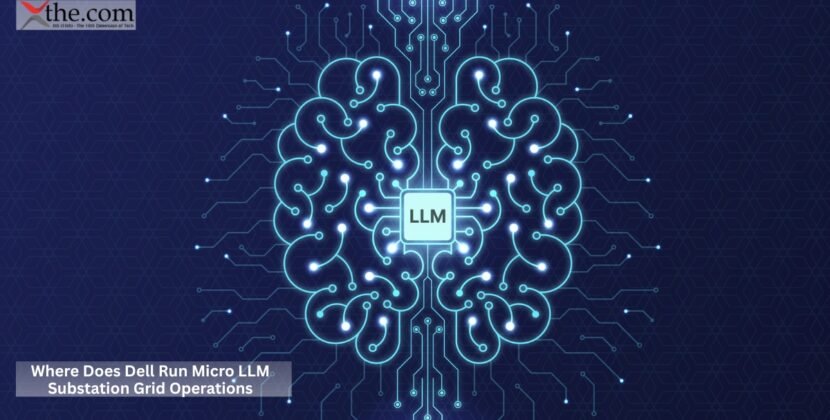
The Dell AI Factory is not just one product. It is a set of Dell hardware, software, and services designed to bring AI workloads closer to where data is created. The main idea is to challenge the belief that advanced AI must rely on large cloud providers. Instead, Dell shows that small, dedicated local inference nodes can outperform big cloud systems regarding latency, cost, and control.
Imagine a transmission substation that monitors real-time voltage changes on a 345 kV line. A cloud-based model adds at least 80 to 120 milliseconds of delay in the best network situations, and even more during storms or network issues exactly when operators need quick insights. A local inference node using Small Language Models can make decisions in under 10 milliseconds. For relay logic and fault detection, this speed difference can mean the difference between safely isolating a fault and a widespread failure.
Rugged PowerEdge XR: The Hardware Doing the Work
The Rugged PowerEdge XR servers are Dell’s solution for tough situations where regular rack servers would not last long. Substations are not like climate-controlled data centers. They face temperatures from -40°F in Alberta winters to 140°F in Texas summers, and deal with electromagnetic interference that standard hardware cannot handle.
The Rugged PowerEdge XR series, especially the XR11 and XR12 models, is built with shock and vibration resistance, wide temperature ranges, and special airflow systems to keep out dust and particles found in factory conditions. With NVIDIA L4 or L40S GPUs in a compact design, these servers can now handle inference tasks that required a whole server room just five years ago.
This is not just theory. One regional transmission organization tested this setup and moved its AI-assisted anomaly detection from the cloud to Rugged PowerEdge XR nodes at 14 substations. As a result, they cut monthly inference costs by 61% and no longer rely on WAN connections for urgent alerts.
Small Language Models and Why Bigger Is Not Better at the Edge
For three years, the enterprise AI market focused on building bigger models with more parameters and larger training sets. This approach worked for knowledge workers using AI in a browser. But it does not meet the needs of a relay engineer who just needs a model to determine whether a voltage pattern indicates a transformer fault or a harmless spike.
Small Language Models, which have between 1 and 7 billion parameters and are fine-tuned on specific datasets, perform better than large general-purpose models on particular, high-stakes tasks. They need much less GPU memory, so they can run on edge hardware that cannot handle huge models. Fine-tuning on specific tasks also gives higher accuracy, and the cost per query is much lower.
A Small Language Model trained on 18 months of SCADA data from a specific grid setup will consistently outperform GPT-class models at fault-signature classification. It also keeps all queries inside the substation, so no data leaves the site.
On-Premises Task-Specific Language Models Edge Deployment: The Financial Architecture
The financial argument for using on-premises, task-specific language models edge deployment should be as carefully considered as any major infrastructure investment. The real comparison is not cloud versus nothing, but cloud API costs versus the cost of hardware and operations over time. All-inclusive per day across monitoring applications, cloud API costs at current commercial rates run approximately $18,000–$26,000 per month, depending on the model tier and token volume. A Rugged PowerEdge XR node with sufficient GPU capacity to handle that workload costs roughly $28,000–$45,000 in capital expenditure, with a hardware lifecycle of five to seven years. The break-even point for on-premises, task-specific language model edge deployment typically falls between 8 and 14 months. Everything beyond that window is operating cost savings — frequently exceeding $200,000 over a standard asset lifecycle.
There is another financial benefit that is often overlooked but is very important for regulated industries: data that stays on-site never triggers a regulatory disclosure. For utilities following NERC CIP standards, local inference is not just cost-effective. It also meets compliance requirements in ways that cloud-based AI cannot.
What Round Rock Is Building Toward
Dell chose to base its AI Factory development and testing in Round Rock for both practical and representative reasons. The campus brings together the engineering teams that test Rugged PowerEdge XR servers, the software teams working on inference optimization with tools like NVIDIA TensorRT-LLM, and the services group that manages field deployments for critical infrastructure clients.
Having all these teams in one place speeds up the feedback between hardware design and actual use. This is important when customers are installing Small Language Models on servers at substations in Saskatchewan or solar farms in West Texas.
The time to modernize the grid is short, and the choices made now will shape operations for the next 15 to 20 years. Utilities and grid operators who carefully compare on-premises, task-specific language models with cloud options—considering latency, data rules, and long-term costs—are most likely to end up with AI systems that genuinely meet the grid’s needs.
The Dell AI Factory, built on the Rugged PowerEdge XR platform and custom Small Language Models, is not waiting for the market to catch up. It is already being used in real-life contexts.
Source: The Farewell to the Round Trip: Why Your AI Needs a Local Address