






Santa Clara, California
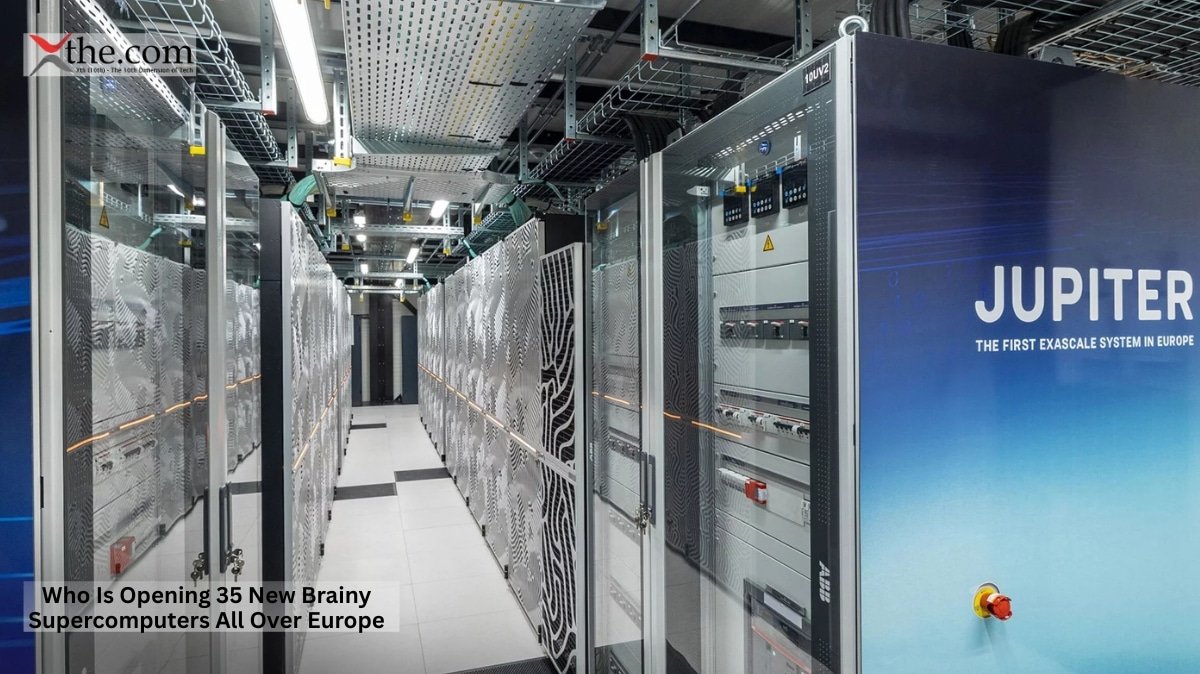
Thirty-five mega-servers. Twenty-three countries. One big announcement. On June 22, 2026, NVIDIA’s AI supercomputers Europe became the defining story at ISC High Performance in Hamburg — and the aftershocks will reach every corporate data team, hardware buyers, and government research offices from Lisbon to Warsaw. This isn’t just steady growth. It’s the biggest single-year supercomputer expansion in European history, with effects that reach far beyond Europe.
The Scale Behind NVIDIA AI Supercomputers Europe
The numbers speak for themselves. NVIDIA announced a record 35 AI HPC supercomputers being built across Europe. These will give over 3 million researchers access to next-generation infrastructure for AI, science, and industry. Together, the systems have provided about 800 AI exaflops of capacity across European research networks since last year, either already in use or soon to be.
To give some perspective, one exaflop equals one quintillion floating-point operations per second. Climate scientists who used to wait weeks for simulation results can now get them in hours. Drug discovery that once took years can now be done in months. These machines aren’t just faster; they open up entirely new possibilities.
These new systems, unveiled at ISC High Performance 2026, will be placed at national supercomputing centers, AI factories, and research institutes to provide accelerated computing resources to more than three million researchers.
The Hardware Architecture Powering the Grid
Three main installations show how NVIDIA is rolling out these systems across Europe, and the engineering choices highlight their strategy.
Italy’s IT4LIA: The Dense Core
IT4LIA is building an AI factory with over 8,000 GPUs using NVIDIA GB200 NVL4 systems, Quantum-X800 InfiniBand networking, and NVIDIA AI Enterprise software. This setup delivers 82 exaflops for AI training and 164 exaflops for AI inference. That many GPUs match what most national computing programs had five years ago. The Quantum-X800 InfiniBand architecture connects these GPU nodes, providing the fast, high-bandwidth communication needed for advanced AI tasks. These systems are built to handle autonomous, multi-step reasoning at an industrial scale, not just process simple database queries.
Germany’s HammerHAI: Sovereign AI Infrastructure
HLRS’s HammerHAI will provide Germany’s first AI factory with more than 850 GPUs via NVIDIA GB200 NVL4 systems and Quantum-X800 InfiniBand. This setup will provide up to 8 exaflops for AI training and 15 exaflops for AI inference, offering secure AI infrastructure for researchers and industry. The idea of “sovereign” AI is important here. Germany isn’t just buying computing power; it’s building its own national AI capability on infrastructure it owns and controls.
Bavaria’s Blue Swan: Regional Science at Scale
BavariaAI’s Blue Swan project adds 1,000 GPUs, NVIDIA GB200 NVL4 systems, and Quantum-2 InfiniBand networking to the FAU Erlangen and LRZ supercomputing centers. This will provide up to 11 exaflops for AI training and 22 exaflops for AI inference. Blue Swan’s goals include creating open multimodal models for public administration, so that German civil servants will use AI systems trained on domestic infrastructure rather than relying on foreign cloud services.
What Agentic AI Has to Do With Supercomputers
NVIDIA’s senior director of HPC and AI Factory Solutions, Dion Harris, stated: “We are currently witnessing a massive inflection point with agentic AI. AI is shifting from a tool that simply answers questions to an autonomous system that executes complex tasks.”
This shift changes the purpose of supercomputers. Traditional HPC tasks ran set simulations with fixed inputs and outputs. Agentic workflows are different—they are iterative, self-directed, and require lots of data that add up over time. The NVIDIA AI supercomputers in Europe are built specifically for this, not just adapted from older systems. The Quantum-X800 InfiniBand network connecting these clusters is designed to handle the fast data exchange that agentic AI needs.
The Mission and Vision systems at Los Alamos National Laboratory in the US will be the world’s first agentic AI supercomputers when they come online. Europe’s infrastructure is being built with precisely that operational model in mind.
How This Alters International Science Data Pipelines
The 35 systems don’t work as separate installations. Instead, they form a grid, and this setup has big effects on how data moves around the world.
In the past, European research networks in areas such as climate science, genomics, and materials research regularly sent their biggest computing jobs to US facilities or commercial cloud providers. The new systems will support research in climate science, healthcare, clean energy, quantum computing, and basic science. This means more work will stay within Europe. Climate research groups working with partners in Hamburg, Bologna, and Stockholm can now use local high-speed networks, which reduce delays and legal risks when moving data across borders under GDPR.
NVIDIA is helping speed up AI-driven work in climate science, healthcare, and clean energy. For example, Siemens Energy used NVIDIA technology to cut gas turbine simulation durations by up to 77%. This kind of time savings isn’t just a small improvement—it changes the economics of engineering research and development for the whole industry.
The Quantum Dimension No One Is Leading With
European research centers, including CINECA, Fraunhofer FOKUS, the Barcelona Supercomputing Center, and the Jülich Supercomputing Center, are merging quantum hardware and software platforms to support combined quantum-classical computing applications.
Jülich Supercomputing Center used NVIDIA GH200 Grace Hopper Superchips to simulate a universal 50-qubit quantum computer. The JUQCS-50 simulator lets researchers examine the limits of quantum problem-solving without waiting for real quantum hardware to be ready. This hybrid method pushes research forward by years.
The NVIDIA AI supercomputers Europe infrastructure expansion 2026 is therefore more than a story about GPU arrays. It is a story about the simultaneous convergence of accelerated computing, quantum emulation, and agentic AI architectures across a geopolitically coherent region.
What American Executives and Investors Need to Watch
For US-based companies, the big question is how hardware will be allocated. NVIDIA’s Blackwell and GB200 NVL4 systems are being rolled out across 23 European countries. Every unit sent to IT4LIA or HammerHAI is one more piece moving through a global supply chain that’s already under heavy demand.
The announcement demonstrates Europe’s continued commitment to expanding its AI and supercomputing infrastructure, as governments, research organizations, and technology companies compete to expand their respective computing capacities and secure their positions in advanced scientific research.
For tech leaders planning their own AI infrastructure, the main takeaway is about structure. Europe’s NVIDIA AI supercomputer rollout shows how national-scale computing can be quickly set up across borders when there’s political support and the right hardware. The 35-system grid wasn’t built slowly over ten years—it came together in just one.
The New Geography of Compute Power
Jensen Huang stated, “AI is the new instrument of science, and Europe is building the infrastructure to put it in the hands of millions of researchers.”
That description is true, but it doesn’t tell the whole story. Europe is also building its own infrastructure to rely less on American and Asian computing for its AI development. The 2026 NVIDIA AI supercomputers expansion in Europe isn’t about isolation—NVIDIA is still an American company, and the hardware supply chain is global. Instead, it marks the rise of a third major computing region, capable of running advanced AI workloads at scale across a group of allied countries.
The push to build next-generation infrastructure across European networks is moving so fast that things change every month. Any organization that still treats European AI capacity as a side issue is relying on an outdated plan.
Source: Europe Unveils a Record 35 New NVIDIA AI Supercomputers