





Comcast Broadband Losses Hit 144,000 as Pricing War Escalates
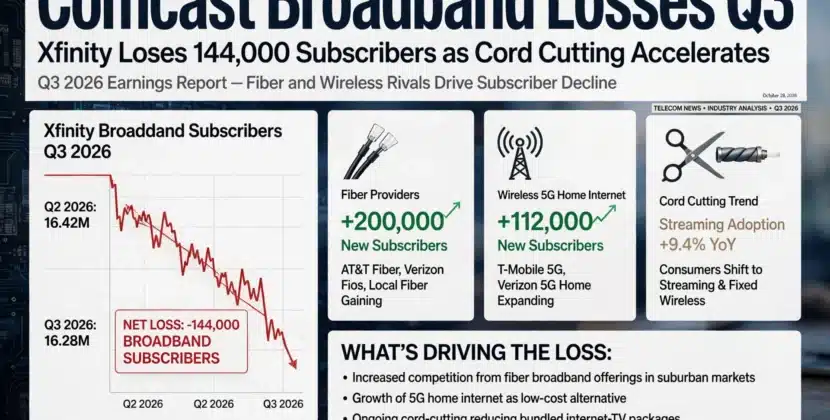
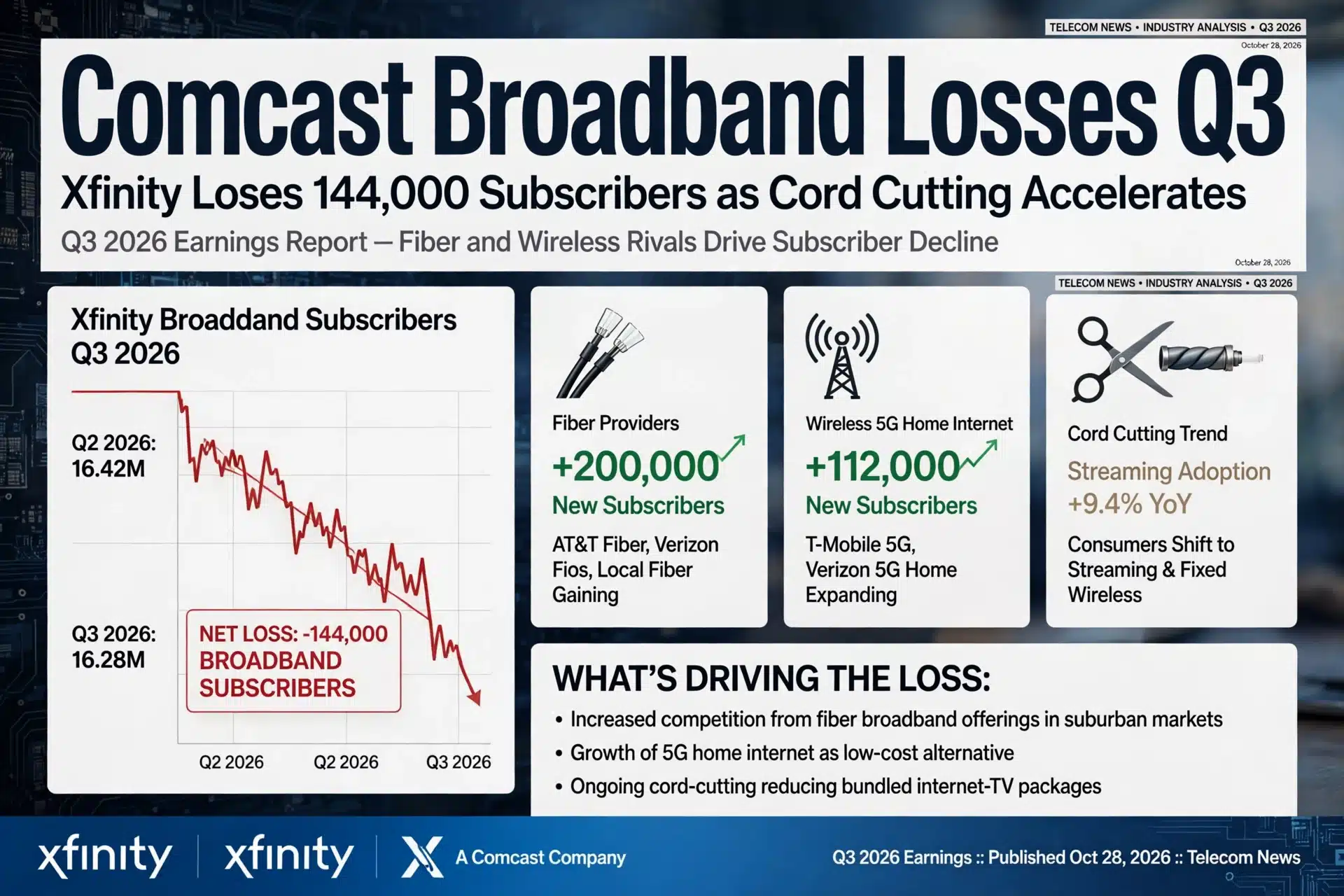
Comcast lost 144,000 residential broadband subscribers in the third quarter of 2026, worse than the roughly 116,800 analysts expected, and plans a $1 billion restructuring charge with layoffs in Q4. The Comcast broadband losses tell us exactly where the US home-internet market is heading: a pricing war that is good for consumers and brutal for cable.
Key Takeaways:
- – Comcast shed 144,000 residential broadband subscribers in Q3 2026, versus 91,000 a year earlier.
- – Its Connectivity & Platforms revenue fell 2.7% to about $19.7 billion; Q4 brings a $1 billion restructuring charge and layoffs.
- – Executives blamed aggressive fixed wireless and fiber overbuilders selling gig internet for $30-40 a month.
- – Analysts project roughly 203,000 more losses in Q4 and intensified competition in 2027 as Starlink scales.
- – For US households, competitors’ low prices are the practical takeaway; cable pricing discipline may finally soften.
What Comcast reported and why the trend is accelerating
The quarter’s headline number, 144,000 lost residential broadband subscribers, came with a comparison the company did not volunteer: a year earlier the loss was 91,000, so the bleeding is getting worse rather than stabilizing. On the earnings call, co-CEO Michael Cavanagh described an “intensely competitive environment,” adding that fixed wireless rivals “continue to take share” while fiber construction stays elevated with what he called pockets of “irrational pricing.” CFO Jason Armstrong gave the blunt version: costs to build fiber run about $1,500 or more per home, and at $30 to $40 a month for gigabit service, someone is building at a loss.
The erosion has a simple economic explanation. A fiber or fixed-wireless competitor that wins a household pays the subscriber’s monthly bill from a converged business, where the same customer often carries the carrier’s wireless line, so the household broadband price is a customer acquisition spend rather than a standalone profit center. Comcast, for all its scale, cannot make that trade the same way AT&T, T-Mobile, and Verizon can, and TD Cowen analyst Gregory Williams argued the “irrational” competition in isolation is close to break-even once convergence is counted, which means it is rational for the people running it and will, in his words, continue.
What the $1 billion restructuring means for customers and jobs
Comcast is taking a $1 billion restructuring charge in Q4 as it launches what it calls transformations in the Connectivity & Platforms business, including layoffs. Two effects matter for readers. On jobs, the cuts come as the company leans harder into AI-assisted customer service, which TechSpot and other outlets framed as agents taking over support workflows; support quality through 2027 will be a real test for subscribers troubleshooting service outages and home network issues. On service investment, the risk is timing: analysts, including Wolfe Research’s Peter Supino, worry that any cost savings will be redirected into lower broadband prices rather than into growth engines like mobile convergence and edge compute, which means the money goes to defending share rather than building new capacity for a period.
None of this signals a retreat from the broadband business; it is a consolidation for efficiency while the market resets. For consumers who subscribe today, the near-term symptoms will be promotional pricing with fine print and rep-facing retention offers when you threaten to cancel. Under the hood, the same trend that is costing Comcast subscribers is the one that makes your next bill negotiation easier: competition has priced a gigabit tier at levels cable historically never matched.
Where the Comcast broadband losses go next
BNP Paribas analyst Sam McHugh expects about 203,000 more subscriber losses in Q4 and calls 2027 challenging for the same reasons, with a Starlink overhang on top. Supino laid out the two threats for next year: higher churn from legacy subscribers coming off promotional rates, and Starlink’s capacity growth exploding as new satellites come online, which widens the addressable pool of households that previously had an excuse to stay with cable, particularly in rural and suburban fringe areas. Neither analyst pretends Comcast will collapse; the question is how fast its fixed-line revenue base erodes and whether price cuts slow the slide.
For household decision-making, look at the competitive landscape now rather than next quarter. Fixed wireless home internet from T-Mobile and Verizon is widely available and priced aggressively, fiber overbuilders are undercutting cable in more zip codes every month, and Starlink is becoming a real option in places where there was only one wired provider. If your broadband contract is up in the next six months, the Comcast broadband subscriber losses imply the median promo price in your area has probably dropped; it is worth a five-minute phone call to your building’s service desk before renewing.
What happens next
Watch three things before the next earnings report. First, Q4 subscriber losses: if they come in around the projected 203,000, the restructuring’s price cuts do not stem the bleed and analysts’ bearish Q4 view is confirmed. Second, the pace and location of layoffs, which signal which parts of the wireline footprint Comcast considers worth defending and which are being left to erosion. Third, rivals’ earnings: if AT&T, T-Mobile, and Verizon keep posting converged share gains at broadband’s expense, expect Comcast’s pricing to start testing the $30-40 tier that executives currently call unsustainable, which would put real downward pressure on introductory broadband rates nationwide.
The Comcast broadband losses story is ultimately a market telling the truth about value. For the consumer, the war was never subsidized broadband; it is paying market rates for gigabit service, and in Q3 2026 the war moved in the consumer’s favor.
Frequently Asked Questions
How many subscribers did Comcast lose in Q3 2026?
144,000 residential broadband subscribers, versus 91,000 in the same quarter a year earlier and more than the roughly 116,800 analysts expected, per the company’s earnings call.
Why is Comcast losing broadband customers?
Management points to aggressive competition from fixed wireless carriers and fiber overbuilders that charge roughly $30 to $40 a month for gigabit speeds; analysts add that convergence economics let those competitors price broadband below standalone cost.
Will Comcast lower prices because of the losses?
Analysts expect continued competitive pressure and possible lower promotional pricing, but Comcast executives have said gig service at $30-40 is hard to sustain; cost savings from the $1 billion Q4 restructuring may go to price cuts rather than network growth, per Wolfe Research.
Sources:
- https://www.fierce-network.com/broadband/comcast-lost-144000-broadband-subs-q3-telecom-analysts-are-bearish-q4
- https://www.reuters.com/business/media-telecom/comcast-broadband-losses-deepen-competition-pressure-core-business-2026-10-22/
- https://www.techspot.com/news/114319-comcast-lost-144000-broadband-customers-last-quarter-planning.html