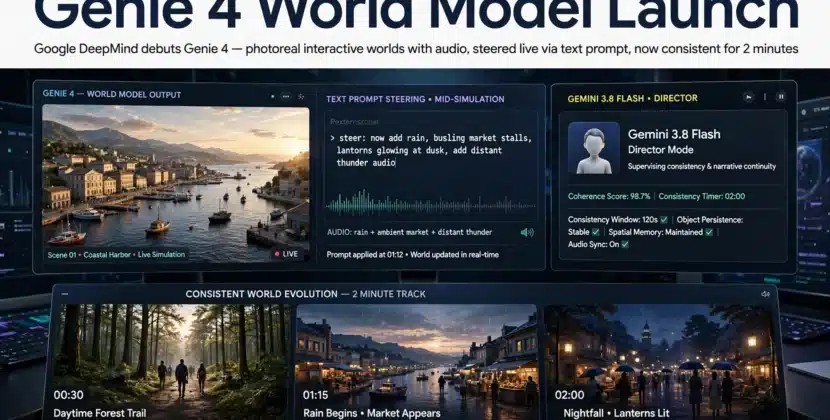






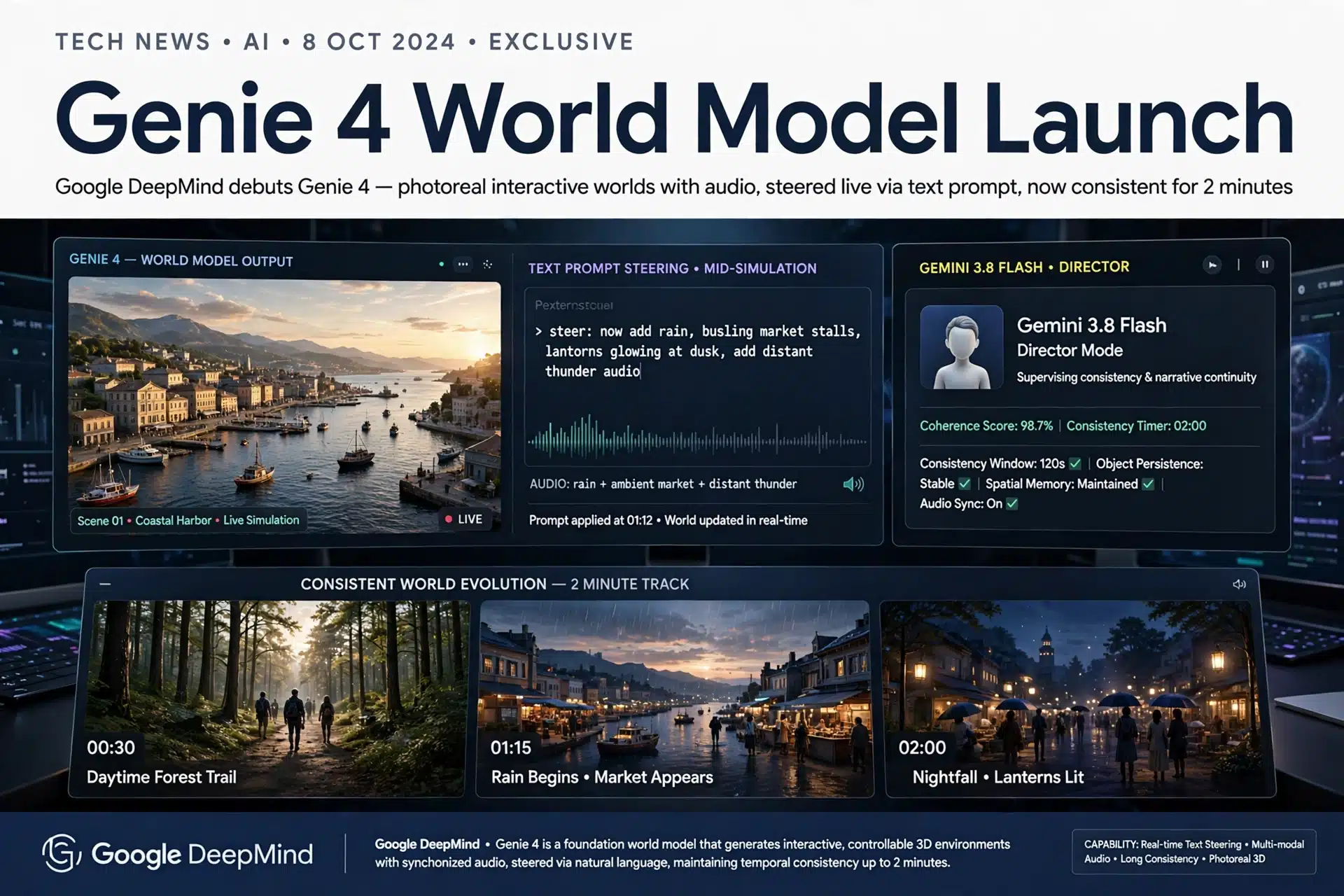
Google Genie 4 World Model Gets Real-Time Audio and Steering
Google DeepMind announced Genie 4 on Tuesday, October 27, 2026, its newest world model that generates photorealistic, interactive simulated environments users can steer in real time with typed prompts, complete with on-the-fly audio. Here is what the Genie 4 world model can do, who gets access first, and how it fits into a rapidly consolidating AI-simulation market that includes Runway, World Labs, and Amazon.
Key Takeaways:
- – Genie 4 launched on October 27, 2026 as a research preview for trusted testers, with wider rollout coming to Google AI Ultra subscribers through Project Genie.
- – The model maintains a consistent scene for up to two minutes, double the limit of Genie 3, with better physics and more humanlike characters.
- – Genie 4 generates native audio in real time, including ambient sounds, music, and interactive dialogue, alongside the visuals.
- – Users can type mid-simulation to change weather, move the camera, or add new characters and objects.
- – The world-model industry is consolidating: World Labs is being acquired by AMD, Amazon is in talks for Decart, and Rivian bought Third Dimension, per TechCrunch.
What Genie 4 is and what changed since Genie 3
A world model is an AI system that generates a simulated environment rather than a fixed video clip: the scene persists, responds to inputs, and obeys consistent internal rules, so a user can act inside it the way a player acts inside a game. Google released Genie 3 a little over a year ago as a research preview, and Genie 4 is the first major successor. The upgrades fall into three buckets: fidelity, duration, and interactivity. Fidelity improved with more photorealistic rendering and better physics. Duration doubled, from roughly one minute of coherent scene time in Genie 3 to two minutes in Genie 4, which matters because most practical uses, like storyboarding a scene or testing a robot’s route, need the world to stay consistent long enough to be useful. Interactivity is the headline: users can type instructions mid-simulation, and the model re-renders the world in response.
The audio generator is the other structural leap. Genie 4 produces ambient sounds, music, and interactive dialogue that match the simulated world as it changes. For US creators who currently cobble together AI visuals from one tool and sound from another, Genie 4 collapses two production steps into one, though Google’s own researchers caution that legibility of in-world text and audio accuracy remain unsolved gaps.
How Gemini and Genie 4 work together
Google describes Gemini, its frontier AI model, as the director of the system: Gemini plans the steps and checks the frames while Genie renders the world. In a research experiment tied to Gemini Robotics, a Gemini model broke a task into steps that Genie 4 then simulated in real time, a workflow Google positions as a way to test robot scenarios safely in simulation before running them on physical hardware. Tejas Kulkarni, research director at Google, told reporters that the future is hybrid world models, where Gemini writes code and text and Genie ingests it in real time to simulate reality at different levels of abstraction.
For US developers, the practical takeaway is that Google is laying the groundwork for simulation-as-a-service inside the Gemini API and AI Studio, where early access partners are expected to get Genie 4 in the coming weeks. Teams building robotics, autonomous driving, or game pre-visualization tools should watch the API rollout schedule, because access terms and pricing will shape which startups can compete with the labs that get first dibs.
Who gets access and when
Genie 4 is available now as a research preview to a limited group of trusted testers, the same curated pool Google uses for its most cutting-edge products. Over the coming weeks, the company plans two broader gates: Google AI Ultra subscribers will get access through Project Genie, Google’s tool for generating interactive worlds from text or image prompts, and early access partners will get it through the Gemini API and Google AI Studio. No public launch date has been announced, and Google’s engineers stressed in the press briefing that it is still early days and the end-to-end product experience is not settled.
For US readers deciding whether to subscribe to AI Ultra specifically for Genie 4, the honest answer is to wait a few weeks for the Project Genie rollout confirmation and early user reports on the two-minute coherence limit in practice, since the trusted-tester window will surface the real-world failure modes before the paying tier arrives.
What the Genie 4 world model means for creators and studios
Trusted testers are already pointing to a use Google did not lead with: film prototyping. Diego Rivas, a Google DeepMind engineer, said in the briefing that real-time simulation is most valuable where keeping a state of flow matters, such as the ideation and storyboarding phases, when creators need rapid iteration rather than finished footage. The plausible US production workflow looks like this: prototype a scene interactively in Genie 4, then hand the approved concept to Veo, Google’s AI video model that renders high-definition clips with synchronized audio, for the final asset. Rivas noted that Gemini Omni could eventually bridge those steps, turning prototypes into polished creative output, though he called those capabilities still a way off.
Competitive context sharpens the picture. Genie 4 arrives a couple of months after Runway released GWM Worlds 2, its second playable world model with audio. Meanwhile, per TechCrunch, the market is consolidating around the giants: Fei-Fei Li’s World Labs is being acquired by AMD, Amazon is in talks to buy Decart, and Rivian acquired Third Dimension to bring simulation in-house for self-driving testing. Genie 4 is Google’s counterweight in that consolidation, and its access model, embedded in subscriptions and an API most US developers already use, is itself a competitive weapon.
What happens next
Watch three markers. First, the Project Genie rollout to AI Ultra subscribers, promised in the coming weeks, which will show whether the two-minute consistency holds for paying users and what usage limits apply. Second, the Gemini API and AI Studio early access, which will reveal pricing and commercial terms that determine whether startups can build on Genie 4 or only experiment. Third, the robotics angle: if the Gemini-orchestrated simulation experiments mature, expect Google to position world models as the training ground for physical robots, a market where US manufacturers and warehouse operators have been waiting for affordable, safe scenario testing.
The honest limitations are in Google’s own briefing: objects and details drift the longer a simulation runs, audio accuracy and in-world text legibility are unsolved, and the product experience is unfinished. Genie 4 is a research milestone heading toward a product, not a shipping tool for most Americans today. But the direction is unambiguous, and for the gaming, film, and robotics industries the two-minute interactive world is the closest yet to a usable previsualization engine that runs on typed prompts.
Frequently Asked Questions
What is the Genie 4 world model?
It is Google DeepMind’s newest AI system for generating interactive simulated environments in real time, announced October 27, 2026, which can be steered with typed prompts and generates synchronized audio including dialogue, music, and ambient sound.
When can US users try Genie 4?
Trusted testers have access now; Google says Genie 4 will roll out in the coming weeks to Google AI Ultra subscribers through Project Genie and to early access partners via the Gemini API and AI Studio. No public launch date has been announced.
How long can a Genie 4 simulation run?
Up to two minutes of consistent scene time, double Genie 3’s limit, per TechCrunch; Google acknowledges details and objects still drift in longer runs.
Sources: