





Counter-Drone Defense Shifts to Microwaves as Fiber-Optic Drones Defeat Jamming
Counter-drone defense has a widening problem: the cheapest drones attacking US forces and allied targets now ignore radio jamming entirely, by flying on hair-thin fiber-optic spools or on fully autonomous AI navigation. Epirus CEO Andy Lowery told the Washington Times’s Threat Status podcast on October 24, 2026, at the AUSA conference in Washington, that the military must field directed-energy systems now and ‘break things and go fast,’ because no country can currently claim air dominance against this new layer of attack. Here is how microwave defense works and why the Pentagon’s counter-drone purchasing is likely to follow it.
Key Takeaways:
- – Cheap fiber-optic and fully autonomous drones carry no RF or GPS link, so traditional jamming cannot reach them.
- – Epirus’s Leonidas system uses high-power microwave energy to disable drone electronics directly, an approach the company calls critical point defense.
- – Lowery said large air-defense systems like Patriot and THAAD are built to stop ‘elephants’ and are being ‘overrun by mice.’
- – Close-in drone attacks have separated Patriot-type sites to within 500 meters or 200 meters, per Lowery.
- – Expect more emphasis on fast fielding: podcast remarks urged the Pentagon to ship systems, learn from operators and adapt.
Why jamming is running out of leverage
Most drones still fly with an antenna chain: GPS for position, and a radio-control link to an operator or an autopilot. Against those, RF jamming works: saturate the control link with noise and the drone can be confused, intercepted in midair, or forced to land. That is the doctrine militaries in many countries, including the US, have trained around since cheap commercial drones entered use.
Lowery’s point at AUSA is that the threat has outgrown that playbook. Drones controlled over fiber-optic cable, a style of wiring cheap and strong enough to spool many at a time, carry no radio link at all, so there is no signal to jam. Fully autonomous drones raise the bar further: they navigate with onboard cameras and AI algorithms, and can be told through locally computed sense-and-avoid not to need GPS or external control. ‘There’s no vector that you can enter with,’ as Lowery put it, meaning a jammer has nothing to interfere with.
These are the exact drone architectures the US has documented from recent conflicts in allied airspace, where fiber-optic spools and autonomous attacks both appear in war reporting over the past two years. Lowery’s framing is that US counter-drone practice has not fully caught up to the technological change.
What microwave defense does differently
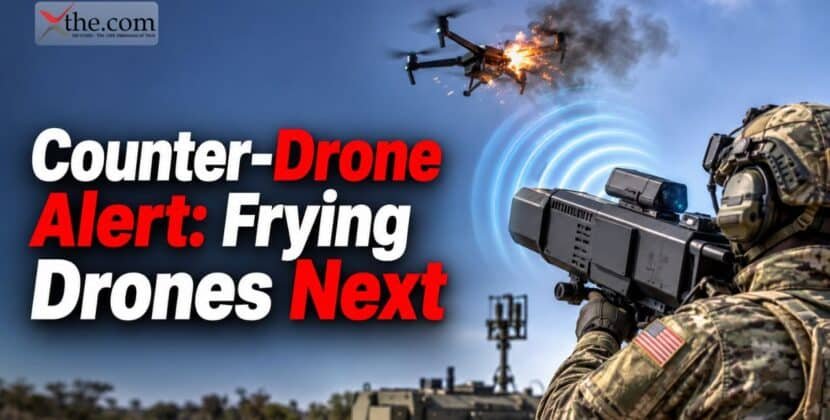
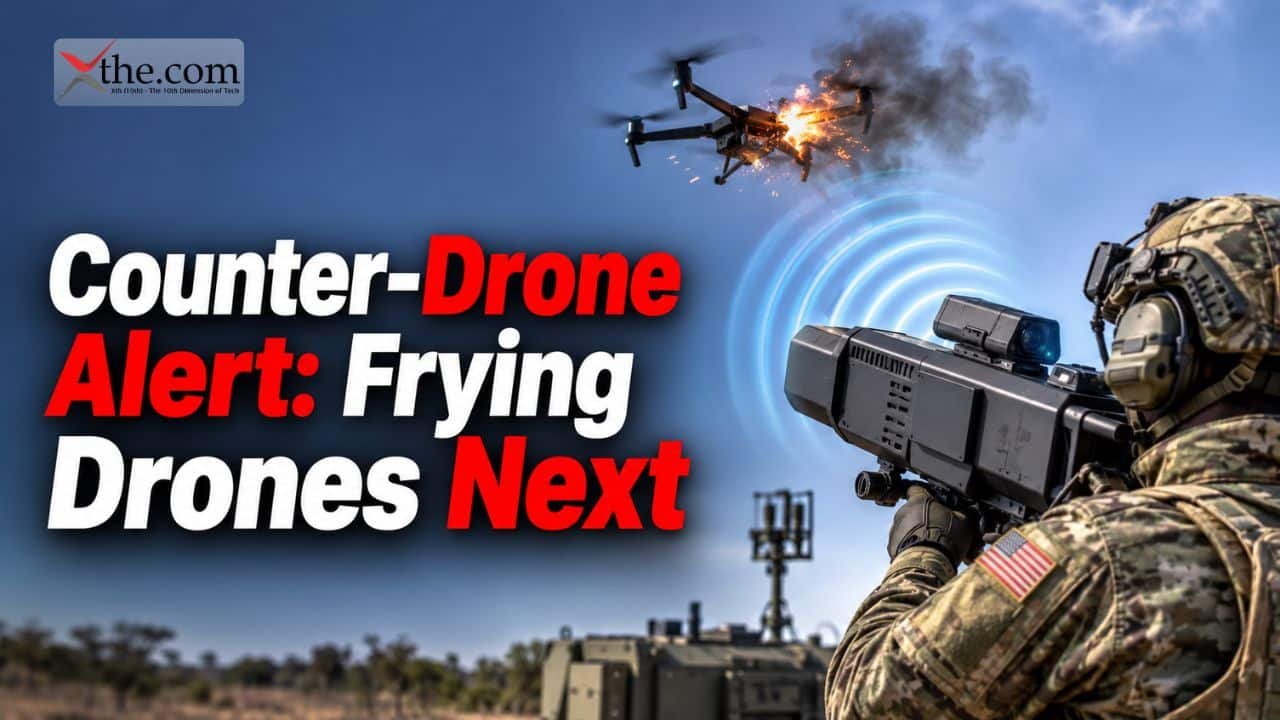
High-power microwave, or HPM, takes a different approach: instead of jamming incoming signals, it uses directed electromagnetic energy over an area to disable the drone’s electronics directly. In Lowery’s comparison, it works ‘just like in an electromagnetic pulse type of a scenario,’ where onboard computers stop functioning whether or not the drone has a radio.
Because the effect area-fills, rather than locking one target, HPM can theoretically sweep up multiple drones simultaneously, which is exactly the threat from drone swarms. Epirus’s core product is the Leonidas system, mounted on Stryker-like vehicles for mobile defense and on fixed platforms for site protection. The company has demonstrated the system against fiber-optic-guided drones in live fire, which Lowery says is why it emphasizes that ‘not jamming’ is the key distinction.
Lowery calls this ‘critical point defense,’ meaning small areas rather than whole-region coverage. A microwave system can guard the end of a runway, a control tower, or a passenger terminal without covering the whole airport, which matters for cost and for avoiding interference with nearby electronics.
The concrete problem, in Lowery’s numbers
Lowery’s most concrete framing was the mismatch in scale. Large US missile-defense systems like Patriot and THAAD dominate traditional wide-area air defense, and he agrees no one does that better than the US, but those ‘big geographical cylinders’ face millions of dollars of complexity against attacks that cost a few thousand. In his metaphor: ‘It’s like bringing an elephant cage and an elephant gun… and we’re being overrun by mice.’
The metaphor has teeth when he details the terrain: those large cylinders once defended sites from kilometers away, but pop-up attacks are now recorded from as close as 500 meters and even 200 meters against the Patriot batteries themselves, sometimes from container trucks or from weeds. When the counter-drone layer that should be handling cheap drones is occupied by $2-to-$4-million interceptors, either interceptors run out or the ambush succeeds. He tied it to recent events directly, noting Saudi Arabia in the past few days, US aircraft engagement in the Iran war, and US bases coming under fire.
On air dominance, Lowery was unambiguous. ‘We can no longer claim air dominance. No country, I think, in the world can claim air superiority, air dominance,’ he said, a striking statement from a US defense contractor at an event celebrating US military capability.
What the military is buying
The Pentagon has already started down this path. Leonidas earlier earned a US Army contract and demonstrated effects against drone swarms; the company also markets the tool as part of a broader point-defense approach. Lowery’s ask during the podcast was for a change in process more than in budget: field promising systems, learn from real operators, and adapt, instead of years of requirements-writing before a single system ships.
That message lands on an audience watching counter-drone costs. Where a missile might cost a few million dollars to destroy a few hundred dollars of drone, an HPM system’s individual engagement cost is largely electricity, which is why the directed-energy lobby and the Army’s rapid-fielding community keep pushing the technology past the demonstration stage.
What happens next
Watch three things. First, deployment: if the Pentagon accepts Lowery’s argument publicly, expect more funded fielding of HPM at bases, ports, and sensitive civilian-adjacent infrastructure, and more US carrier projects announced in the AUSA-adjacent news cycle. Second, doctrine: the military services are already drafting counter-drone guidance, and stand-off weapon procurement dominated by large interceptors may get slower growth while point-defense gets faster growth. Third, the civilian market: drone incursions over US airports and prisons are already on state legislative agendas, and if HPM systems get smaller and cheaper, city-level systems could appear first, initially airport-runway defense.
For US readers the relevance is direct: drone war is changing countermeasures at home, because airport protection already faces drone incursions, and the same fiber-optic drones built for war are available to careless or malicious actors here.
Frequently Asked Questions
How does a high-power microwave weapon stop a drone?
It bathes the target area in directed electromagnetic energy that induces current in the drone’s electronics and stops its computers from functioning, similar to how an electromagnetic pulse disables an unshielded circuit. The effect applies whether the drone is jammed-resistant fiber-optic cable or fully autonomous; the electronics stop regardless of the control link.
What did Epirus’s CEO say at AUSA?
Andy Lowery told the Washington Times’s Threat Status podcast on October 24, 2026 that no country can currently claim air dominance against the new drone threat, that large air-defense systems ‘designed to go after elephants’ are being ‘overrun by mice,’ and that the Pentagon should field promising counter-drone systems now and adapt from real-operator feedback.
Could microwave defense protect US airports from drones?
In principle yes: Epirus describes Leonidas as point-defense for the end of a runway, a control tower, or a passenger terminal. In practice, civilian airport use would require careful regulation, since HPM energy can interfere with other electronics nearby, so airports would deploy it in tightly bounded zones rather than across a whole airfield.
Sources: