




The Fed Just Raised Interest Rates for the First Time Since 2023: Here’s How It Hits Your Wallet
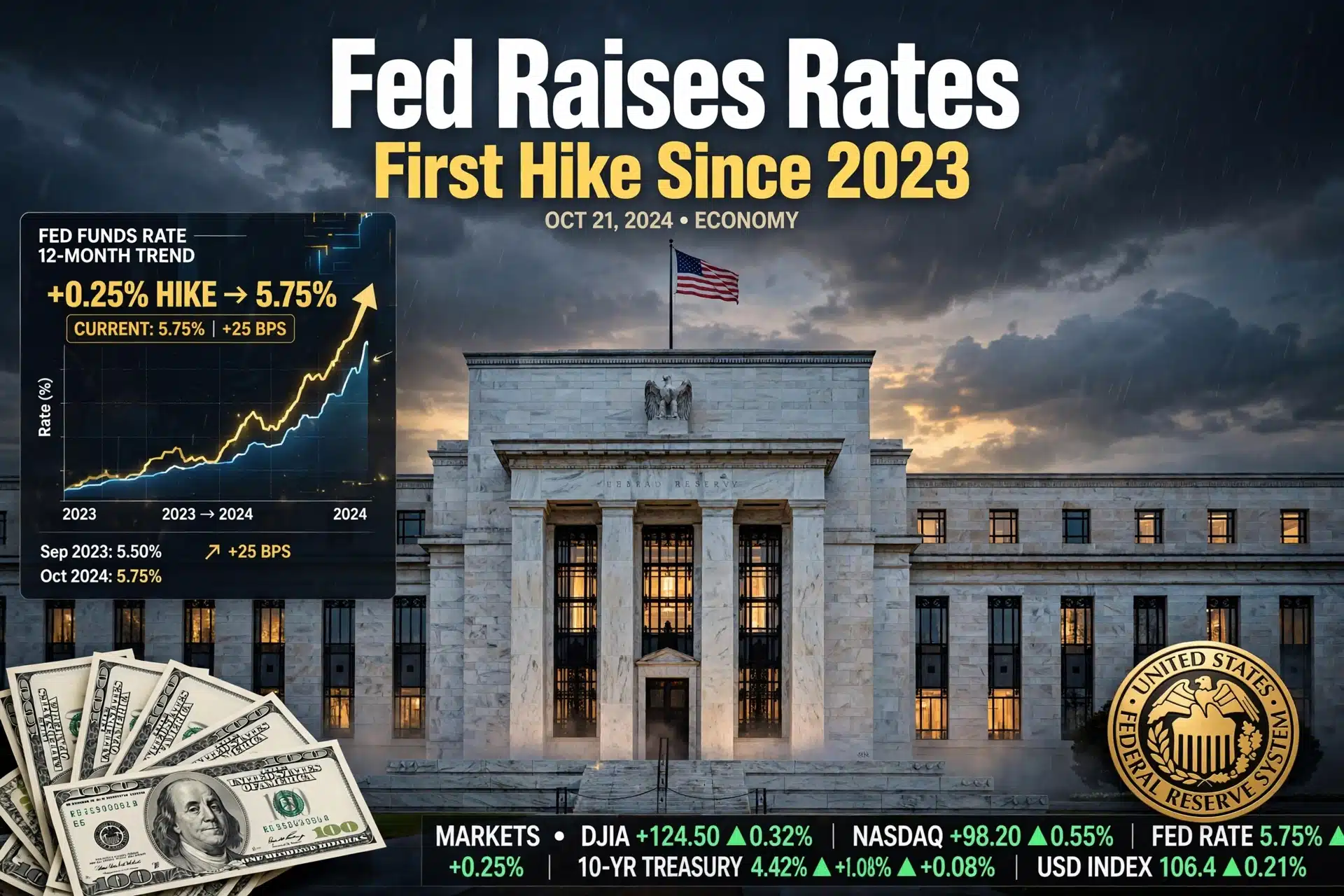
The Federal Reserve raised its benchmark interest rate on September 16, 2026, marking the first rate increase in more than three years and signaling a dramatic shift in the central bank’s fight against inflation. Policymakers voted 12-0 to lift the federal funds target range by 25 basis points to 3.75%-4.00%, the first hike since July 2023.
The decision lands as inflation runs at 3.4%, well above the Fed’s 2% target, with energy costs from the Iran war pushing prices higher. For American households, the hike is not an abstract policy event: it flows directly into mortgage rates, credit card interest, auto loans and the returns on savings accounts. Here is a complete breakdown of what the Fed did, why it did it and how it affects your money.
Why the Fed Raised Rates for the First Time Since 2023
For most of the past three years, the Fed’s story was about cutting or holding rates as inflation cooled from its post-pandemic peak. That changed in 2026. The war in Iran triggered what the International Energy Agency called the largest oil supply shock in modern history, driving crude above $100 a barrel and raising the cost of everything that moves in trucks, planes and ships.
With energy feeding through to consumer prices, inflation reaccelerated to 3.4%, and the Fed concluded that waiting risks letting inflation expectations become entrenched. Officials also pointed to resilient consumer spending and a solid labor market as evidence the economy can absorb a modest tightening. The unanimous 12-0 vote underscored that this was not a contested decision but a consensus that the pause in cutting had run its course.
How the Rate Hike Affects Credit Cards
The most immediate impact is on credit card debt. The federal funds rate feeds directly into the annual percentage rates that card issuers charge, and most variable-rate cards will see their APRs rise by the same 25 basis points within one or two billing cycles. On the average American household credit card balance, that translates to roughly $25-30 more in interest per year for every $10,000 carried, assuming balances are not paid in full.
Financial experts recommend treating the hike as a cue to attack high-interest debt. Balance transfer cards with 0% promotional periods become more valuable when baseline rates rise, and paying down variable-rate balances before the new rates fully take effect can save real money. Minimum-payment borrowers feel the hike the most, since interest compounds on revolving balances month after month.
What It Means for Mortgages and Auto Loans
Mortgage rates do not track the federal funds rate one-for-one, but they respond to the same inflation forces that motivated the hike. Fixed 30-year mortgage rates have already climbed since the Fed signaled tightening, and analysts expect the September decision to keep upward pressure on housing borrowing costs. Higher rates also cool demand, which could eventually slow home price appreciation, a mixed blessing for first-time buyers.
Auto loans show a similar pattern. Most auto loans are fixed-rate, so existing borrowers are protected, but new buyers face higher APRs: average used-car rates have risen to about 10.25%, while new-car rates sit near 6.2%. Shopping multiple lenders and scoring the best available rate matters more when the baseline cost of money is rising.
The Good News: Savers Earn More
Rate hikes are not all pain. Yields on savings accounts, certificates of deposit and Treasury bills rise with the federal funds rate, meaning savers finally get a meaningful return. High-yield savings accounts should push back above recent levels, and short-term Treasuries offer attractive, essentially risk-free income for cash that must remain liquid.
Retirees and others living on fixed income benefit disproportionately from higher rates, a reversal from the zero-rate era that penalized savers. Money market funds and CD ladders become more compelling strategies for households sitting on cash reserves.
What Comes Next: Will the Fed Raise Rates Again?
Markets currently price roughly even odds of one more 25-basis-point increase before year end, and the Fed’s own projections show the median federal funds rate ending 2026 at about 4.1%, holding there through 2027. Much depends on two variables: the trajectory of oil prices as the Iran conflict evolves, and whether inflation shows sustained movement back toward 2%.
The next inflation reports and the Fed’s December meeting will be the decisive checkpoints. For households, the practical playbook is straightforward: lock in fixed rates on big borrowing where possible, refinance variable debt into fixed, build savings yields while they last, and keep a close watch on the Fed’s messaging, because in a data-dependent environment, headlines from the Middle East can reshape your monthly bill.
Frequently Asked Questions
Why did the Fed raise interest rates in September 2026?
Inflation stood at 3.4%, driven partly by oil prices spiking on the Iran war, and the Fed voted 12-0 to raise the federal funds range to 3.75%-4.00% to keep inflation expectations in check.
How does the rate hike affect my credit card?
Variable-rate card APRs typically rise by the same 25 basis points within one or two billing cycles, adding roughly $25-30 per year in interest for every $10,000 of carried balance.
Will mortgage rates go up after the Fed hike?
Mortgage rates don’t move one-for-one with the Fed, but the hike reinforces upward pressure from inflation, and 30-year fixed rates are expected to remain elevated near recent levels.
Do savers benefit from higher interest rates?
Yes. Savings accounts, CDs, money market funds and Treasuries yield more when the Fed raises rates, which is welcome news for savers and retirees after years of low returns.