






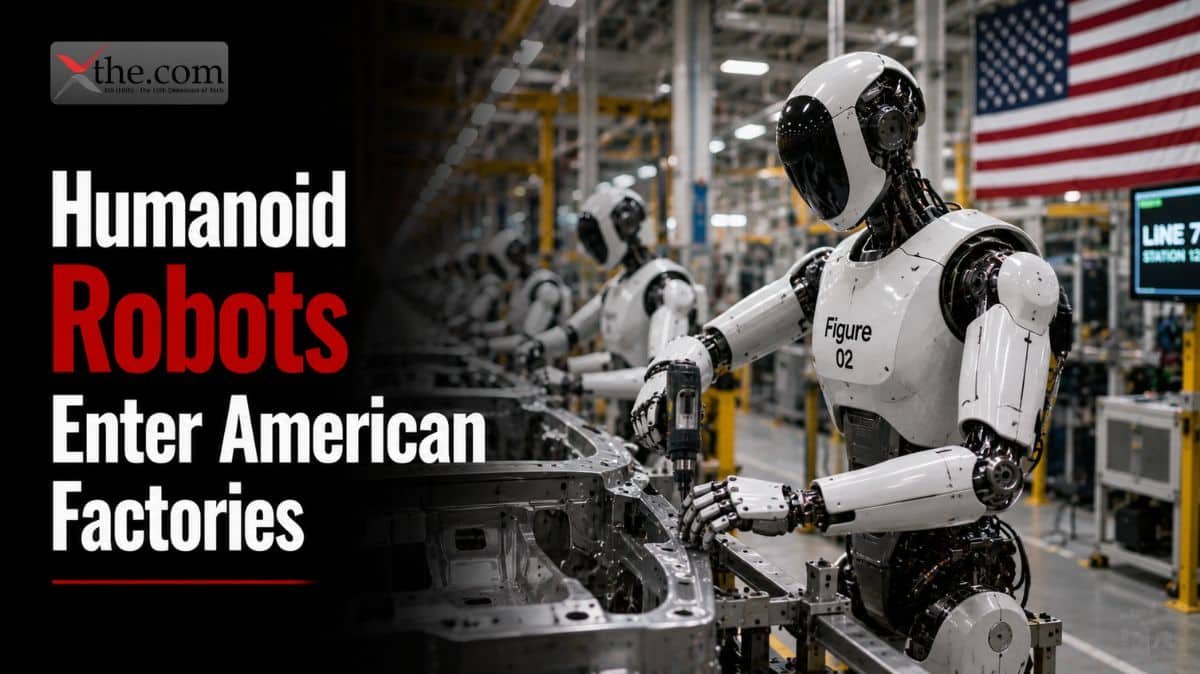
Robots Leave the Lab and Enter the Workplace
The era of humanoid robots in American workplaces has officially begun. In 2026, a new generation of bipedal robots is moving out of research laboratories and onto factory floors across the United States, marking a milestone that futurists have predicted for decades.
Companies including Figure AI, Agility Robotics, Tesla, and Apptronik are deploying humanoid robots in warehouses, manufacturing plants, and logistics facilities across the country. While the current fleet numbers in the hundreds rather than thousands, industry experts say the technology has reached an inflection point.
What Humanoid Robots Can Actually Do in 2026
Today humanoid robots are far from the science fiction vision of machines that can do anything a human can. Instead, they are being deployed for specific, repetitive tasks that are dangerous, physically demanding, or difficult to staff with human workers.
At BMW Spartanburg, South Carolina plant, Figure AI Figure 02 robots are handling material transport tasks, carrying parts between workstations and loading components into assembly machines. The robots can navigate complex factory environments, climb stairs, open doors, and carry loads up to 55 pounds.
Agility Robotics Digit robot is deployed at Amazon warehouses for package sorting and loading. The robot stands about five feet tall, weighs approximately 140 pounds, and can identify and pick up packages of various shapes and sizes.
Tesla has begun testing its Optimus robot in its own Gigafactories, performing tasks such as part inspection, simple assembly operations, and material handling. CEO Elon Musk has stated that Tesla plans to sell Optimus robots to external companies by 2027, with a target price of under 0,000.
The Business Case for Humanoid Robots
The primary driver behind the adoption of humanoid robots is the persistent labor shortage in American manufacturing and logistics. The US manufacturing sector currently has approximately 600,000 unfilled positions, according to the Bureau of Labor Statistics.
Humanoid robots offer several advantages over traditional industrial robots. Unlike fixed robotic arms, they can move freely through existing facilities without requiring expensive infrastructure modifications. They can use the same tools, doors, and workstations designed for human workers.
The economics are beginning to make sense for early adopters. While a humanoid robot costs 50,000 to 50,000 upfront, companies estimate the total cost of ownership at approximately 0 to 0 per hour, compared to 5 to 0 per hour for human workers.
The China Factor
A major concern driving American investment in humanoid robots is competition from China. Chinese manufacturers including Unitree, UBTECH, and Fourier Intelligence are producing humanoid robots at scale, with some models available for as little as 6,000.
China Ministry of Industry and Information Technology has set a national goal of mass-producing humanoid robots by 2027. The Chinese government views humanoid robotics as a strategic technology comparable to semiconductors and electric vehicles.
The New York Times reported on August 13, 2026, that American humanoid robot startups are racing to scale production before Chinese competitors can dominate the global market.
Impact on American Workers
The rise of humanoid robots has reignited the debate about automation and job displacement. Morgan Stanley estimates that 62.7 million American jobs could be substituted by humanoid robots by 2050. However, the firm also projects that the technology will create millions of new positions.
For now, the impact on employment is minimal. The current fleet of a few hundred humanoid robots is concentrated in a handful of early-adopter companies. Most labor economists view the near-term impact as complementary rather than substitutive.
However, as robots become more capable and less expensive, the range of tasks they can perform will expand. By the early 2030s, humanoid robots could be performing a wide variety of warehouse, manufacturing, and logistics tasks.
Policy Implications
Policymakers in Washington are beginning to grapple with the implications. Congressional leaders are exploring tax incentives for companies that deploy humanoid robots in ways that complement rather than replace human workers.
Proposed policies include deployment-specific tax credits, retraining programs for displaced workers, and updated occupational safety standards for human-robot collaboration in workplaces.
The debate cuts across traditional political lines. Some conservatives argue humanoid robots are essential for maintaining American manufacturing competitiveness. Some progressives worry about worker impact but acknowledge that labor shortages make some automation inevitable.
What Comes Next
The humanoid robot industry is expected to grow rapidly. Figure AI plans to produce 10,000 units per year by 2028. Tesla targets 100,000 Optimus units annually by 2030. Agility Robotics is building a factory in Dayton, Ohio, capable of producing 10,000 Digit robots per year.
As production scales and costs decline, humanoid robots will become accessible to a broader range of businesses. By 2030, they could be as common in warehouses and factories as robotic arms are today.
For American workers, the message is clear: the robots are coming, but slowly enough that there is time to adapt. Workers who develop skills in robot programming, maintenance, and supervision will be well-positioned for the jobs of the future.
The technical challenges facing humanoid robots remain significant. Balance and locomotion on uneven surfaces, manipulation of delicate objects, and navigation in cluttered environments are all areas where robots still lag far behind human capabilities. However, advances in machine learning, particularly reinforcement learning and sim-to-real transfer, are accelerating progress in these areas.
Safety is another critical consideration. Unlike industrial robots that are typically caged and separated from human workers, humanoid robots operate in the same spaces as people. Ensuring that these robots can safely coexist with humans requires sophisticated perception systems, force-limited actuators, and robust emergency stop mechanisms.
The investment landscape reflects the growing confidence in humanoid robotics. Venture capital funding for humanoid robot startups reached .8 billion in the first half of 2026, more than double the amount invested in the same period of 2025. Major corporate investors including Amazon, Microsoft, and Hyundai have all made significant investments in humanoid robot companies.
Education and training programs are also emerging to prepare the workforce for a future where humans and robots work side by side. Several universities have launched programs in robotics engineering and human-robot interaction, while community colleges are developing certificate programs in robot maintenance and programming.
As the humanoid robot industry continues to mature, standards and best practices are beginning to emerge. Industry groups including the Robotics Industries Association and the International Organization for Standardization are developing guidelines for safety testing, performance benchmarking, and interoperability between different robot platforms.
External Sources:
- Christian Science Monitor: https://www.csmonitor.com/Business/2026/0612/ai-humanoid-robot-workforce








