






Santa Clara, California | July 21, 2026
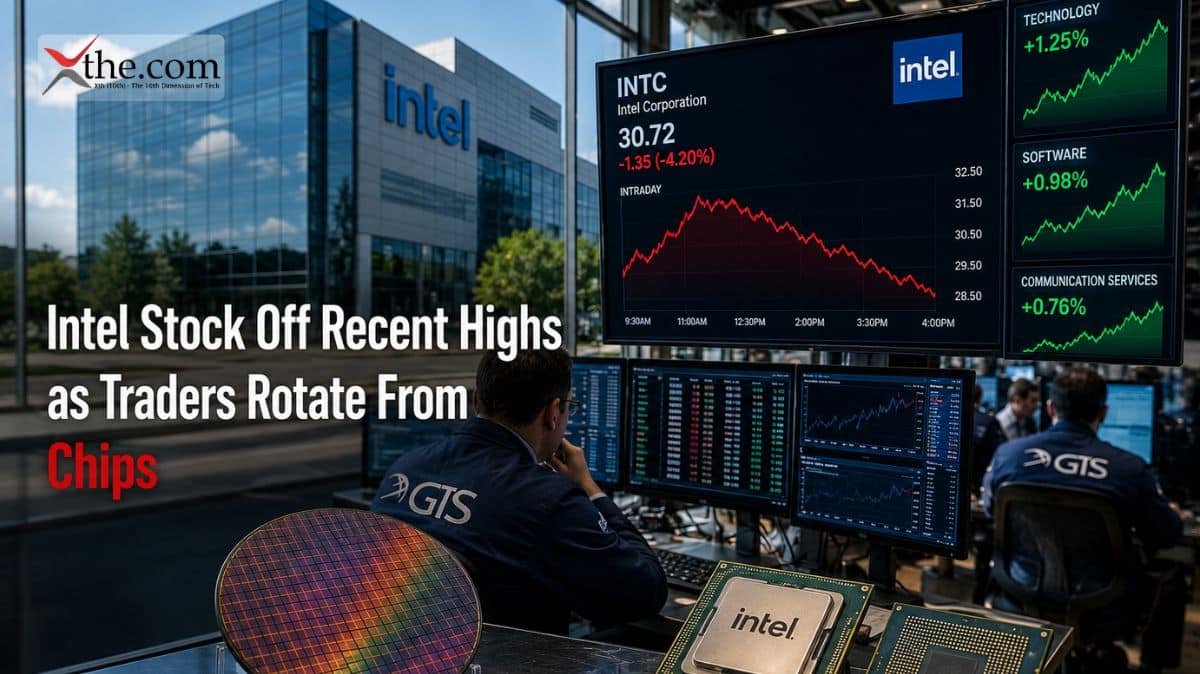
A few weeks ago, investors chased semiconductor stocks with little hesitation. Today, the mood has shifted. Momentum traders have begun locking in profits, valuations face renewed scrutiny, and companies that benefited from the artificial intelligence rally must now prove that earnings can justify elevated expectations. That backdrop explains why Intel stock off highs, despite growing optimism around Intel AI data center growth earlier this year. The latest chip sector rotation traders are watching has turned investor attention from momentum to execution.
Intel Stock Off Highs as Investors Review Semiconductor Valuations
Intel started the second half of 2026 with new momentum. Its stock rose as investors expected more spending on enterprise AI infrastructure and saw its foundry strategy as more credible. However, markets do not always move in a straight line.
The recent decline illustrates a classic semiconductor sector rotation rather than an outright rejection of Intel’s long-term strategy. Investors who aggressively accumulated AI-related names earlier in the year have rotated capital into sectors viewed as offering more attractive short-term risk-reward profiles.
This has left Intel stock off highs even as many of the underlying business catalysts remain intact. The shift shows changing investor psychology more than a fundamental deterioration in Intel’s operating outlook.
Now, Wall Street is asking whether this drop is just normal profit-taking or the start of a longer period of doubt.
Why Chip Sector Rotation Traders Are Taking Profits
Leadership in technology stocks can change quickly. Semiconductor companies have seen big gains from heavy investment in AI computing, but high valuations often lead investors to take profits.
Numerous factors have encouraged chip sector rotation traders to reduce exposure.
Uncertainty about interest rates has made investors pickier about high-growth companies. After big gains in AI stocks, many portfolio managers have shifted money into industrials, financials, and more defensive sectors.
Competition is also heating up. Nvidia still leads in AI accelerators, AMD is growing its enterprise products, and big cloud companies are making their own custom chips, adding more pressure.
Given all this, investors want more than just positive forecasts. They are looking for real results.
Intel Riding AI Data Center Story Faces Its Next Test
Much of Intel’s recent rally depended on Intel riding the AI data center story rather than instant financial performance.
This story was based on a few key developments.
Intel rolled out a more ambitious AI product plan to compete better in enterprise computing. Management pointed to new opportunities in AI servers, networking hardware, and accelerator tech, and stressed improvements in manufacturing advanced chips.
Investors also see Intel’s foundry plans as a possible long-term boost. If Intel can win more outside customers, its manufacturing could shift from being a cost to a real source of revenue.
These themes fueled enthusiasm surrounding Intel AI data center growth during 2026.
However, stories like these need to be backed up by real financial results. Quarterly earnings are when expectations are put to the test.
What the Intel Earnings Thursday Preview Must Deliver
The upcoming Intel earnings Thursday preview represents one of the company’s most important in recent quarters.
Wall Street will pay less attention to the headline earnings number and more to signs that Intel’s strategy is working.
Foundry Customer Wins
The biggest boost for Intel could come from new commercial deals for its Foundry Services.
Investors want to see that big tech companies trust Intel’s manufacturing enough to place large orders. Announcements of major customers would help prove that Intel’s investments can pay off over time.
AI Chip Roadmap Progress
Investors also want proof that Intel is closing the gap with competitors in AI hardware.
News about better accelerator performance, more customer adoption, faster production, and improved software could boost confidence in Intel AI data center growth.
More corporate customers now look for full AI platforms, not merely individual chips. Intel needs to show that its whole ecosystem is getting better.
Margin Stabilization
Profitability is just as important as growth.
Years of heavy investment have hurt Intel’s profit margins, but now investors want to see signs that things are stabilizing. Better manufacturing, careful spending, and a stronger product lineup would show that Intel can manage growth with returns for shareholders.
Margin improvement would strengthen confidence that Intel AI data center growth story fades is not becoming the dominant market narrative.
Is “Intel Stock Off Recent Highs Chip Rotation” Temporary?
The phrase “Intel stock off recent highs chip rotation” sums up how the market feels right now.
Short-term drops often happen after long rallies, especially in tech stocks where expectations run high.
History shows that good semiconductor companies often go through periods of consolidation before leading the market again. Investors look at earnings, execution, and management to tell if a drop is just a reset or a sign of deeper problems.
For Intel, this difference is very important.
If management demonstrates accelerating customer demand, improving margins, and tangible progress in AI infrastructure, today’s weakness could appear temporary. Conversely, disappointing execution could reinforce concerns that recent gains reflected excessive optimism rather than improving fundamentals.
Can Intel Prevent the Story That “Intel AI Data Center Growth Story Fades”?
Investor narratives evolve rapidly.
Earlier this year, enthusiasm centered on Intel riding AI data center story. More recently, skeptics have questioned whether “Intel AI data center growth story fades” will become the main theme for investors.
Intel still has chances to shift that conversation.
Big enterprise AI projects are still growing around the world. Both governments and private companies are committed to boosting computing power for generative AI, research, cybersecurity, and cloud services.
If Intel can win even a small part of these investments and show better manufacturing, investor faith could bounce back fast.
In the end, it’s execution, not hype, that will decide which story wins out.
Investor Outlook
The latest dip does not mean Intel’s long-term recovery plan is in trouble. It just shows that investors now expect more after months of interest about AI and chip growth.
For shareholders, Thursday’s earnings report is more than just another update. It’s a test of Intel’s credibility. Progress with foundry customers, AI products, and profits could show that the recent drop is only a short-term pause, not a sign of lasting doubt.
Semiconductors are still one of the most important parts of global tech. Whether Intel can turn its big plans into real financial results will decide if today’s traders come back as long-term investors or keep searching for AI growth elsewhere.








