






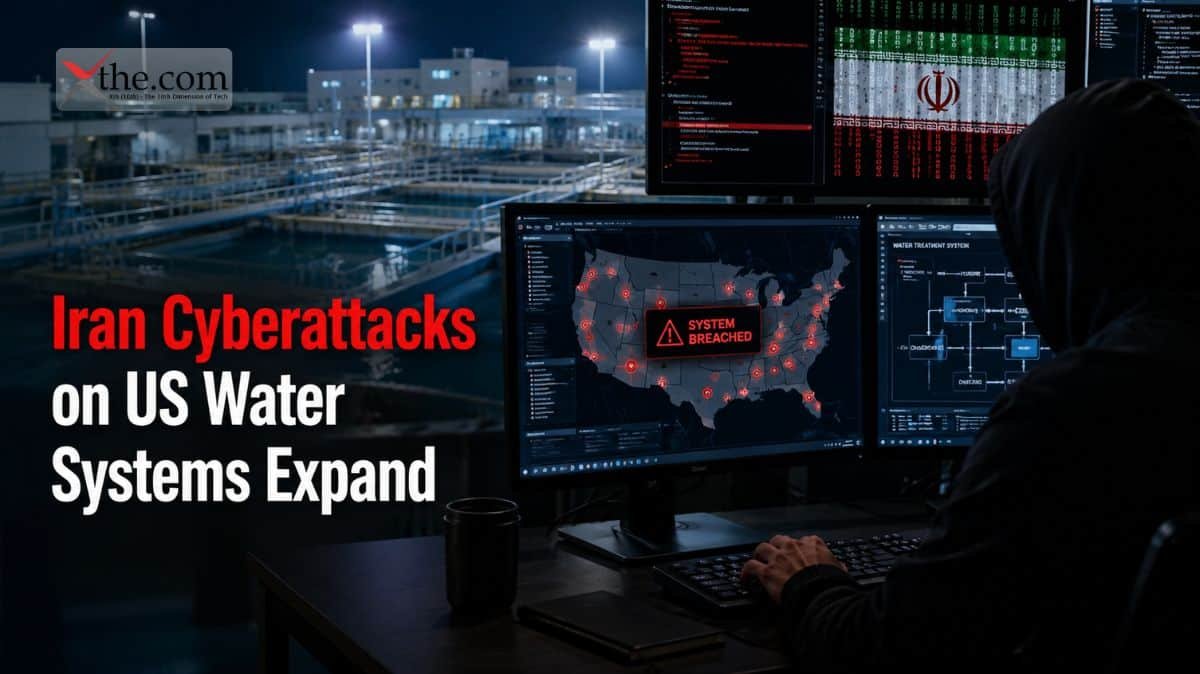
The Expanding Cyber Campaign
On August 1, 2026, The New York Times dropped a bombshell report citing state and local officials: a cyber campaign targeting U.S. water and wastewater systems has expanded far beyond its initial footprint, with malicious activity now reported across at least seven states. The report confirmed that evidence leads directly to Iran, marking a dangerous escalation in the ongoing conflict between Washington and Tehran.
The attacks represent a chilling evolution in Iran’s strategy. Rather than confronting the U.S. military directly in the Persian Gulf, Iranian-linked hackers have shifted their focus to America’s most vulnerable critical infrastructure — the water systems that millions of citizens depend on daily. The campaign has been described by cybersecurity experts as both “sophisticated and reckless,” exploiting industrial-control technologies that were never designed to withstand hostile internet environments.
States Affected and Confirmed Breaches
While officials have not publicly named all seven states, several have come forward with confirmed incidents:
Table
| State | Confirmed Incident | Impact Level | Date Reported |
| Minnesota | 30+ water/wastewater facilities targeted | High | July 26-27, 2026 |
| Michigan | Small number of communities affected | Moderate | Early August 2026 |
| South Dakota | Rapid City wastewater lift station breached | Moderate | August 2026 |
| Georgia | Malicious activity detected | Under investigation | August 2026 |
| 4 Unnamed States | Confirmed malicious activity | Varies | August 2026 |
The geographic spread is particularly alarming. Unlike previous cyber campaigns that focused on high-profile targets on the coasts, this operation has hit utilities across the American heartland — suggesting a deliberate strategy to create widespread panic and demonstrate Iran’s ability to strike anywhere within the continental United States.
Minnesota: Ground Zero
Minnesota was the first state to disclose the scale of the assault. On July 26 and 27, operational technology systems at more than 30 water and wastewater facilities were simultaneously targeted in a coordinated wave of attacks.
The attacks were so severe that one municipality was forced to temporarily shut down a water plant as a precautionary measure. While state authorities have emphasized that drinking-water safety was not ultimately compromised, the operational disruption sent shockwaves through local government and exposed just how fragile America’s water infrastructure cybersecurity truly is.
Minnesota officials have been working closely with the FBI and the Cybersecurity and Infrastructure Security Agency (CISA) to investigate the full scope of the breach. Early forensic analysis suggests the attackers exploited known vulnerabilities in supervisory control and data acquisition (SCADA) systems — legacy industrial controls that remain ubiquitous in municipal water facilities.
Michigan and South Dakota Confirm Attacks
Following the New York Times report, Michigan officials confirmed that malicious activity had affected a small number of communities within the state. Crucially, they noted that systems continued operating safely despite the intrusion attempts — a testament to the rapid response by state cybersecurity teams.
In South Dakota, the city of Rapid City separately disclosed an incident involving a wastewater lift station. While less critical than a drinking-water treatment plant, the breach demonstrated that Iran-linked actors were targeting the entire water management chain — from sewage processing to potable water distribution.
The pattern suggests a reconnaissance phase: attackers are mapping America’s water infrastructure, identifying weak points, and testing response capabilities. Security analysts warn that these intrusions may be precursors to more destructive attacks capable of altering chemical treatments, shutting down pumps, or contaminating supplies.
Why Water Systems Are Vulnerable
America’s water infrastructure represents a cybersecurity nightmare. The Environmental Protection Agency (EPA) estimates there are approximately 148,000 public water systems in the United States, the vast majority serving small communities with limited IT budgets and virtually no dedicated cybersecurity staff.
Key Vulnerabilities:
- Legacy SCADA Systems: Many facilities run on Windows XP-era software that no longer receives security patches
- Remote Access: COVID-19 accelerated the adoption of remote monitoring tools, often without proper VPN or multi-factor authentication
- Flat Networks: Operational technology (OT) and information technology (IT) networks are frequently interconnected, allowing attackers to pivot from email phishing to pump controls
- No Federal Mandate: Unlike the financial or healthcare sectors, water utilities face no comprehensive federal cybersecurity requirements
The July 2026 attacks exploited these weaknesses with ruthless efficiency. Attackers reportedly used commodity malware and known exploits — tools available on the dark web for less than $1,000 — to penetrate systems that protect millions of American lives.
Iran’s Cyber Warfare Strategy
Iran has long maintained one of the most active state-sponsored cyber programs in the world. Groups linked to the Islamic Revolutionary Guard Corps (IRGC) — including APT33 (Elfin), APT34 (OilRig), and APT35 (Charming Kitten) — have previously targeted energy infrastructure, financial institutions, and government networks across the Middle East and beyond.
The shift to water systems represents a tactical evolution. By targeting critical infrastructure rather than military assets, Iran achieves several strategic objectives:
- Psychological Impact: Nothing terrifies civilians like the threat of poisoned or unavailable drinking water
- Asymmetric Warfare: A handful of hackers can disrupt services for millions at negligible cost
- Plausible Deniability: Cyberattacks are harder to attribute definitively than missile strikes
- Domestic Pressure: Water crises create political pressure on U.S. lawmakers to de-escalate the Iran conflict
As of August 7, 2026, the U.S. government had not formally attributed the campaign to Tehran in an official public statement. However, the New York Times report, citing state and local officials, made clear that the evidence points unmistakably in Iran’s direction.
Federal Response and CISA Alert
The Biden administration’s cyber response apparatus has been activated at the highest levels. CISA issued an emergency directive to water sector operators, urging immediate patching of known vulnerabilities and disconnection of internet-facing SCADA interfaces where possible.
The FBI has opened a multi-state investigation, working through its Cyber Division and local field offices to collect forensic evidence. The Department of Homeland Security has also coordinated with the EPA — the lead federal agency for water security — to assess whether additional regulatory authorities are needed to mandate minimum cybersecurity standards.
Congressional reaction has been swift. Bipartisan lawmakers have called for emergency funding to help small water utilities upgrade their cybersecurity posture. Senator Mark Warner (D-VA), chair of the Senate Intelligence Committee, described the attacks as “a wake-up call we cannot ignore.”
Implications for Critical Infrastructure
The Iran water system cyberattacks have exposed a fundamental vulnerability in American national security: the soft underbelly of critical infrastructure. While the Pentagon spends hundreds of billions on missile defense and aircraft carriers, a municipal water plant in Minnesota can be compromised with a phishing email and a five-year-old software exploit.
Long-term Implications:
- Regulatory Overhaul: Expect new federal mandates requiring water utilities to meet baseline cybersecurity standards
- Insurance Crisis: Cyber insurance premiums for critical infrastructure are likely to spike
- Public-Private Partnerships: Tech companies may be called upon to provide free or subsidized security tools to small utilities
- Geopolitical Escalation: The attacks blur the line between kinetic and cyber warfare, raising questions about appropriate retaliation
The attacks also serve as a warning to other adversaries. If Iran can penetrate American water systems with relative ease, China and Russia — both possessing far more sophisticated cyber capabilities — could inflict exponentially greater damage in a future conflict.
Frequently Asked Questions
Q: Which states have confirmed Iran-linked cyberattacks on water systems? A: Minnesota, Michigan, South Dakota, and Georgia have publicly confirmed incidents. At least three additional states have reported malicious activity but have not been publicly named as of August 7, 2026.
Q: Was any drinking water actually contaminated? A: No. Authorities in all affected states have confirmed that drinking-water safety was not compromised. However, one Minnesota municipality temporarily shut down a water plant as a precaution.
Q: How did the attackers gain access to water systems? A: Forensic analysis suggests exploitation of vulnerabilities in SCADA (supervisory control and data acquisition) systems, many of which run on outdated software with inadequate network segmentation.
Q: Has the U.S. government officially blamed Iran? A: As of August 7, 2026, no formal public attribution had been issued by the federal government. However, The New York Times reported that state and local officials have identified Iran as the source.
Q: What should water utility operators do? A: CISA has urged immediate patching of known vulnerabilities, implementation of multi-factor authentication, network segmentation between IT and OT systems, and disconnection of internet-facing industrial controls where possible.
External Sources:
- The New York Times: https://www.nytimes.com/
- SecurityWeek: https://www.securityweek.com/
- CISA: https://www.cisa.gov/
- EPA Water Security: https://www.epa.gov/watersecurity
- Wikipedia Iran War: https://en.wikipedia.org/wiki/2026_Iran_war








