






Beijing, China, July 20, 2026
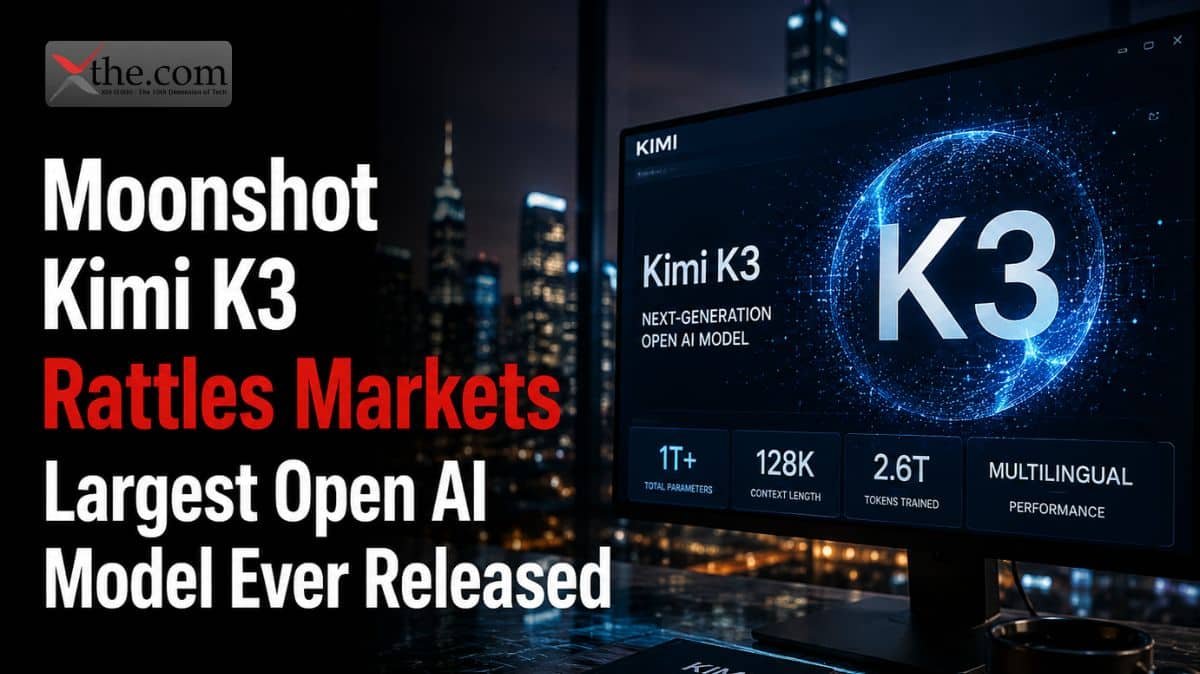
Nvidia’s stock began to fall before most Wall Street analysts had even finished reading the technical documentation. This shows how quickly a single product launch from Beijing can now affect global markets, which is exactly what happened last week when Moonshot AI put out the Kimi K3 launch. The Moonshot AI model arrived with a bold claim that appeared hard to believe until the numbers confirmed it: it is the largest open-weight AI system ever released to the public, with 2.8 trillion parameters. Chip stocks in New York and Tokyo dropped within hours. Researchers who follow frontier model benchmarks rushed to check the claims. Three days later, it seems less like hype and more like a real turning point.
The Numbers Behind the Shock
Size is not everything with large language models, but K3’s scale stands out. Moonshot designed it as a Mixture-of-Experts model, so only 16 out of 896 expert subnetworks are active for each request. This approach keeps inference costs reasonable, even though the number of parameters is nearly three times that of the previous K2.6 model. K3 offers a one-million-token context window, built-in image understanding, and a constant reasoning mode called “thinking mode.” Two major innovations, Kimi Delta Attention and Attention Residuals, drive these efficiency gains. Moonshot shared both as open research before including them in K3.
API pricing is set at $3 per million input tokens and $15 per million output tokens. This pricing targets developers who might otherwise choose a closed American alternative. The full open weights will be released on July 27, allowing anyone to download, fine-tune, and run the model without paying Moonshot any licensing fees.
Kimi K3 vs GPT-5.6 Sol — Where It Wins and Where It Doesn’t
The benchmark results are more complex than the headlines make them seem, which is important for anyone making buying decisions. On Artificial Analysis’s composite leaderboard, K3 scored 732 points higher than its predecessor and finished just behind Claude Fable 5. Independent testers also compared Kimi K3 vs GPT-5.6 Sol. In these tests, K3 falls behind on overall reasoning but does better on certain programming tasks. The results are mixed rather than a clear win for either model.
Moonshot’s model clearly outperforms the previous generation of American frontier systems. The company’s own evaluation suite shows K3 outperforming Claude Opus 4.8 and GPT-5.5 on coding and agentic benchmarks. Arena.ai’s blind developer testing also ranked K3 first in Frontend Code, ahead of Claude Fable 5. In simple terms, K3 outperforms GPT-5.5 and Claude Opus on the tasks that enterprise engineering teams do most: writing front-end code, running multi-step agent workflows, and managing long programming sessions without losing track. This is not simply a symbolic win. These are the features that matter most to CTOs choosing a coding assistant, and companies like Cursor and DoorDash have already used earlier versions of Kimi in their tools.
There are still limits to independent verification. At launch, there was no public model card, license file, or downloadable weights, and researcher Simon Willison pointed out this issue. The weights release on July 27 ought to address most of these gaps.
A DeepSeek Moment, Again
Anyone who remembers the DeepSeek surprise in January will see the same pattern here. A Chinese lab, mostly unknown to Western investors, releases a model that equals the top proprietary systems from Anthropic and OpenAI, but at a much lower cost. The market reacts in a familiar way: semiconductor stocks drop first, based on the idea that if advanced AI no longer needs the most expensive chips at large scale, the demand for high-end AI hardware must be reconsidered.
This time, there is a key difference. K3’s release comes just before the 2026 World Artificial Intelligence Conference in Shanghai and constitutes a real comeback for Moonshot. The company had lost ground over the past eighteen months as DeepSeek surged past it. The Alibaba-backed Moonshot operation, which also counts Tencent and Meituan among its backers, spent that time rebuilding instead of stepping back, and K3 is the result of those efforts.
What This Means for the Chip Trade
For semiconductor investors, the message is clear, even if opinions differ. Nvidia and similar companies have long assumed that training and running top models requires huge, costly hardware clusters. Each open-weight release that closes the performance gap while lowering compute costs challenges that idea. It does not remove the requirement for advanced chips, but it does mean the market must rethink how much of this hardware future models will actually need.
Moonshot AI IPO 2026: From Startup to Hong Kong Contender
The market’s reaction has done what Moonshot’s own pitch could not: it sped up an IPO timeline that had been stalled for months. Moonshot AI IPO 2026 plans now point toward a Hong Kong listing within six months, with a shareholder resolution for approval and a possible filing as early as the third quarter. Valuation has risen quickly. Moonshot recently closed a two-billion-dollar funding round, raising its value to between twenty and thirty billion dollars—a sevenfold increase from 4.3 billion at the end of last year. Annual recurring revenue reportedly grew from about $100 million in March to around $300 million by June.
To meet China’s new securities rules, Moonshot is replacing its offshore VIE structure with a joint-venture model, which Beijing now requires for red-chip companies seeking foreign investment through Hong Kong. CICC and Goldman Sachs are advising on the offering. CEO Yang Zhilin, a former Tsinghua professor who also worked at Meta and Google, says the company has over ten billion RMB in cash and is not in a hurry to move forward. However, the market’s response to K3 may force him to act sooner.
The Road Ahead
The gap between Chinese open-weight systems and leading American models is real and getting smaller with each new release. Kimi K3 shows that this progress is now visible in public benchmarks and stock prices, not just in private research. When the full weights are released on July 27, developers everywhere will get their first chance to see what a 2.8-trillion-parameter open model can do outside of a demo. What they discover will influence buying decisions, chip demand forecasts, and Moonshot’s journey to a Hong Kong listing before the year ends.
Source: Alphabet and Tesla earnings this week could ripple through crypto markets








