






New York, New York | July 30, 2026
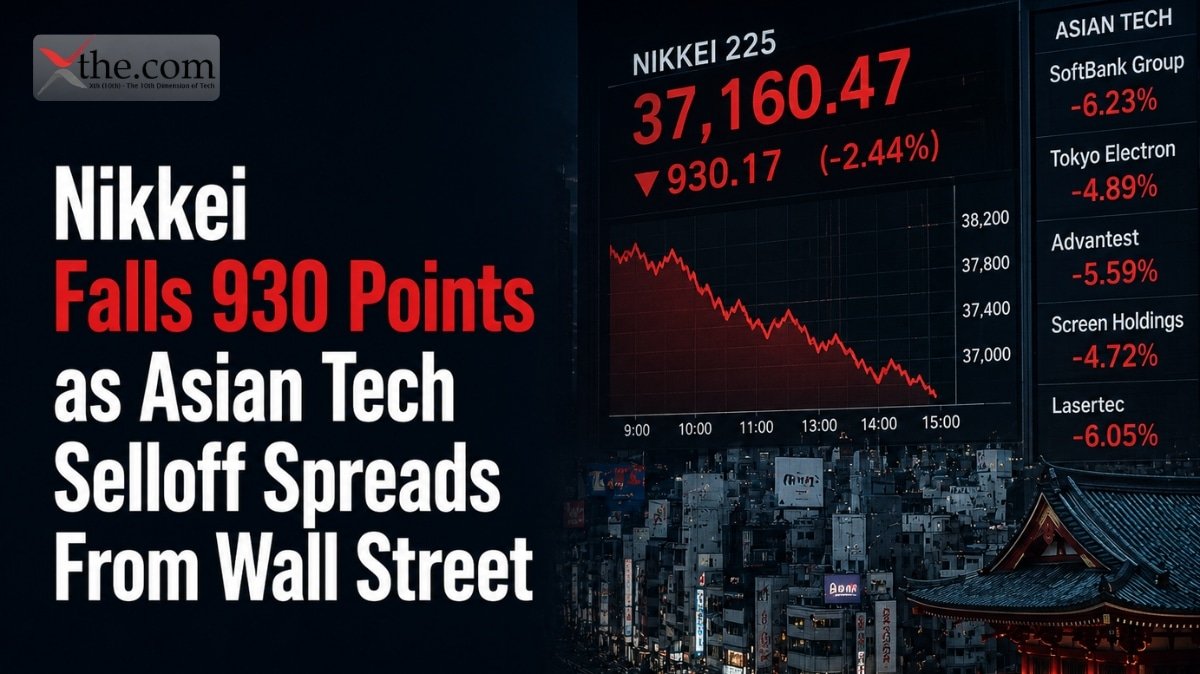
A single trading session erased billions of dollars in market value across Asia as investors abandoned technology shares at a pace rarely seen this year. The **Nikkei falls 930 points story became the defining headline of Thursday’s trading after Japan’s benchmark index absorbed the shockwaves that first rattled Wall Street before spreading through South Korea and toward broader regional exchanges. What initially appeared to be a U.S. semiconductor correction has quickly developed into an Asian markets tech sell-off, now indicating rising concern over earnings expectations, artificial intelligence spending, and semiconductor valuations. The latest decline in Japanese stocks in 2026 demonstrates how tightly connected global equity markets have become when technology stocks dominate investor outlooks.
Nikkei Falls 930 Points as Technology Stocks Lead Market Lower
Japan’s main stock index had one of its biggest single-day drops this year, with most of the losses coming from technology and semiconductor companies. This followed a tough day on Wall Street, where major chipmakers and AI companies faced heavy selling as investors questioned high valuations and whether future earnings would support recent price increases.
The Nikkei Index decline in July 2026 involved more than just local issues. Investors replied to a coordinated decline in semiconductor stocks across regions, underscoring how much Japan’s tech sector relies on global demand. Companies that make advanced chips, equipment, and electronics saw widespread selling as big investors pulled back from growth stocks.
Traders pointed out that earlier corrections usually remained within a single region or sector of the tech industry. This week was different, as sales occurred simultaneously in the U.S., South Korea, and Japan, raising concerns about a broader adjustment across the sector.
The Semiconductor Correction Expands Across Asia
The main feature of Thursday’s trading was the speed at which the **Asian chip stocks contagion spread between financial markets.
South Korean semiconductor manufacturers had already experienced heavy losses after weakness in U.S. chipmakers triggered concerns about slowing demand for AI infrastructure. Japan soon followed, as investors sold shares in companies closely linked to semiconductor production, advanced manufacturing equipment, and electronic components.
Unlike previous market pullbacks that focused on individual companies, this decline affected nearly every major participant in the semiconductor supply chain. Equipment manufacturers, chip designers, materials suppliers, and electronics exporters all faced considerable selling pressure.
This broader correction shows how connected semiconductor markets are today. Making chips now relies on specialized companies in many countries. When investors lose confidence in one area, money often leaves the entire sector rather than picking out stronger companies.
The result has been an accelerating **global tech stock weakness that now stretches well beyond Silicon Valley.
Wall Street Sets the Mood for Global Markets
Wall Street still sets the mood for global tech stocks since most of the biggest AI and semiconductor companies are listed in the U.S.
Recent earnings reports from top tech companies showed ongoing investment in AI infrastructure, but also pointed to higher costs for expanding data centers, buying advanced graphics chips, and building new cloud platforms.
Even though revenue is still growing, investors are starting to doubt if current stock prices faithfully reflect future risks. Rising spending, slower profit growth, and high P/E ratios have led many managers to cut back on tech stocks.
That reassessment quickly crossed international borders.
Japanese institutional investors closely watch U.S. semiconductor leaders, since many Japanese firms supply key equipment and materials. When U.S. tech stocks fall, Japanese suppliers often see even steeper declines due to concerns about future orders and spending.
Understanding the Nikkei Drop July 2026 Cause
The phrase **Nikkei drop July 2026 cause has quickly become one of the most searched market questions because no single event explains the decline.
Instead, several powerful forces converged during the same trading week.
First, investors wondered whether AI companies could sustain the strong earnings growth expected in the coming years. Second, chip stocks had become very expensive after months of heavy buying. Third, worries about higher borrowing costs prompted investors to shift capital from high-growth sectors to safer industries.
Together, these factors created an environment where even minor disappointments could trigger significant selling pressure.
Market strategists warn that corrections after long rallies can feed on themselves. As prices drop, trading algorithms, ETFs, and big investors rebalancing their portfolios can exacerbate the declines, no matter how strong individual companies are.
This helps explain why the **Asian tech stocks selloff spread so quickly through different markets in just one trading session.
Trader Sentiment Turns More Defensive
Another key change has been the clear change in investors’ thinking.
Instead of focusing on fast-growing tech companies, many big investors are now putting more money into safer sectors like healthcare, utilities, consumer staples, and dividend-paying industrial firms.
This shift does not mean the AI investment trend is over. It shows that more people think tech stock prices have risen faster than earnings can justify right now.
Portfolio managers now seem more willing to wait for clearer evidence that AI spending will continue to drive stable revenue growth before jumping back into semiconductor and tech stocks.
Global Investors Face a Defining Test
The latest Asian markets tech selloff has become more than a regional market event. It represents a test of investor faith in one of the decade’s strongest investment themes. Artificial intelligence, cloud computing, and advanced semiconductor manufacturing continue to fuel long-term innovation, but equity markets rarely move in a straight line.
History shows that top tech companies regularly face sharp drops during long bull markets. Similar declines happened in past chip cycles, but strong companies usually bounced back as demand and earnings improved; whether this correction follows that pattern will depend on company guidance, upcoming results, and management’s comments on AI spending.
The stakes are especially high for Japanese companies. Japan’s chip industry is a key part of the global supply chain, providing equipment, chemicals, silicon wafers, and advanced components. If global chip demand stays weak, export revenues could fall, but a rebound would strengthen Japan’s function as a major tech manufacturing center.
Why This Cross-Market Correction Matters
The current global tech stock weakness differs from many previous downturns because it is unfolding across multiple regions simultaneously. Wall Street’s decline has quickly affected South Korean semiconductor manufacturers and Japanese technology exporters, underscoring the increasingly interconnected nature of today’s financial markets.
Cross-market contagion often occurs when institutional investors rebalance global portfolios rather than making country-specific decisions. Exchange-traded funds, quantitative trading strategies, and multinational investment funds frequently reduce exposure to entire sectors during periods of heightened volatility. That dynamic explains why the Asian chip stocks contagion spread so quickly despite differences in economic conditions among the United States, Japan, and South Korea.
Analysts also note that tech stock prices were high after months of interest in AI. Tech shares beat the wider market for much of the year, so many companies were at risk of profit-taking when investor mood changed. Even firms with strong finances and good earnings saw their stocks fall as investors took profits.
Financial Consequences Beyond Technology
The effects go beyond chip makers. Tech companies shape capital spending, jobs, industrial output, and exports in major economies.
For example, Japan’s economy benefits greatly from demand for chip-making equipment and specialized machinery. If Japan’s stock decline in 2026 continues and global chip demand drops further, it could hurt business confidence, investment, and export growth.
Banks and other financial institutions are also keeping a close eye on currency markets. When stocks are volatile, investors often turn to safe-haven investments like the Japanese yen and U.S. Treasuries. These moves can impact global companies, exporters, and central bank decisions in the coming months.
Investors should remember that tech selloffs often create winners and losers within the sector. Companies with steady cash flow, a broad customer base, and prudent spending may bounce back faster than those relying primarily on risky AI growth bets.
What Investors Should Watch Next
The next several weeks will likely determine whether the Nikkei falls 930 points episode marks the beginning of a deeper correction or represents a temporary repricing following an exceptional rally.
Corporate earnings are still the key factor. Investors will closely watch updates from chip makers, AI infrastructure firms, and cloud companies to see whether tech spending remains strong. Signs that customers are still investing in cutting-edge chips and data centers could help steady the market.
Central bank policy is also important. Expectations about interest rates still affect how tech-sector stocks are valued. Higher borrowing costs usually lower the value of future earnings, so expensive tech stocks are especially sensitive to changes in monetary policy.
Finally, global politics and trade conditions remain major factors. Chip supply chains span many countries, so the industry is exposed to risks posed by trade policies, export controls, and regional tensions.
Gazing Forward
The Nikkei’s drop in July 2026 shows how quickly confidence can change when tech stock prices come under new scrutiny. Although the trigger started on Wall Street, the tech selloff that spread to Japan and South Korea highlights how closely linked today’s chip industry and financial markets are. There’s no single reason for the Nikkei’s fall; it’s the result of high valuations, shifting expectations for AI earnings, portfolio changes, and wider worries about tech spending. While volatility may persist for now, companies driving AI and chip innovation remain at the heart of the global economy. The next earnings season will show if this correction turns into a longer downturn or just a pause before the next wave of tech growth.
Source: Nikkei 225 Falls to a Two-Month Low as AI Chip Stock Selloff Deepens Despite Broader Market Recovery








