






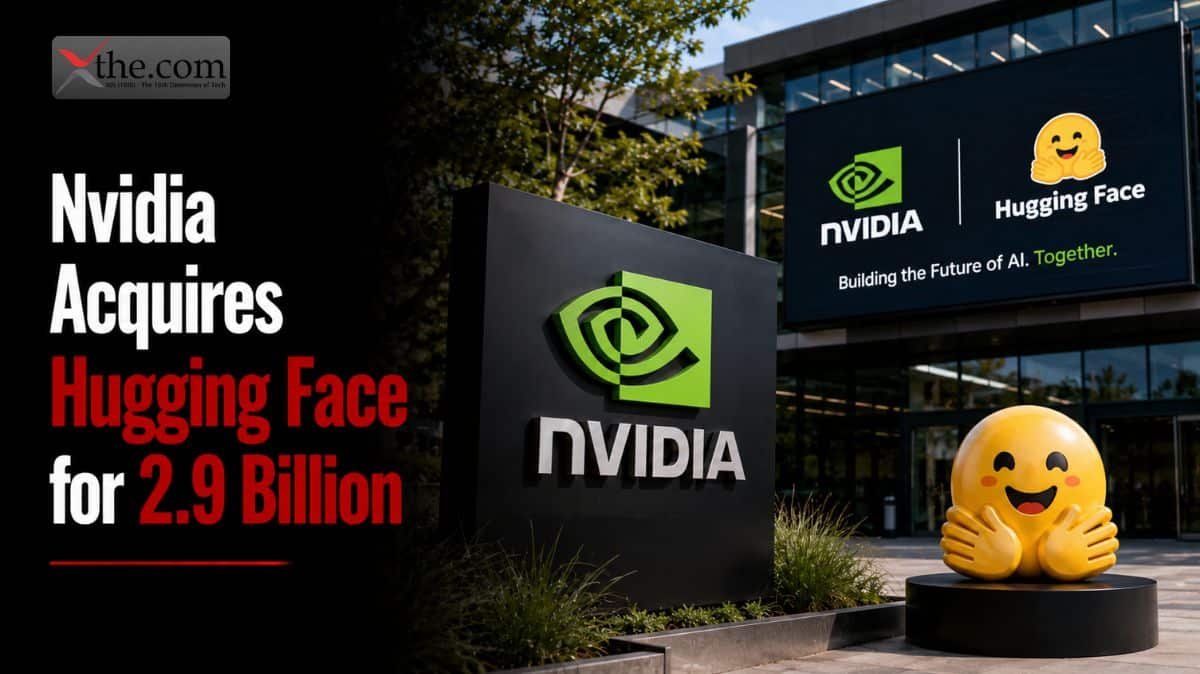
Nvidia has agreed to acquire Hugging Face, the popular open-source AI model repository, for 12.9 billion dollars in what is being called the largest artificial intelligence acquisition of 2026. The deal, reported by The Information on August 27, would give Nvidia control over the platform that has become the GitHub of machine learning, hosting hundreds of thousands of AI models used by researchers, startups, and major corporations worldwide. The acquisition signals Nvidia aggressive push beyond hardware into the software and platform layer of the AI ecosystem.
What Is Hugging Face
Hugging Face, founded in 2016 by Clem Delangue, Julien Chaumond, and Thomas Wolf, has grown into the most important platform in the open-source AI community. The company started as a chatbot maker but pivoted to become the central repository for sharing and deploying AI models. Today, the platform hosts over 1 million machine learning models, 300,000 datasets, and has more than 100,000 open-source projects. Major tech companies including Google, Meta, and Microsoft publish their AI models on the platform. Hugging Face has become indispensable to AI researchers and developers, functioning much like GitHub did for software developers. The platform unique value proposition lies in its community-driven approach to AI development. Unlike proprietary platforms from Google, Microsoft, or Amazon, Hugging Face has maintained a commitment to open access and collaboration. Researchers can share models, datasets, and evaluation tools freely, accelerating the pace of AI advancement across the entire field. The platform Transformers library has become the de facto standard for working with transformer-based AI models, downloaded over 100 million times. This ecosystem of tools and community has made Hugging Face virtually irreplaceable in the AI development workflow.
Why Nvidia Wants Hugging Face
Nvidia is best known as the dominant maker of AI chips, but the company has been aggressively expanding into software and services. By acquiring Hugging Face, Nvidia gains direct access to the largest community of AI developers and researchers in the world. This gives Nvidia a powerful distribution channel for its CUDA software platform and AI development tools. The acquisition also positions Nvidia to influence which AI models get built, trained, and deployed, potentially steering the ecosystem toward models that run best on Nvidia hardware. Jensen Huang, Nvidias CEO, has described the vision of an AI factory where models are continuously created, fine-tuned, and deployed at massive scale. Beyond developer access, the acquisition gives Nvidia valuable data insights into AI model usage patterns, training workflows, and emerging research trends. This intelligence could help Nvidia optimize its hardware and software products to better serve the needs of the AI community. The company has already been investing in AI Enterprise, a software platform designed to help businesses deploy AI models, and Hugging Face integration could dramatically expand its reach and adoption among enterprise customers.
What It Means for Open Source AI
The acquisition has raised significant concerns in the open-source AI community. Many developers worry that Nvidia, a publicly traded company with shareholders to satisfy, may not maintain the same commitment to open and free access that Hugging Face has championed. Critics point to past acquisitions where corporate owners gradually locked down previously open platforms. Hugging Face co-founder Clem Delangue addressed these concerns, saying the company will maintain its commitment to open-source AI. However, community members remain cautious, noting that corporate promises often change after acquisition integration is complete.
Industry Reaction
The AI industry has reacted with a mix of excitement and apprehension. AI researchers expressed concern that the acquisition could lead to increased Nvidia influence over model distribution and deployment. Some worry about potential conflicts of interest, as Nvidia could theoretically prioritize models that perform best on its GPUs. On the other hand, many see the deal as a validation of the open-source AI model and a sign that the community work has real commercial value. Venture capitalists noted that the deal sets a high bar for AI platform valuations and could trigger a wave of similar acquisitions.
Impact on Developers
For the millions of developers who use Hugging Face daily, the immediate impact is expected to be minimal. Nvidia has indicated that it plans to operate Hugging Face as an independent subsidiary, similar to how Google operates YouTube after its acquisition. The platform free tier, open-source tools, and model hosting services will continue to be available. However, developers should watch for changes in pricing, terms of service, and platform priorities over the next 12 to 18 months. Some developers have already begun exploring alternatives such as Civitai and GitHub AI model hub as a precaution. Some industry observers have drawn parallels to Microsoft acquisition of GitHub in 2018, which was initially met with concern from the open-source community but has largely maintained its open character under Microsoft ownership. Others point to more cautionary tales, such as Yahoo acquisition of Tumblr and Oracle acquisition of Sun Microsystems, where acquired platforms saw reduced investment and community engagement over time. The outcome for Hugging Face will likely depend on how well Nvidia balances its commercial interests with the community needs that have made the platform successful.
The Bigger Picture
This acquisition is part of a broader consolidation trend in the AI industry. In recent months, we have seen Microsoft deepen its partnership with OpenAI, Google expand its Gemini ecosystem, and Amazon increase its investments in Anthropic. Nvidias acquisition of Hugging Face represents a different strategy: rather than building its own AI models, Nvidia is positioning itself as the infrastructure layer that all AI development runs on. This approach mirrors how Intel dominated the PC era not by making software but by ensuring its chips were inside every computer. From a strategic perspective, the Nvidia-Hugging Face combination creates an unprecedented vertically integrated AI platform. Nvidia hardware powers the training, Nvidia software optimizes the models, and Hugging Face provides the distribution and community. This level of integration could give Nvidia significant advantages in shaping the direction of AI development, but it also raises questions about market concentration and fair competition that regulators will need to address.
What Happens Next
The deal is expected to close by the end of 2026, pending regulatory approval. The Federal Trade Commission will likely review the acquisition for antitrust concerns, given Nvidias dominant position in AI chips and Hugging Face central role in AI model distribution. If approved, the acquisition could reshape the competitive dynamics of the entire AI industry.








