





NVIDIA GTC Berlin: The AI Factory That Ships in a Container
Attendees at NVIDIA GTC Berlin On October 21, 2026, NVIDIA’s keynote announcement: a modular AI data center design that cuts onsite deployment from roughly six months to 14 days. The event, hosted by CEO Jensen Huang at Berlin’s Tempodrom, also introduced a security-focused runtime for autonomous AI agents and a stack of open models, marking NVIDIA’s deeper push into Europe. Here is what the announcements are, and what they signal for US buyers of AI capacity, and what the numbers to watch are.
Key Takeaways:
- – NVIDIA announced DSX POD, a validated reference design for complete Vera Rubin AI factories built in modular containers by partners.
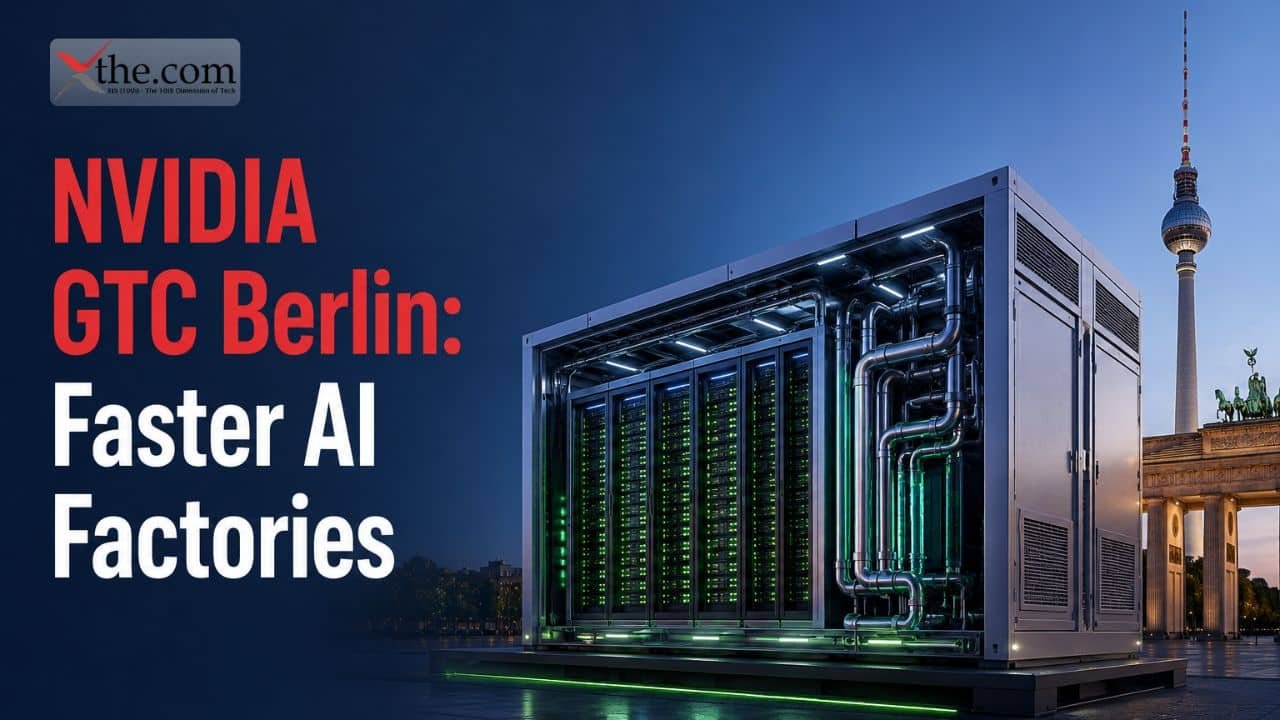
- – Onsite deployment of a DSX POD can shrink from about six months to 14 days when site utilities are ready, per Huang.
- – DSX factories cut on-site water use for cooling by up to 100 percent and deliver the same output with up to 30 percent less power.
- – NVIDIA unveiled OpenShell, an open-source, policy-controlled agent runtime with kernel-level sandboxing, for safe autonomous agents.
- – The keynote capped a weeklong European tour with nearly $10 billion committed to the regional AI ecosystem.
Where does GTC Berlin fit into NVIDIA’s roadmap
The AI Factory story explains the timing. GTC Berlin is an event held October 20-22 at STATION-Berlin, and NVIDIA’s own FAQ positions it as the European GTC event with a keynote at the Tempodrom on October 21. On stage, Huang framed a five-layer stack: energy powering advanced computers, those computers organized into the AI factories generating intelligence from the models on top.
What the DSX POD design changes
The practical centerpiece was DSX POD. It is a reference design for a complete Vera Rubin AI factory assembled by partners inside modular shipping-style containers, then integrated and validated before it is ever delivered to a customer site. Once a site has power and cooling ready, assembling and commissioning a facility in 14 days rather than six months is Huang’s stated goal. He called it “a complete transformation of the world supply chain.” For buyers, the design bundles compute, networking, cooling and validation into one contract line rather than a multi-vendor construction project, which is where most of the schedule risk normally lives.
What OpenShell means for safe AI agents
The policy layer was OpenShell. Huang described an AI agent as a combination of a model, a harness for orchestration and memory, a sandbox that isolates work, and knowledge plus tools for acting on the outside world. He then made security the headline: at the moment an agent starts, “the privileges are different.”
OpenShell is an open-source, policy-controlled runtime that inserts a kernel-controlled sandbox between any autonomous agent and the file systems, networks, and tools it tries to reach. It enforces application policy and monitors agent behavior for drift, aligning agent rights to each environment. For US businesses now deploying agents into production, that is a good idea. An agent’s blast radius is already small enough to be survivable, but if a customer service agent gets broken into, monitoring and policy controls need to catch it fast, and reducing stem access privileges is one piece of that.
Why Europe, and why that matters in the US
Berlin marked the end of a weeklong tour through Paris, London, Stockholm, and Dublin, where NVIDIA announced nearly $10 billion of commitments to the European technology ecosystem, working with more than 12,000 partners. Huang listed L’Oreal, Revolut, Spotify, Merck, Zara, Porsche, Nestle, HSBC, and Vodafone as examples of firms working with NVIDIA; his point was that AI adoption is no longer US-only.
For US readers, that competition matters in three ways. First, sovereign AI capacity in Europe competes for chips and power contracts that would otherwise be available to US cloud providers, which is already affecting pricing across the industry. Second, designs first stressed in European projects eventually arrive in US deployments: the DSX POD is a global reference design, not a regional product. Third, an event that anchors the agentic-AI security stack gives US CTOs an early template for rules they will need for themselves.
The open model lineup
NVIDIA also walked through an array of open models available today: Nemotron for language tasks, Cosmos for world simulation, GR00T for humanoid robotics, Alpamayo for autonomous driving, Ising for quantum-classical hybrid compute, and Earth-2 for physics-based AI.
Huang pushed the notion of “sovereign intelligence,” that is, post-training NVIDIA’s open models on proprietary company data for specific tasks. He extended that logic to the enterprise in North America, where those models already cover most enterprise data coming from an open-source stance. In practice, US engineering teams have stuck closely to foundation models; the pitch is that model post-training on firm-specific data may offer durable differentiation.
Researchers at Lambda added to that view. At GTC Berlin, Lambda announced support for Confidential Bare Metal, an expansion of NVIDIA Confidential Computing to dedicated third-party infrastructure. That matters for enterprises in regulated industries that want to run sensitive data through LLMs without operator or administrator access, and is exactly the audience that Germany’s hosting industry courts.
What happens next
Expect three follow-ons. First, the DSX POD will get a US customer reference in short order: hyperscalers, energy-constrained states, and defense cloud buyers all have strong incentives to evaluate a containerized plant that deploys in two weeks. Second, OpenShell will likely be folded into or exposed through NVIDIA’s agent tooling, and as it is open source, not NVIDIA-proprietary, vendors beyond NVIDIA would be sensible to integrate it as industry standard, the same way CUDA spread. Third, Huang’s events run in series; the next stop in the global GTC tour is San Jose on March 15-18, 2027, and many of this week’s claims will have customer case studies behind them by then.
For US buyers, the practical takeaway is simple: AI factories are becoming procurement line items with turnkey timelines, not multi-year construction megaprojects. If your 2027 data center plan still assumes 6-to-9-month commissioning, the numbers in Berlin should raise questions about what a cheaper, faster path buys you.
Frequently Asked Questions
What did NVIDIA announce at GTC Berlin?
On October 21, 2026, CEO Jensen Huang unveiled DSX POD, a containerized Vera Rubin AI factory reference design that can be deployed onsite in about 14 days, introduced the OpenShell open-source agent sandbox for safety, and touted nearby $10 billion in a broad set of AI infrastructure investments committed during his European tour.
Is NVIDIA GTC Berlin open to the public?
GTC Berlin is an industry conference: it ran October 20-22 at STATION-Berlin, with a keynote on October 21 at the Tempodrom and on livestream access via NVIDIA’s website. Anyone can watch recorded sessions for free on NVIDIA’s site.
Do GTC Berlin announcements affect the United States?
Yes. DSX POD containerized AI factories are region-neutral reference designs that US cloud and colocation providers can evaluate, and the OpenShell agent runtime is open source, so American development teams can adopt or contribute to it directly.
Sources: