






New York, New York | July 28, 2026
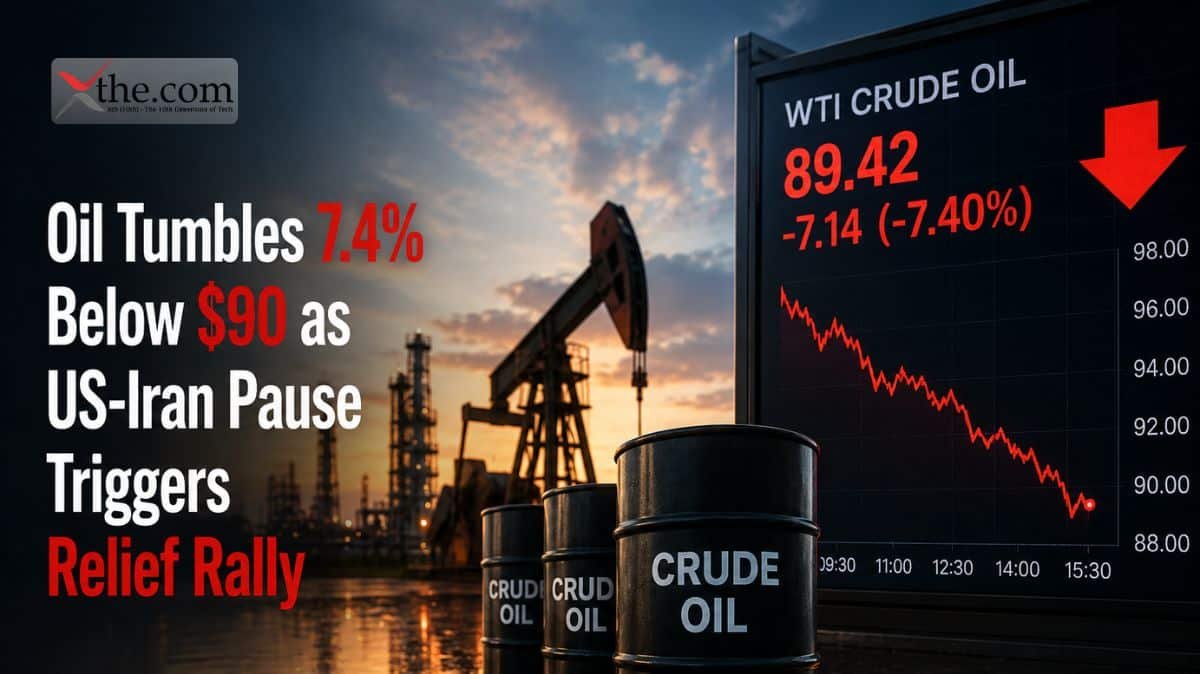
Oil traders spent nearly two weeks pricing in the possibility of a wider Middle East conflict. Within hours, sentiment changed dramatically. Oil tumbles below $90 became the defining market headline after the United States and Iran refrained from launching additional military strikes, causing a broad-based US-Iran strike pause rally across global financial markets. At the same time, Brent crude falls 7.4 percent, while investors shifted capital toward equities, government bonds, and precious metals since geopolitical fears eased.
This sudden turnaround showed how fast commodity markets move when geopolitical risks fade. Traders expecting long-term supply problems instead saw one of the biggest one-day drops in crude prices this year.
Oil drops below $90 because tensions ease.
The oil market responded right away once it was clear that the US paused its military campaign against Iran and Tehran did not launch new attacks.
This outcome was what investors wanted—a lower risk of immediate supply problems.
The market witnessed “Oil tumbles 7.4 percent below $90” as Brent crude dropped as much as 7.4 percent below $90 before recovering about half of those losses later in the day. Even after bouncing back, prices stayed well below the highs reached during the worst of the tensions.
This drop wasn’t only about profit-taking. It showed that a big geopolitical risk premium, added to oil prices in recent weeks, had been removed.
Traders see the Strait of Hormuz as a key route for global energy. Any threat to shipping there quickly raises worries about oil supply, transport costs, and refinery operations. When those worries eased, many speculative bets were quickly reversed.
Understanding the US-Iran strikes pause rally.
The US-Iran strikes pause rally extended well beyond the energy market.
Stock markets rose as investors became more willing to take risks, while government bonds attracted those looking for balance during ongoing uncertainty. Gold also rose, showing that people still wanted safe-haven assets even as oil prices fell.
The combination created an unusual but understandable market response in which bonds gold gain relief rally became one of the defining investment themes of the day.
Government bond yields fell as more investors bought Treasuries, and gold stayed popular even as military tensions eased. Analysts pointed out that while the risk of immediate escalation dropped, ongoing uncertainty kept demand for safe assets high.
Meanwhile, the dollar weakened Monday against other major currencies as investors moved away from this usual haven. The weaker dollar also helped steady commodity markets after oil’s sharp drop.
Brent remains significantly higher despite the correction.
While the headlines featured the sharp drop that day, the bigger picture is different.
Even after Brent crude falls 7.4 percent, the international benchmark remains substantially above where it began the year. In fact, Brent up 50 percent year-to-date, illustrating the remarkable resilience of energy prices despite intermittent periods of volatility.
Ongoing instability in the Middle East, shipping problems, production worries, and higher geopolitical risks have all pushed crude prices up during 2026.
So, this recent drop is just a pullback in a very strong year for oil, not a sign that the basics of the market have changed.
Energy analysts keep warning that oil supply is still at risk from new geopolitical shocks. Any trouble with major exporters or shipping routes could quickly bring back the risk premium that faded on Monday.
Relief spreads over financial markets.
As military tensions eased, different types of assets responded in sync.
Global stock markets reacted favorably to lower energy costs, since cheaper oil usually means less inflation for transport companies, manufacturers, airlines, and consumers. Investors saw the pause in military action as removing a major risk for the world economy.
The fact that both bonds and gold rose at the same time showed that investors were still careful, even as the mood improved.
This mix of hope and prudence matches today’s geopolitical reality. People in the market know that ceasefires or pauses do not solve deeper regional issues.
The “US Iran pause triggers relief rally” therefore represents an immediate reaction to reduced escalation risks rather than a definitive signal that geopolitical uncertainty has disappeared.
Why oil prices remain highly sensitive
Oil markets are especially sensitive to political events because most production happens in just a few areas.
The Middle East still supplies a large part of the world’s crude oil, so traders, refiners, shipping companies, and decision-makers watch every military move closely.
Even small changes in how people see supply risks can cause big swings in prices.
For example, worries about tanker traffic in key waterways can move prices even before anything actually happens. In the same way, news about diplomatic restraint often leads traders to sell quickly and remove extra risk premiums from futures contracts.
Monday’s trading showed just how quickly these expectations can change.
Investors remain focused on the next move.
Even with the relief rally, professional investors are still careful.
Energy markets are still watching official statements from the US and Iran, naval movements in the Gulf, and diplomatic talks with regional allies.
Should tensions re-emerge, oil prices could quickly bounce back from Monday’s drop. dually reduce volatility and encourage further normalization across commodities and currency markets.
For central banks, lower oil prices might help a bit by easing inflation, especially when policymakers try to manage growth and stable prices.
Market outlook
This sharp drop is a sign that international affairs are still a major force in commodity markets. Oil falling below $90 got investors’ attention because it showed a sudden change in expectations, not in global demand. Even though Brent crude’s 7.4 percent fall was one of the biggest daily moves this year, the fact that it’s still up 50 percent shows how strong energy prices are despite ongoing supply worries. If diplomacy holds, the rally could continue, but if tensions increase again, the risk premium could return just as fast, keeping oil one of the most closely watched and volatile assets.
Source: Oil prices settle at lowest in over a week, as US pauses attacks on Iran








