






New York, New York — July 30, 2026
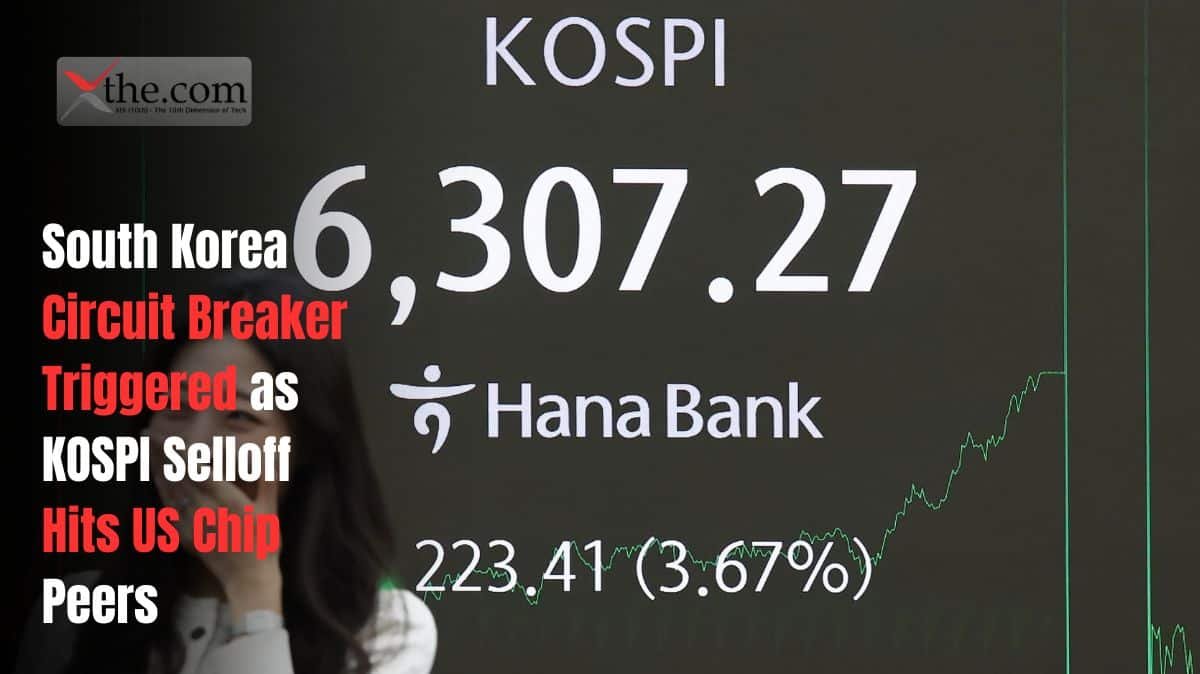
About $270 billion disappeared from Samsung Electronics and SK Hynix in just two trading days this week, and the impact was felt on Wall Street even before markets opened in New York. The KOSPI circuit breaker triggered for the second day in a row on Wednesday, something the Korea Exchange had never seen before. SK Hynix fell nearly 13%. Samsung Electronics dropped close to 8%. The SK Hynix Samsung stock crash did not stay contained inside Seoul’s trading floors. It reached across the Pacific and reshaped Wednesday’s opening bell for chipmakers from Boise to Santa Clara, confirming what traders had suspected for a week: memory chips now trade as a single global market.
For US investors, this event shows that the semiconductor supply chain is now truly global. A trading halt in Seoul is no longer only a local issue; it signals what might happen to companies like Nvidia, Micron, and AMD before the New York market opens.
Why the KOSPI Circuit Breaker Triggered Again
South Korea’s exchange halts trading for 20 minutes whenever the benchmark index falls 8% in a single session, a mechanism meant to let panic cool before it compounds. That threshold has now been crossed eight times in 2026 alone, a frequency that speaks to how unstable the AI-linked chip rally has become. The KOSPI plunge 8 percent threshold was breached first on Tuesday, when the index sank 10.8% in its fourth-largest single-day decline on record, then again, a day later as an opening bounce reversed into a fresh rout.
Samsung Electronics and SK Hynix make up about 40% of the KOSPI index, so their moves matter a lot. SK Hynix posted a record second-quarter profit, up 557% from last year, which would normally be good news. But the stock still fell nearly 10% because the results did not meet very high expectations. This gap between strong results and falling stock prices shows that valuations had gotten ahead of the actual business performance.
The Search for a KOSPI Circuit Breaker July 2026 Root Cause
If you ask five analysts what caused this, you will likely get five similar but different answers. At least three main factors drove the KOSPI circuit breaker in July 2026 factors. First, Chinese memory maker CXMT had the country’s largest stock listing of the year, briefly reaching a valuation close to half of US rival Micron’s, prompting questions about how long Korea could maintain its lead in high-bandwidth memory. Second, there were reports that China was making progress with its own lithography equipment, adding to the worries. Third, a Wall Street Journal article revealed a $250 billion Nvidia financing deal linked to an OpenAI data-center project, making investors wonder how much of the industry’s revenue comes from real new demand and how much is just money moving between a few big companies.
If you are wondering what caused the SK Hynix and Samsung stock crash, there is no single answer. The immediate trigger was a strong earnings report that still failed to meet high expectations in a market ready for disappointment. The bigger issue was that the KOSPI had climbed nearly 300% since April 2025, so even a small correction was bound to look dramatic.
How the Asian Chip Selloff US Impact Reached Wall Street
The Asian chip selloff US impact showed up almost immediately in premarket trading. Micron and SanDisk both dropped more than 8%. Western Digital fell over 11%. Intel lost about 6%, Marvell dropped 7.5%, and Applied Materials, a key supplier, fell about 6.5%. AMD also fell more than 8% in a later session as the decline continued. Earlier in the week, Nvidia’s shares had already fallen nearly 5% after the news of OpenAI’s financing, briefly losing its spot as the world’s most valuable public company.
Credit markets also showed signs of trouble. Credit-default swaps for Oracle, Alphabet, Amazon, Meta, Broadcom, and Nvidia hit record highs, which means bond investors are getting nervous about how the AI expansion is being funded. This is important because the issue is no longer just about stocks. It is now affecting the credit markets that support the whole AI investment cycle.
Semiconductor Global Contagion and the Leveraged ETF Problem
Korea’s drop was steeper than Japan’s or Taiwan’s, even though all three have big chip industries, because of a local factor. In late May, I allowed single-stock leveraged ETFs for Samsung and SK Hynix, letting retail investors double the daily moves of these stocks. Their purchases totaled about 14 trillion won, or $9.7 billion. When the market turned, the leverage made losses much worse. The KODEX SK Hynix leveraged ETF has dropped more than 80% since June, and the Samsung ETF is down nearly 75%.
Finance Minister Koo Yun-cheol apologized to parliament this week, admitting the products were introduced without sufficient caution. His ministry is now moving toward a South Korea single-stock leverage ETF cap, limiting any individual’s exposure to roughly 20% of their portfolio, alongside a tripling of minimum deposit requirements and a short suspension on new listings. It is a rare case of a government responding to a market-structure problem in real time.
The bigger concern for American investors is semiconductor global contagion: that a correction rooted in Korean retail leverage and Chinese competitive anxiety metastasizes into a repricing of the entire AI supply chain, from equipment makers in California to factories in Arizona. The Philadelphia Semiconductor Index is still up about 90% over the past year, so there is no need to panic yet. However, a 20% drop in a month is significant, and investors with heavy bets on AI infrastructure ought to assess whether their positions can withstand further selling.
What Comes Next for US Chip Investors
Samsung Electronics will release its full second-quarter results on July 30, but how the market reacts may reveal more about investor mood than the actual numbers. Since SK Hynix’s strong quarter still disappointed investors, even good news from Samsung might not be enough. This week shows that the AI chip trade is now driven as much by retail leverage, credit markets, and geopolitics as by company earnings. Investors who focus only on AI demand in the next few days may miss the bigger picture. The key question is whether Korea’s leverage unwind ends before it causes bigger problems for Wall Street’s own AI financing.
Source: Korean Stocks See Record Wave of Trading Halts on Chip Selloff








