






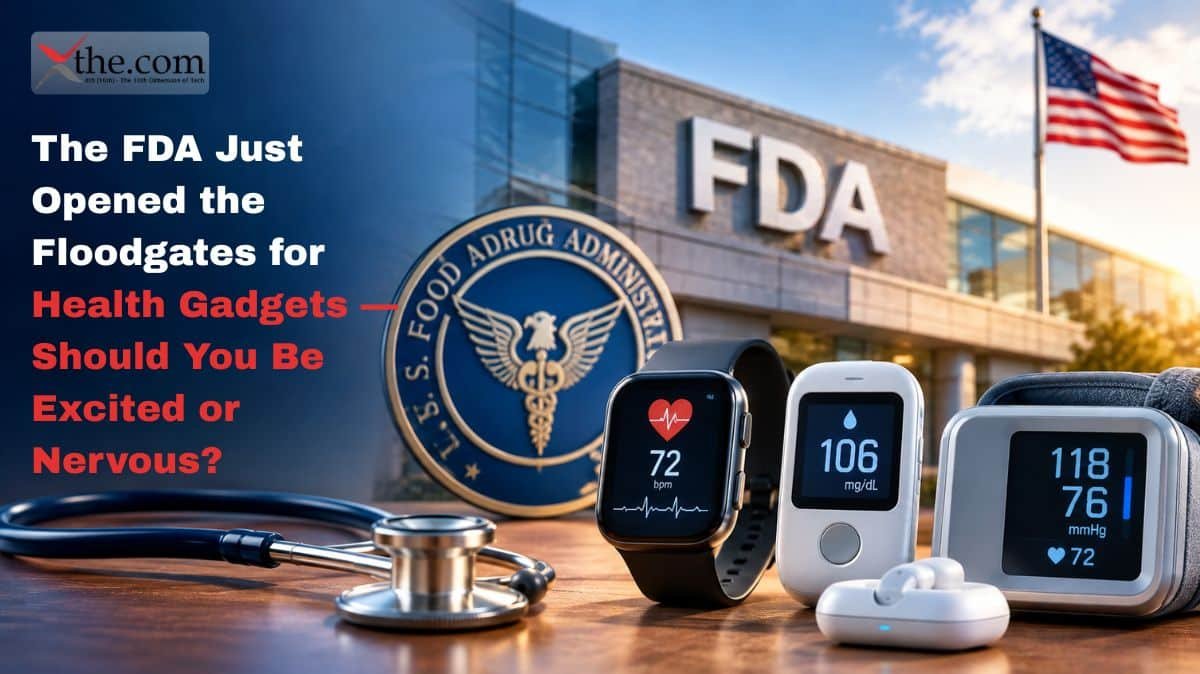
Your smartwatch already counts your steps, tracks your sleep, and nags you to stand up. Now the federal government has made it easier for that little wrist computer to go much further — and not everyone in medicine is cheering.
What the FDA Actually Did
In January, the Food and Drug Administration released a pair of guidance documents that clarify — and in many cases loosen — the rules around wearable health features and AI-powered clinical software. Certain wellness features and clinical decision-support tools now fall outside medical-device oversight entirely, meaning companies can ship them faster, without the long and expensive review process that governs things like pacemakers and glucose monitors.
Here’s the catch that has health-policy experts raising eyebrows: the guidances were issued without the usual public-comment period. Normally, doctors, patient advocates, and researchers get to weigh in before rules like this take shape. This time, they woke up to find the decisions already made.
The industry’s argument is straightforward. Wearables are evolving at software speed, and regulation built for hardware timelines was strangling harmless, helpful features. Let wellness tools be wellness tools, the thinking goes, and reserve heavy scrutiny for products that genuinely diagnose or treat.
The critics’ counterargument is just as simple: the line between “wellness” and “medical” is exactly where people get hurt. A feature that estimates your blood pressure trend sounds like wellness — until a user makes a real health decision based on a wrong number.
The Apple Watch Lesson
You don’t have to imagine the risk; researchers have already measured it. A study examining the Apple Watch’s hypertension-notification feature found that while the alerts can flag real cases of high blood pressure, the absence of an alert provides limited reassurance — particularly for older adults and people already at elevated risk. In other words, a quiet watch doesn’t mean a healthy heart, but it’s human nature to read silence as safety.
That’s the psychological trap at the center of the wearable era: these devices are good enough to trust, but not good enough to trust completely. Millions of Americans are now walking around making micro-decisions — skip the doctor, pop a pill, panic at 2 a.m. — based on sensors designed to a consumer-electronics standard, not a hospital one.
Amazon Wants to Be Your First Medical Opinion
Into this shifting landscape steps the biggest retailer on Earth. Amazon has launched an AI health chatbot for One Medical members — an assistant that can answer health questions and help schedule appointments, rolling out right behind similar health-focused AI tools from OpenAI and Anthropic.
The pitch is compelling, especially in a country where the average wait for a primary-care appointment can stretch for weeks. Ask the chatbot at midnight, get a sensible answer, book a follow-up if needed. For routine questions — Is this rash serious? Can I take these two medications together? — a well-built assistant could genuinely improve access and cut costs.
But the timing is awkward, because the medical establishment’s top safety watchdog has just put AI chatbots at the very top of its worry list.
The Number One Health Tech Hazard of 2026
ECRI, the nonprofit that has ranked health-technology dangers for decades, named the misuse of AI chatbots as its top hazard for 2026. Not faulty ventilators, not cybersecurity attacks on hospitals — chatbots. The group says tools like ChatGPT have suggested incorrect diagnoses, invented body parts, and otherwise produced confident, fluent, wrong answers that could lead to real harm.
Anyone who has used these tools recognizes the failure mode: the answer sounds authoritative even when it’s fabricated. A human doctor hedges, asks follow-ups, notices the thing you didn’t mention. A chatbot fills in the gaps with whatever pattern fits best. When the stakes are a suspicious mole or chest pain, that gap can be the whole game.
None of this means health AI is doomed — it means the industry is growing up in public, with regulators, watchdogs, and giants like Amazon all pulling in different directions at once.
Wall Street Has Already Voted
Whatever the experts worry about, investors are all in. Digital health startups raised $14.2 billion in 2025 — the highest total since 2022 — and AI-focused health companies captured 54% of that money, according to Rock Health. More than half of every dollar flowing into digital health is now an AI bet.
That money will buy real breakthroughs: earlier disease detection, cheaper triage, rural patients getting specialist-level guidance from a phone. It will also buy a wave of half-baked products shipping under looser rules to a public that can’t easily tell the difference.
A Regulatory Gap Is Opening in Real Time
The deeper story here is that America’s health-tech rulebook is being rewritten on the fly, and nobody — not the FDA, not doctors, not the companies — fully knows where the new lines will settle. Ōura’s chief medical officer has publicly floated an entirely new regulatory pathway for wearable screening features, essentially admitting the current categories don’t fit the technology anymore. The White House, HHS, and FDA are separately running a month-long sprint with outside experts to define how clinical AI should even be benchmarked. And trade groups like AdvaMed are in open debate with the administration over tariffs and device-fee agreements that shape what gets built in the first place.
Translation for the rest of us: the next two years will bring a wave of health features — blood-pressure screening, sleep-apnea flags, AI triage — arriving under looser rules than the gadgets of the last decade. Some will be genuinely life-saving. Some will be marketing dressed in a lab coat. Regulators are openly acknowledging they haven’t figured out how to tell the difference at scale yet.
The Bottom Line for Your Wrist and Your Wallet
The FDA’s lighter touch isn’t inherently good or bad — it’s a trade. Faster innovation, weaker gatekeeping. As a consumer, you can protect yourself with three habits. Treat wearable readings as hints, not verdicts; a strange reading is a reason to see a doctor, not a reason to skip one. Use AI health chatbots for questions, never for diagnoses. And when a gadget or app makes a medical-sounding claim, ask the one question that cuts through all of it: was this actually reviewed by someone, or just released by someone?
The gadgets are only going to get smarter. The rules just got looser. That means the most important upgrade in health tech this year isn’t on your wrist — it’s your own skepticism.








